Showing posts with label Walpole Park. Show all posts

Saturday, 31 January 2015

Back Birding on the South Coast of Hampshire

Rainy and breezy conditions put paid to any bird ringing this morning, so instead I took the opportunity for a bit of local birding. The plan was to start at Farlington Marshes to look for the long staying Spoonbill, then to Walpole Park for the Ring-billed Gull, Titchfield Haven, for nothing in particular, but hopefully to see the Marsh Harrier and then finish up back on my patch at Curbridge.

Farlington Marshes
There was a bitterly cold north-westerly breeze, which I had expected but the occasional driving rain I had not, and it made for quite an unpleasant walk around the seawall at times. The tide was high when I arrived, and Dark-bellied Brent, Canada and a couple of Greylag Geese were feeding on the reserve. Duck species were represented in good numbers, with Pintail, Wigeon, Teal and Shelduck all present. The water on the main lake was quite high and as a result there was no wader roost to speak of, a few Redshank, a couple of Snipe and an Avocet was about it. Five Bearded Tits were giving great views whilst feeding in the reed bed right next to the sea wall, and a Reed Bunting perched up briefly before flying off.

Dark-bellied Brent Geese - Farlington Marshes

There must have been well over a thousand brent geese on the marsh, with most of them on the middle marsh. I was scanning through them on the off chance of picking up a Black Brant, I did not find one but did pick up the colour ringed individual below. This is now the third colour ringed brent I have found in the last couple of weeks so will send them off soon to see where they are from.

Colour ringed Dark-bellied Brent Goose - Farlington Marshes

As the tide was dropping, hundreds of waders were leaving their high tide roosts and starting to feed on the intertidal. The majority were Dunlin, but also Knot, Redshank, Bar-tailed Godwit and Grey Plovers. A flock of Black-tailed Godwits were roosting on the stream, two of which were colour ringed. Unfortunately, they were both roosting on one leg so I was unable to get a full combination. The stream is where the Spoonbill has been hanging out, but it was not there today. 

Black-tailed Godwit - Farlington

By the time I returned to the seawall the tide had dropped considerably. Waders were feeding all over the intertidal but the highlight was a flock of 47 Avocets, that were feeding in the Broom Channel to the west of the reserve.

Walpole Park, Gosport
My visit to Walpole Park was in the hope of ticking off the Ring-billed Gull for the year. I pulled up and immediately picked it up sat next to the lake. Well, I say lake, but work is currently being carried out on them so both lakes have been drained to leave just mud. Luckily this work hasn't deterred the ring-billed as it was sat in its usual place. I couldn't resist taking a few more pictures.

Ring-billed Gull - Walpole Park, Gosport

Titchfield Haven
I didn't stop long at the Haven, just enough time to scan the exposed mud around the seafront and look up the valley for the Marsh Harrier. There was nothing really of note, a few Great-crested Grebes were on the sea, and Teal and Pochard on the river. A Buzzard was perched on a post by the south scrape, looking for an easy meal no doubt. A few hundred gulls were on the foreshore, at least 20 each Common and Herring Gulls, a couple of hundred Black-headed and one Mediterranean Gull.

Curbridge
When I got to Curbridge the tide was low and Little Egrets, Redshank and Greenshank were feeding in the creek by the Horse and Jockey pub. In the main estuary there were another three Greenshank, 11 Redshank and five Curlew. My main reason for going though was to check out the low tide gull roost, as you never know what might drop in. There was a good sized flock present, at least 250 birds, that was made up mainly of Black-headed Gulls, but there was also 67 Common Gulls, four Herring and three Mediterranean Gulls. I have been birding this creek since I was a teenager and had never previously recorded Med Gulls until last year when over 200 were present.. Three times this week I have visited and recorded at least one on each visit. One of the Meds was colour-ringed with a red ring, with white numbers, Unfortunately I could only make out the last two numbers, which were 99, before the whole flock was flushed by a Buzzard.

Common, Mediterranean and Black-headed Gulls - Curbridge

Sunday, 30 November 2014

Gulls in Flight at Walpole Park, Gosport

This morning a team of us went to Walpole Park in the hope of catching some Black-headed Gulls. From my previous posts about the site you may have gathered that the gulls there are very tame, and so we have decided to try and catch and colour-ring some birds. Rather than setting up our own scheme, we are piggy-backing of another scheme in Hampshire for Black-headed Gulls, but also have a handful of Mediterranean and Common Gull colour rings, just in case we manage to catch any of them. Today we failed to catch any gulls, although a Herring Gull toyed with us for a while, before flying off. We did however ring three Mute Swans, a ringing tick for each of the three trainees present.

Whilst hanging around at the site I decided to have another play with my new camera, and in particular try it out on birds in flight. When using my camera I tend to use it on manual and use auto ISO. For all of the images below I used 1/500th of a second shutter speed and an aperture of 5.6, wide open on my Canon 400 f5.6. This morning it was overcast and dull and the camera was selecting an ISO of between 200 and 800. There were four species of gull present, but as I mentioned earlier the Herring Gull was hanging around by the net and so I didn't get a chance to photograph that one; the others were Common Gull, Black-headed Gull and of course the ever present Ring-billed Gull.

Ring-billed Gull
This adult winter Ring-billed Gull has always been very approachable, so much so that I don't think I have taken many flight shots of it. The series of shots below shows very clearly the small white window in the black wing tip, which is one of the ID features.


I know, not a flight shot but thought I would include it anyway, this must be the most photographed Ring-billed Gull in the country.

Common Gull
Another adult winter bird, note the size of the white window on this bird, and how much larger it is than the Ring-billed it is.


Black-headed Gull
The images below are all again adult winter birds, hopefully I will have some pictures of these in the hand soon.


Friday, 31 October 2014

A Firecrest, Redwing and another American Gull - October 2014

This mornings ringing session was a very sedate affair, with only 18 birds ringed of nine species, and of those half were re-traps. But amongst the new birds there was some quality in the form of our first Firecrest and Redwing of the year. The Redwing was the first that I had heard this autumn, and given that we had another eight flying over the ringing area, there had clearly been an arrival.

Redwing, Titchfield Haven - October 2014
The Firecrest was a real cracker, as of course they always are, this bird we aged as a juvenile due to the pointed tail feathers, and a male by virtue of the amount of orange in the crown.

Juvenile Male Firecrest - Titchfield Haven

This was the 25th Firecrest to be caught at the Haven, the first was in 1982 and the second in 1988, with the remaining 23 caught between 2000 and 2014. Despite the status of this species as a breeder in Hampshire and regularity with which it occurs along the Hampshire coast in winter, its occurrence remains unpredictable at the Haven, as demonstrated below.


During the ringing session the other species captured were Cetti's Warbler, Robin, Blackbird, Wren, Reed Bunting, Blue Tit and a female Blackcap. A Brambling, several Linnets and Goldfinches were recorded passing over.

I have recently been given permission to ring at Walpole Park in Gosport, and will be hoping to catch and colour-ring Black-headed, Common and Mediterranean Gulls at the site. After ringing I nipped down there to see how many birds were present and how they were behaving. There were around 100 Black-headed Gulls present, a few Herring and a Common Gull.

Adult Winter Black-headed Gull - Walpole Park
Adult Winter Herring Gull - Walpole Park

Of course the star attraction at Walpole Park over the last 12 winters has been the Ring-billed Gull. It had arrived back on 26th October, and had already taken up residence in its usual place. As interesting as it would be to catch this bird, colour ring it, and see where it goes during the summer, I will not be making any attempts to catch it.

Adult Winter Ring-billed Gull

Mute Swans and Canada Geese also make the most of the food on offer at Walpole Park and whilst I was there I found three that were ringed. One bird had an orange colour ring, whereas the other two had just metal rings. The swans are so approachable that it is easy to read the ring numbers, and take close up photos. I will let you know where they are from when I find out the details.

Adult Mute Swan - Walpole Park
Adult Mute Swan wing feathers.

Thursday, 7 November 2013

Ring-billed and other Gulls at Walpole Park, Gosport

With strong south-westerly winds across the south of England this week there has been no opportunity for bird ringing. Instead I decided to spend a few hours working my way along the coast looking for gulls and other storm blown species. Back in January I wrote about an adult ring-billed gull that had been frequenting a park in Gosport every winter for the last 10 years, well this last weekend it had returned, so my first stop was to go and look for it.

Adult Ring-billed Gull Larus delawarensis - Returning for its 11th Winter

Being over 10 years old now, this bird is a full adult, and therefore is probably in the easiest plumage for identification of the species. In winter plumage an adult ring-billed essentially looks like many other gull species, pure white head, breast, belly and under-tail coverts and black tips to the primaries.

Flight View of Adult Ring-billed Showing obvious Small White Window in Primary Tips

There are still some obvious and distinctive identification features and these include the large yellow bill with obvious black band near the tip, the yellow legs, the pale yellow iris and when in flight the small white window in the otherwise black wing tips. The bird showed very well for the whole time I was there, so if anyone is interested in getting some experience with this species, Walpole Park may be worth a visit.

Adult Winter Black-headed Gull Larus ridibundus - The deep red legs and bill suggest this
bird is several years old

There are often many other species of gull at the site, the most common being black-headed gull. Black-headed gulls reach full adult plumage in their second winter and therefore there are only two plumage's to consider. Adult birds show some vertical head streaking, light grey back and mantle and pure white nape and underparts (see above). First winter birds lack the bright red bill and legs, have brown primaries and brown feathers in the tertials and lesser coverts (see below).

First Winter Black-headed Gull - Note the brown primary tips, tertials and
some lesser coverts. The leg colour is also duller and more orange than that
of the adult bird (above)

Another species that is a regular along the south coast is Mediterranean gull, although the numbers in winter are much lower than during the summer months. There was only one bird at Walpole Park and that was an adult winter bird. Mediterranean Gulls in adult plumage have pure white wings, including the primaries. They have a deep, blood red bill with a black band and dark red legs, white eye crescents and a dark mask. Overall this species is larger and stockier than black-headed gull, with a squarer shaped head and subsequently stands out from the black-heads.

Adult Mediterranean Gull Larus melanocephalus - the light grey upper parts

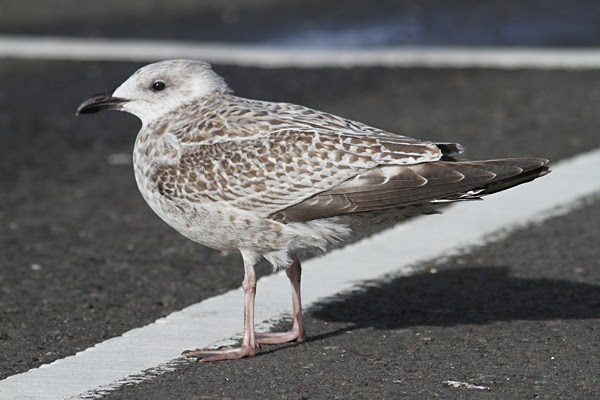
Herring Gulls are another common species, often with a variety of ages present. On this visit there was just one first winter bird. This bird had a fairly short dark bill, which was slightly paler at the base. A paler head, breast and underparts and brown markings on the under parts. The tertials exhibit broad dark centres and a dark subterminal band is present on the back and mantle.

First Winter Herring Gull Larus argentatus - Walpole Park


Walpole Park has a bit of a history with American Gulls as in November 2005 a first winter laughing gull joined the ring-billed and was present at the site from 5th November through until the 13th. It did go missing at times but for the patient it provided some great views. 

First Winter Laughing Gull Larus atricilla Walpole Park November 2005

Unfortunately I was limited by time every time I visited but I did still manage to get some acceptable record shots.

First Winter Laughing Gull Walpole Park November 2005
Related Posts Plugin for WordPress, Blogger...