Showing posts with label Barn Swallow. Show all posts

Thursday, 7 August 2014

Farlington Marshes - 7th August 2014

The tides weren't ideal but we decided to start this autumns wader ringing sessions anyway. The priority species, as last year, was Common Sandpiper. Any individuals captured were to be colour-ringed in the hope of learning a bit more about their migration patterns, and how they use the marsh. We arrived on site at around 18:30 and went out to set the nets straight away; we intended to put up five nets and on the scrape only. 

Once the nets were set it was a waiting game, so we took advantage and did a bit of birding. It was a bit of a breezy evening but there were plenty of Barn Swallows and Common Swifts around to keep us occupied. The swallows were feeding over the meadows and gathering around the reed bed in readiness for roosting.
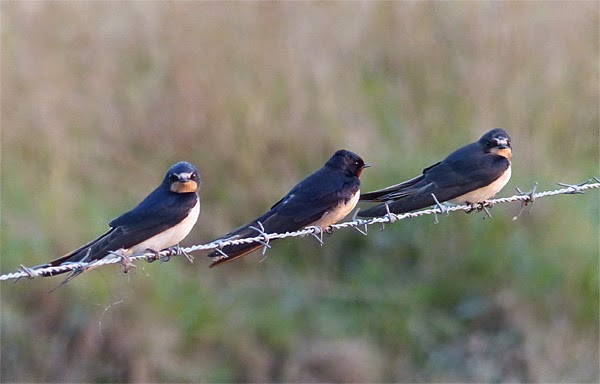
Barn Swallows gathering in readiness to roost

Bearded Tits were very evident in the reed bed, constantly pinging as the flew back a forth across the reed bed. The stream was the best place for waders, with about 25 Black-tailed Godwits, 15 Northern Lapwing, five Common Sandpipers and a couple of Common Redshank and Common Teal.

Black-tailed Godwits, Common Teal and Mute Swans on the Stream

As the sun set over Portsmouth Harbour the wind began to drop and the tide neared its peak. The five Common Sandpipers on the stream began to call and circled around before heading out into the mid-marsh.

Sunset over Portsmouth Harbour

Our first net round produced two birds, and Dunlin and a Common Sandpiper, both of them juveniles. As I mentioned earlier the Common Sandpiper was a target species for us and was fitted with a combination of colour rings that would allow for the bird to be individually identified in the field.

Common Sandpiper with colour rings

This juvenile bird was aged due to the generally brown but extensively buff tips and dark subterminal bands to the upper parts, and the coverts, were brown and with very heavy dark brown and bright rufous-brown barring.

Juvenile plumage of Common Sandpiper showing extensive barring.

Our second and final round produced four birds, three Dunlin and a Common Redshank, all the birds were once again juveniles. This time last year we were commenting on how we were only catching adult birds, so it was a refreshing change to be catching juveniles.

Dunlin 

The chestnut fringes on the wing and body feathers age this bird as a juvenile. Some juvenile feathers will be retained through to the next summer so birds should still be able to be aged up to that point.

Juvenile Dunlin showing buff fringing to feathers

The upperparts and coverts of the Redshank were extensively fringed buff and warm brown, thereby ageing it as a juvenile. The bill was a dull reddish colour, darkening towards the tip again a juvenile feature.

Juvenile Common Redshank with obvious buff tips to plumage

Saturday, 25 January 2014

More Manor Farm Bird Ringing - 25th January 2014

This morning I headed back to Manor Farm Country Park for a spot of bird ringing, and for a change I was accompanied by a nearly full complement of trainees. We started early, with the aim of getting the nets up before first light, in the hope of catching some winter thrushes. The session didn't start as well as hoped due to equipment failure,  but the first net round still produced two Redwing, a Blackbird, a Song Thrush, a Wren and two Dunnocks. The second net round wasn't much better; the highlight this time being a new female Goldcrest. Another Redwing made the effort almost worthwhile, but there was really not much more to report.

All of the Redwing were aged as first year birds, or age code 5, so I took a couple of photos of one.

Head Shot of Redwing at Manor Farm Country Park

Close up of Greater Coverts showing Large Thorns on Juvenile Coverts

Pointed Tail Feathers of Juvenile Redwing

During the session we caught four recoveries, three Dunnocks and a Blackbird. The two longest recoveries were both Dunnocks, one was originally ringed on the 9th April 2011 and the other on 12th February 2012, so 2 years 291 days and 1 year 337days since ringing. By the end of the session we had ringed nine species, but unfortunately had added no House Sparrows for my RAS project.

I did also hear back from BTO HQ this week about one of the nestling Barn Swallows that I had ringed in the summer. This bird had been ringed in the nest on 2nd June 2013 and was retrapped on the 25th August seven kilometres to the south-west, 84 days later. Not the longest distance recovery, but it is nice to know that one of my birds successfully fledged.

Sunday, 15 September 2013

Titchfield Haven Bird Ringing - Mid September 2013 Update

It is now mid way through September and the ringing season is progressing well. We have tried to maintain our usual level of effort, but on occasion it has not been possible to open all the nets due to a lack of man power. Nonetheless the sample of birds caught has followed the trend set earlier in the season. Sedge warbler numbers are still very high, and almost equal to the number of birds caught in 2011, which was our record year for that species. Reed warblers also seem to have had a good year, with the total at 551, the third highest total ever and only 26 birds behind the second highest. Grasshopper warblers numbers continue to built; the total of 293 to date, seems low but it is still already the sixth highest total for this species.


Summary of Ringing Totals 2010 - 2013

Willow warbler numbers have improved after a slow start, which is perhaps an indication of a late breeding season. The number of birds ringed is on a par with those of 2011 and is up on last year which is good to see. Garden warbler numbers are also good this year and are up to the level of 2010, but not those of 2011. Whitethroat numbers have reached more than 100, which is only the fourth time since 1973.


Tabular Summary of Ringing Totals 2010 - 2013

Chiffchaff numbers remain quite low, but again this may be and indication of a late breeding season, similarly this may be the case with blackcap. Cetti's warbler numbers have been very good and indicate a good breeding season in the ringing area.


Wryneck Jynx torquilla (Barry Duffin)

As well as the more common species it has also been a good year for a few of the rarer ones. A wryneck trapped 7th September was only the 3rd ringed on the reserve, the others being in 21st September 2003 and 15th September 1974. Four spotted flycatchers have been ringed this year, this equals the most ringed in a season and six lesser whitethroats in a season is the highest since 2008.


Tree Pipit Anthus trivialis (Barry Duffin)

A single tree pipit was only the ninth trapped at the reserve. I have previously posted pictures on this blog of leucistic birds since they can often look quite stunning. The barn swallow below, was trapped on 21st August. This is the second leucistic swallow I have seen in recent years, it would be interesting to know what colour the plumage is as this bird moults to its adult plumage.


Leucistic Juvenile Barn Swallow Hirundo rustica (Barry Duffin)

So far this year a total of 2973 new birds have been ringed of 31 species, 178 birds have been retrapped including 24 controls. The controls come from three species sedge and reed warbler and blackcap, three have been foreign controls.

Sunday, 9 September 2012

Titchfield Haven - Bird Ringing Update 9th September 2012

The weekend began with a fantastic sunrise over Titchfield Haven, a bright orange sky, no wind and mist hanging in the valley, what better way could there be to start a weekend. It was feeling very autumnal on Saturday, and it was not long before the nets were sagging due to the weight of water from the heavy dew. Ringing was slow to start, with only a handful of birds captured on the first round, and a paltry four Grasshopper Warblers was a disappointment. A ringing session carried out on Monday (3rd September 2012), had resulted in 46 Grasshopper Warblers being ringed, which is the second highest daily total ever for this species in September, the highest being 55 on 12th September 2010. Looks like this species might have peaked now.

Dawn 8th September 2012, Titchfield Haven

By contrast this week was the time for the Sylvia warbler to take centre stage, and Saturday 8th began with a dozen or so Blackcaps, and a couple of Common Whitethroats, but for the second time this year the star bird was a juvenile Lesser Whitethroat. We watched this bird in the field working its way along a line of sallows before flying straight into our net.

Juvenile Lesser Whitethroat


As the sun rose and insect activity increased so did the level of bird activity, and we had soon captured 23 Sedge Warblers, 19 Reed Warblers, 27 Blackcaps and a new Cetti's Warbler. Willow Warblers are still trickling through, we caught four new birds and one Chiffchaff, for comparison.

Willow Warbler (left) and Chiffchaff (right)

We ended the day having caught over 80 birds, which was a great result given the slow start. Sunday 9th September was a little more breezy, and therefore there was less mist. The nets were dry, a little more cloud, but still great ringing conditions. Today was one of scheduled event days, this time the local Wildlife Explorer group. It is always nice to see so many enthusiastic children getting up so early to see wildlife; no pressure but it was down to us to keep them occupied.


Wildlife Explorers at Titchfield Haven

Once again things were very quiet to start and our first round produced only a handful of birds, but it did include five more Grasshopper Warblers and a few Sedge and Reed Warblers. The children were great and despite the lack of birds were very attentive and enthusiastic with what we caught, even when it was a moulting adult Dunnock and a Great Tit. We persevered, and added a couple more Common Whitethroats and single Chiffchaff, Willow Warbler, Cetti's Warbler and Goldcrest, before decided to try and catch some hirundines.  

Mixed Flock of Barn Swallow, House Martin and sand Martin

There was a large, mixed flock of hirundines swarming around the sallows, occasionally coming low over the reeds, and it was not long before we had caught our first, then second, then third Barn Swallow. The Wildlife Explorers had never seen a Barn Swallow in the hand, and were really enjoying the birds, even more so when we pulled a House Martin out of a bag.

Juvenile House Martin

It has been a couple of year since I last ringed a House Martin, but I must admit I think they are cracking birds, that is when not covered with flat flies (their resident parasites).

Juvenile House Martin

This bird was a juvenile and had pale tips to the wing feathers and the tertials, and the upperparts were generally dull and not gloossy.

Juvenile House Martin

Interestingly, House Martins have feathered legs and feet, which I was once told was due to the fact that the species wintered at high altitude and therefore needed to insulate their legs against the cold, but I have never seen this in any published literature...but its a great story. 

Feathered Leg of the House Martin

Sunday finished with only 42 birds captured, of which one was a control Sedge Warbler and a very happy Wildlife Explorer group.

Overall the week had been mixed, with 3rd and 8th September being the busiest days, with over 80 birds being caught on each. A total of 65 Grasshopper Warblers, 62 Sedge Warblers, 55 Reed Warblers and 44 Blackcaps were ringed, along with a scattering of other species, including another Lesser Whitethroat and two Common Redstarts, one of which was a juvenile male. 

Juvenile Male Redstart 3rd September (B S Duffin)

To catch three Common Redstart in one year is exceptional for the haven, we usually only catch one a year.

Thursday, 23 August 2012

Swallow Ringing, Titchfield Haven - 23rd August 2012

I had a night off from bat surveying tonight so as the weather was good a few of us decided to try and catch some Barn Swallows at Titchfield Haven. We have been watching the birds over the last couple of weeks, and the usual roost had not seem to have arrived yet, but still we thought we would give it a go. The session started well with a flock of around 10 Yellow Wagtails flying just over the net, but unfortunately not returning, and then the swallows arrived. Only one to start with, but it was a start, but soon we were up to a mixed flock of around 40 Barn Swallows and 10 Sand Martins.

The birds were flying low over the reeds, and did not appear to notice our nets, and before we knew it we had captured 29 birds. Our total included 23 Barn Swallows, 22 new birds and one control, and six Sand Martins.

Juvenile Barn Swallow

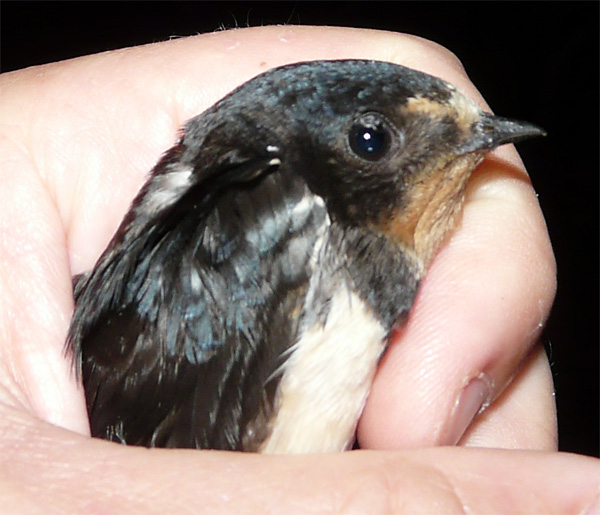
Our total was a mix of adults and juvenile birds, with six adult and 17 juvenile swallows and one adult and five juvenile Sand Martins. In the autumn adult Barn swallows still have a deep red face and throat and long tail streamers, whereas juveniles have short, and blunt tail streamers and a reddish buff face and throat, as shown in the pictures above and below.

Juvenile Barn Swallow

Adult sand Martins have a very well marked breast band and lack any buff tips to the upperparts....

Adult Sand Martin

                 .......whereas the upperparts of juveniles are heavily fringed with pale whitish or buff tips to the tertials and the upper wing coverts.

Juvenile Sand Martin

As with several other bird species this year, the number of bird present was lower than the same time last year, but hopefully some birds are still nesting and the bigger flocks will follow.

Sunday, 1 July 2012

It's still blowing a gale....

Another weekend and again the strong winds made it impossible to try any mist netting so it was back to the local stables to check up on the nesting Barn Swallows. It had been three weeks since my last visit, when the nesting birds were all on eggs, so I was expecting to find chicks, and I was not to be disappointed.

Walking into the first stable I was greeted with three expectant faces looking over the rim of the the mud nest cup. The birds were well developed and not too far off fledging, which was good to see given the appalling weather we have had recently in the UK.

Barn Swallow Fledglings

There are 25 stables at this site, and all the horses were out in the paddocks, so I was able to check them all. In total 10 nests had chicks in, although one brood was too small to ring, so I will have to pop back next week. The average brood size was three, although there was one brood of five and one of four.

Barn Swallow

There was a fair variation in size between the chicks with their wing lengths ranging from 67mm to 95mm, and their weights ranging from 15.5 to 28.7 grams. In total 30 birds, from nine nests were were ringed, which was a good total for my first visit. Hopefully there will be a couple more broods for them all this year.

Saturday, 9 June 2012

A Ripe Old Age for a Blackbird

Another weekend and another missed opportunity for ringing due to strong winds and heavy rain showers....will it never end! 

Barn Swallows Hirundo rustica


So with no hope of mist netting I popped over to the local stables to check on the status of the resident Barn Swallows. There are 20 stables at this site and it was pleasing to see that most of the horses were out in the paddocks so I would be able to check the nests. The swallows were back and settled in, but not in as many numbers as last year, but still eight nests had eggs in, and another five looked to be active so I will have to pop back.

With the weather deteriorating I decided to do some data entry and whilst entering details from my last ringing session at Manor Farm Country Park, on 27th May, I noticed the age of a male Blackbird I had retrapped. This bird was originally ringed at Manor Farm on 16th November 2003, a distant 8 years 193 days previously, as a first year male. Although the age of this bird is not a national longevity record, which currently stands at 14 years 2 months and 1 day, it was by far the oldest retrap of any birds I have ringed. The bird wasn't in very good body condition and was well below the usual body weight, weighing only 80.8 grams (the usual range is 87 - 127 grams), which I presume is a result of working overtime feeding chicks rather than old age. Interestingly, it was only the third time it had been captured since its ringing date, so it would appear it doesn't frequent the farm museum very often, or else it remembers what a mist net looks like!

Sunday, 11 September 2011

Titchfield Haven Bird Ringing - Early September Update

Well, after a record breaking month for some species during August, we were anticipating the continuation of large numbers of birds during September....and then.......the rain and wind arrived!!! Despite the onset of strong winds and heavy rain, to date we have still managed five morning sessions and one evening session, and amassed a total of 495 birds of 17 species. As expected, Blackcap numbers increased with a healthy 100 new birds captured, 40 on 1st was the peak day, which coincidentally was the peak day for Grasshopper Warblers also, with 40 new birds also. Subsequently, however the numbers of birds moving has dropped off considerably, Blackcaps have struggled to a peak of 22 on 4th, whilst Sedge and Reed Warblers only managed peaks of 23 and 24, respectively, with the monthly totals equaling 61 and 55, respectively.


Juvenile Blackcap Head


I mentioned in the end of August update, that we had caught our first Lesser Whitethroat of the year in the beginning of September, well we only had to wait until 4th September to catch our second. Whitethroat numbers have also continued to build, with 22 new birds captured during September to date,  142 in total for the year,  an excellent, and record, annual total for the site. Garden Warbler numbers began to tail off, with only seven new birds captured during September to date, but a record 82 for the year, and Willow Warbler numbers also tailed off as expected, with only five new birds captured during September so far, and a total for the year of 122.


Juvenile Lesser Whitethroat

The Grasshopper Warbler has proven to be the second most numerous species captured during September and the year to date, with 96 new birds captured during September, and an amazing total of 867 for the year. Greedily, we were hoping to reach the magic 1000 new birds for the year, but given the appalling weather during the early part of September, that is now looking unlikely!!!!


Juvenile Barn Swallow


Our evening ringing session was carried out on 2nd September, it was a glorious evening, no wind, clear skies and an amazing sunset, and so at short notice, we opted to have a go at capturing the hirundines roosting within the reedbed, and it was worth the effort!!! In total we captured 98 new birds, 84 Barn Swallows, 12 Sand Martins, a Yellow Wagtail and the first of the aforementioned Lesser Whitethroats. 


Daubenton's Bat


During our ringing activities, we regularly catch bats in our mist nets, with a majority of those captured being bats of the pipistrelle species Pipistrellus sp. Being the experienced, and licenced bat worker it is usually my responsibility to extract them, so on 3rd September, when we caught a Daubenton's bat, it was left to me to extract it. This species has been known to carry rabies so I took particular care whilst extracting it to ensure I was not bitten!!
Related Posts Plugin for WordPress, Blogger...