Showing posts with label Stonechat. Show all posts

Saturday, 25 April 2015

Gunver Head and Stepper Point, St Merryn, Cornwall

The intention was to start early and go for a walk around Gunver Head and Stepper Point. A slight over indulgence of red wine the night before meant that we had a slightly later start than intended and arrived just after 9 am. We parked in the lay-by mid way between Crugmeer and Lellizzick and headed along the permissive path to Gunver Head. It was a dull and overcast start, but as we headed west along the path a couple of Barn Swallows drifted past. As we approached the cliff three Northern Wheatears flicked up and sat on a nearby fence, a good start, which built my anticipation for the rest of the walk.

Male Stonechat
Stonechat taking flight
Stonechat in flight

We worked our way around the cliff path, Spring Squill covered the cliff top giving it a subtle blue haze, and the sweet smell of Gorse filled the air. Herring Gulls, Shags, Fulmars and a pair of Oystercatchers had taken up the best nesting sites on the cliff. Linnets, Skylarks, Meadow Pipits and several pairs of Stonechats were present in the gorse, and seemingly already on territory. 

Skylark
Skylark

A very approachable Raven provided me with an interesting diversion. It allowed me to get within two metres of it, I have never got this close to a Raven before. This unusual behaviour made me question the bird’s health as they are generally such shy birds, hopefully it was just used to people.

Raven

Other than the occasional passing Swallow there was little evidence of spring migration and it was only as we approached the car that I picked up our first Whitethroat and Chiffchaff.

Sunday, 26 October 2014

Titchfield Haven, Bird Ringing Update - 26th October 2014

Today's ringing session had a very end of season feel about it, which was not helped by the dull and dreary conditions. Bird wise, the numbers were low, with only 21 birds captured which included two retraps and a control. The most numerous species was Chiffchaff, with nine new birds ringed, bringing the total for the year to 607. Two more Robins elevated the total to 87, which is the highest total in a year for this species. Cetti's Warbler numbers are also still building and two new birds today has taken the total to 60 for the year, evidence of a good breeding for this species. 

A re-trap Kingfisher was a colourful highlight amongst the dreariness of the day; this bird was a juvenile female, and one of 11 new birds ringed this year so far.

Juvenile Kingfisher
Juvenile Kingfisher

The Siberian Stonechat is still loitering at the Haven, and today it was tantalisingly close to our ringing area, but did not venture in, although I was able to grab a couple more pics of it.

Siberian Stonechat - Titchfield Haven

One of the Common Stonechats did make the mistake of venturing in though. This bird was a very straight-forward individual to a age and sex. The mainly dark throat and face are clearly evidence of a male bird and there was an obvious moult limit in the wing.

Juvenile Male Stonechat
Wing of Stonechat, note the juvenile alula, primary coverts, primaries and secondaries. The
lesser, medium and greater coverts are all post juvenile, as are the tertials.
Common Stonechat - note the abrasion on the edges of the primary and secondary
feathers and the contrast between them and the post juvenile tertials. The tail feathers
are also juvenile and heavily abraded. Also note the colour and dark centres of the rump
feathers, in contrast to unstreaked, salmon pink rump of the Sibe Stonechat (from previous posts)

Our Goldcrest total has also been steadily building and now stands at 38 birds; today we did not catch any unringed birds, but a juvenile male that we caught late on turned out to be a control which was nice. I will add the info to the ringing recovery page once I hear back from BTO HQ.

Control Goldcrest caught at the Haven today.

There wasn't much else to report with regard to vis-mig, a flock of 31 Linnets flying west was the most notable record, otherwise the only passerines recorded were a Grey Wagtail and a couple of Greenfinch's.

Sunday, 19 October 2014

Siberian Stonechat Revisited, Titchfield Haven - 19th October 2014

The night was a somewhat blustery and wet one, but by 6:30am the rain had cleared and the wind dropped so it was possible open some nets in the more sheltered areas. It was a relatively quiet session, with 24 birds trapped including six Blackcaps, five Reed Warbler, three Chiffchaffs, two each of Goldcrest and Cetti's Warbler and single Song Thrush and Blackbird. It was certainly a surprise to be catching five Reed Warblers at this time of year, but what was more surprising was the weight of some of the birds. Three of the Reed Warblers weighed over 15 grams, with one weighing 16.3 grams, considerably more than the usual 10 - 12 grams expected. The Blackcaps too were a good weight, with five of the six birds weighing over 20 grams.

After ringing I decided to go and have another look at the Sibe Stonechat, this time with the batteries in my SLR charged. The bird was back in its usual location, in the recently cut meadow immediately south of the meadow hide. Earlier on it had been reported on the fence near the hide but when I arrived it was towards the back of the meadow and sheltering on the edge of the taller vegetation, or feeding on the ground. It would regularly perch up in full view, but due to its extremely pale colouration, it could at times be surprisingly difficult  to pick out. I was able to grab a series of shots but as you can probably tell these have been very heavily cropped, but they are probably slightly better than yesterdays attempts.

First Winter Siberian Stonechat Saxicola maurus
First Winter Siberian Stonechat Saxicola maurus

There were at least 15 Common Stonechats in the same meadow and these were much more confiding, regularly sitting directly in front of the hide. I thought I would include a picture of one for comparison.

Common Stonechat Saxicola rubecola

At around 1:30pm news broke of an adult Franklin's Gull at Blashford Lakes, another second for Hampshire, the first being in 1970, which then was a first for the Western Palearctic. I was just on the point of heading to Curbridge, but instead decided to go to there. The bird had not been seen for about an hour when I arrived, but since there is usually a good gull roost in the evening I decided to wait on. The Franklin's did not re-appear but there was enough going on the keep me occupied. The long-staying Great White Egret was in view, as were two Green and one Common Sandpiper. Numerous duck and geese species, including Shoveler, Eurasian Teal, Wigeon, Greylag and Egyptian Geese. A very late Sand Martin got my pulse racing briefly, but it was just a Sand Martin. All the time I was there a constant stream of gulls were passing through, Black-headed was very numerous, as were Lesser Black-backed and Herring. The other gull species recorded were Common, Great Black-backed and a cracking adult Yellow-legged Gull.

Sunday, 12 October 2014

Times they are a changing, Titchfield Haven Ringing Update - October 2014

This post reflects changes on two levels at Titchfield Haven; the first is that after 42 years of bird ringing at the Haven we have decided to set up a ringing group. Titchfield Haven Ringing Group (the obvious name to choose) has been formed in the hope that we can build a keen group of bird ringers who will help continue with our ringing studies at the site in the future. We currently have a group of three qualified ringers, Barry Duffin, Duncan Bell and me (Trevor Codlin) and several trainees, who are progressing well towards their ringing permits.

The second change is the season; summer is now well and truly behind us and autumn has arrived, although the severe thunderstorms we have had this week have been a bit out of season. Bird ringing has become slightly more unpredictable during the first half of October, due to some very variable weather. Despite this, and the fact that we are now approaching the middle of October, bird numbers have been holding up well. On the 3rd October 114 news birds were ringed, on the 5th October 145 and today, 11th October, 84 new birds were ringed. Of course the species mix has changed and Reed, Sedge and Grasshopper Warblers no longer predominate the numbers, instead we are faced with large numbers of Chiffchaffs and Blackcaps. Reed Bunting numbers have also picked up and we have now ringed 21 new birds.

Occasional gems also pop into our nets and so far this October they have been in the form of two Bearded Reedlings, one male and one female, and a Stonechat. Bearded Reedling is not an uncommon species at Titchfield Haven, but the reed bed is so vast that they rarely stray into our ringing area, so these two were a real treat and the first of the year.


Male Bearded Reedling - © B S Duffin
Female Bearded Reedling - © B S Duffin

Similarly, the Stonechat is another species that does breed along the Meon Valley, and is regularly seen by us as we carry out our studies, but not often caught. Only 31 Stonechats have been ringed at the Haven since 1972, this individual was the first ringed since 1996, so a bit of a rarity in ringing terms.

Stonechat - © B S Duffin

The total of new birds ringed for the July to October ringing period has now passed 4400, and as I have stated in previous posts, there have been some very notable totals. Willow Warbler was the first with a record number of 270 birds ringed, and the Blackcap total has also set a new record, with the magic number of 800 new birds fast approaching. The Sedge Warbler total of 1225, is the fifth highest total, whilst the Reed Warbler total of 689 is the second highest. The Grasshopper Warbler total of 340 in also the fifth highest, and Garden Warbler at 67 is the third highest. Common Whitethroat numbers were at their second highest and Cetti's Warbler numbers are also high. A species that I haven't really mentioned before is the European Robin; currently the total for the year stands at 80 birds, only four off equalling the previous highest total. I haven't mentioned Chiffchaff yet because the migration of this species is still in full swing, with over 50 birds ringed today. As we approach 600 new birds ringed this total is already the second highest ever, but is unlikely to surpass 2011 when 858 new birds were ringed.

Tuesday, 7 October 2014

Birding in Cornwall - October 2014

This last week I have been on a family break in Cornwall. I was hoping to connect with some good birds whilst down here, and at the very least see some migrants. We were based at St Merryn, on the north coast and within walking distance of Trevose Head and the Stepper Point/Crugmeer area. 

Booby's Bay - Cornwall

The first spot I birded at was Booby's Bay, which is located on the Trevose Head peninsula. There was limited bush cover on the headland itself, but there was plenty around Booby's Bay and the nearby golf course. Birding was tough and there were very few migrants to be found, in fact the most numerous species was Northern Wheatear, with four birds present one evening, otherwise it was just a scattering of Chiffchaffs.

Northern Wheatear's - Booby's Bay
Around 30 Oystercatchers, a Curlew and a Turnstone were feeding regularly on the rocks in the bay and Northern Gannets were present offshore. Whilst scanning over the bay I noticed a dead seal pup being washed in on the rising tide. On closer inspection it appeared to have been in the water for a while as fur had started to lift from its skin, particularly around the head and face. Blood was still present from what appeared to be its umbilical cord, suggesting that it might have been still born. Looking at the head shape it looked like it was a Grey Seal pup.

Dead Seal Pup - Booby's Bay

The Crugmeer/Stepper Point area was my favoured birding area. The meadows were full of Meadow Pipits, Linnets and Skylarks, and there were plenty of Stonechats present. A small wooded valley that leads to Harbour Cove, had lots of potential for migrants and the adjacent cabbage field was popular with Meadow Pipits and Linnets. There was a report of a Lapland Bunting on one day, but I couldn't find it.

Stonechat - Crugmeer/Stepper Point

Despite the lack of birds there was a good variety of butterflies present, Small Copper, Clouded Yellow, Small and Large White, Red Admiral, Speckled Wood, Small Tortoiseshell, Peacock and Painted Lady were recorded regularly, but the most numerous species was Wall Brown, a species which is quite uncommon in Hampshire these days.

Small Copper - Crugmeer/Stepper Point
Wall Brown - Crugmeer/Stepper Point
Wall Brown's - Crugmeer/Stepper Point

On the 2nd October I met up with a mate and spent the day birding the valleys west of Penzance. We visited Porthcurno, Polgigga, Porthgwarra, Nanquidno, Kenidjack, Bottalack Head and Pendeen. There was little to report of note, Chiffs were present at most places, we had a few Goldcrests, a Blackcap, six Jays at Polggiga was apparently notable, but for me the best birds were two Choughs at Kenidjack and a couple of Balearic Shearwaters past Pendeen. A Buff Tip caterpillar provided a bit of a distraction from the birding, and Clouded Yellows were recorded at most places.

Buff Tip Caterpillar - Kenidjack Valley

We ended the day with a visit to Ryan's Field at Hayle where two Little Stints, a Curlew Sandpiper, 100+ Dunlin and two Curlews were present. 

Another good birding area was Park Head, which we visited on the 3rd October. We walked from Porthcothan along the cliff, there were good numbers of Gannets feeding offshore, at least 40 Great Black-backed Gulls and 15 Oystercatchers roosting on one of the offshore islands. On shore there were at least 100 Meadow and 20 Rock Pipits, 50 Linnets, six Stonechats, two Wheaters and a Chiffchaff.

Northern Wheatear - Park Head

On our final day and the way home I decided to make a slight detour and call into Davidstow Airfield. I was hopeful that the overnight rain would have brought in a good yankee wader, but alas that was not to be. At least 20 Pied Wagtails were feeding over the grassland, along with a flock of around 35 Linnets and 15 Meadow Pipits.

Pied Wagtail - Davidstow Airfield

Common Ravens are regular at Davidstow, this time there were just the two, and half a dozen Northern Wheaters were still present.

Northern Wheatear - Davidstow Airfield

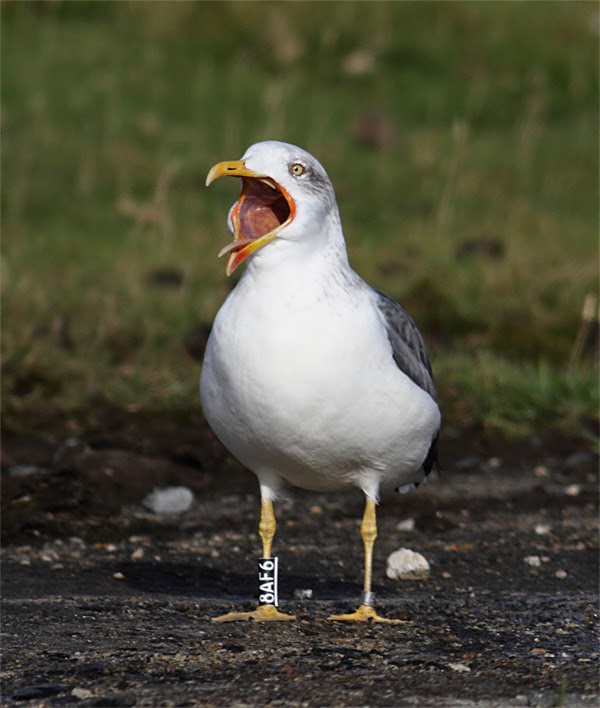
A mixed flock of large gulls was made up of mostly Lesser Black-backed, about 25 and five Herring Gulls. It is often quite easy to get close to the birds roosting on the airfield as it is possible to drive right up to them, as was the case with these birds. Two of the Lesser Black-backs were ringed, one with just a metal ring, that I couldn't read, and the other a black darvic ring, with white numbers and letters on it.

Adult Winter Lesser Black-backed Gull - Davidstow Airfield

The darvic ringed bird was an adult and having carried out a bit of research it appears likely that it is a bird ringed by Paul Veron on the Channel Islands. I will let you know when I find out the details.
Adult Winter Lesser Black-backed Gull - Davidstow Airfield

Saturday, 2 November 2013

Bearded Parrotbill...Reedling or Tit.....Ringing at Farlington Marshes - November 2013

Despite the success of last weeks ringing session at the Haven, and our first Radde's warbler (sorry to mention it again!), today we decided to go to the Hampshire and Isle of Wight Wildlife Trust's Farlington Marshes reserve to try and ring bearded parrotbills. We had been aiming to try several weeks ago, but the weather conditions have been against us. This morning it was forecast to be flat calm for the first few hours, then strong winds and squally showers moving in by lunchtime, so we decided to give it a go.

As you may have gathered from the title to this post, the bearded parrotbill is a species that has puzzled ornithologists for over two centuries. It is considered to be a member of the Paradoxornithidae family, but is thought to be an outlier in that family. It is the only parrotbill species to exhibit sexual dimorphism and a bill that bears no resemblance to other parrotbills. Subsequently the English name has changed from bearded tit to bearded reedling, and now to bearded parrotbill. There is no guarantee that this latest name will last long though, as according to molecular evidence the link with parrotbills may be a remote one.

We erected four nets at dawn and could hear bearded parrotbills calling their distinctive 'pinging' call almost immediately, but our first net round produced only three wrens. There have been at least 35 birds in the reedbed at Farlington and so we were hopeful of catching some birds, and and we didn't have to wait long.


Male Bearded Parrotbill

Male birds are striking and probably the most stunning breeding species in the British Isles. They are easily identified by the chestnut and white upperparts, grey head and throat and distinctive black moustache. The bright yellow bill and iris put the finishing touches to this beautiful species.

Male Bearded Parrotbill - Note the characteristic black moustache that
give the bird its name, grey head and rich chestnut and white upperparts.

Female birds are by contrast much duller and lack the distinctive moustache and the head is a buffish-brown colour. The wings are chestnut and white, as with the male birds, but not as bright.

Female - Bearded Parrotbill - The female is much duller than the male and
lacks the moustache and grey head.

Another striking feature of male birds are the black undertail coverts, which add to the overall stunning look of the species. Female birds lack the black and instead theirs are buff.


Male and Female Bearded Parrotbills - Note the striking black undertail
coverts of the male bird.

Ageing bearded parrotbills at this time of year can be tricky as both adult and juvenile birds undergo a summer complete moult and are therefore inseparable. Birds moult from mid-July through to late October and prior to that the 1st primary of a juvenile bird is longer than the longest primary covert, and its tip is rounded. In adult birds the 1st primary equals the length of the primary coverts  and its tip is pointed. A feature which is used by some ringers is the colour of the iris, which is paler in juvenile birds and richer in adult birds. Of course this feature is only any good if you have experience with the species, or have several birds for comparison. Fortunately we caught 17 birds, 16 were new and one was a retrap and so we had plenty of birds to compare. 


Comparison in eye colour of full grown birds - the bird on the right is undoubtedly
a bird of this year (age code 3), the bird on the left could be adult, or maybe a juvenile
from a first brood

The image above illustrates the difference in eye colour in two male birds. The right hand bird has a very pale, yellowish iris which would suggest a juvenile bird. In contrast the bird on the left, has an iris which is more orange in colour. This bird could be an adult, but the iris was still yellowish towards the outer edge which may indicate a juvenile bird but from a first brood. The image below illustrates two females, the bird on the right was an adult that was ringed at least two years before. Looking at the bird on the left, it again has a very pale iris indicating a juvenile bird. Another interesting feature is the colour of the bill, the adult birds bill is brighter, whereas the presumed juveniles bill is darker, this is not evident in the male birds.

Comparison of eye colour in female birds. The right hand bird was a retrap
that was at least two years old.

The session was not only memorable for the beardies but also for another species that I have not handled this year...a common stonechat. We had seen three birds feeding on the edge of the reedbed and suspected that there might be a chance of catching one or two. This bird was a juvenile (age code 3) male. 

Common Stonechat Saxicola torquata

Adult stonechats undergo a complete moult after breeding, whereas juvenile birds undergo a partial moult. Therefore birds can be aged by the presence of retained juvenile feathers, evidence of wear and fringing. This bird exhibited a moult limit in the greater coverts and also a fair amount of wear and fringing in the wing and tail feathers, as seen below.

Common Stonechat

The surprise bird of the day was a sedge warbler, a species that should by now be well on the way to Africa. We have caught a few late birds during October at Titchfield Haven, but to catch this species in early November is exceptional. I looked back at the previous latest date for the species in Hampshire, and other than a previous bird that was recorded wintering on one occasion, the latest date is 9th November and that was in 1963. The latest bird in Hampshire in 2011 (2012 data not yet available) was 16th October.

Sedge warbler Acrocephalus schoenobaenus

By the end of the session we had caught 24 birds, 17 beardies, three wrens, and one each of robin, stonechat, Cetti's and sedge warbler. Looking at the forecast for the rest of the weekend it is doubtful that there will be anymore ringing.
Related Posts Plugin for WordPress, Blogger...