Saturday, 13 April 2013

Yellow-fronted and Cross-billed Blue Tits - April 2013

It was almost back to normality this week in that I dusted off my ringing kit and was able to have three ringing sessions. For the first I headed back down to Manor Farm Country Park, whereas the two latter sessions were in my back garden. 

Sunday 7th April was the first session and having not got up very early for a while, it was tough extracting myself from the warmth of my bed at 05:15, and when I ventured outside, the heavy frost covering my car didn't help to fill me with enthusiasm. But it wasn't long before I was at Manor Farm the nets were up and and the sun was breaking through.

As with the last session I was going to be assisted by a handful of trainees only and so limited the number of nets I put up to four. The first net round yielded an adult redwing as the highlight, a couple of blue tits and a re-trap blackbird. The next round was slightly better with more blue tits and blackbirds, a few robins, on re-trap from two and a half years ago, and a couple of new house sparrows. The latter is still one of the target birds at this site, since it is where I run my BTO RAS project, alas we did not catch or see a re-trap. It is difficult to understand what is going on at this site, since the sparrow population seems to be declining, yet superficially the site looks the same. Hopefully I will have more time available this year to investigate.

The session was steady with 25 birds captured of 11 species, 16 new and nine re-traps, so a nice mix for the trainees. The highlight for all was a Eurasian treecreeper, not a species I catch many of each year, but always a delight.

The second session was on Monday 8th April, an evening session in the garden after work, oh how I love these light evenings!! Recent windy conditions have made ringing difficult, so I have to take every opportunity that I can. There have still been quite a few siskins in the garden, and this was the main motivation for opening the nets. I did catch one new one, and a new Eurasian goldfinch, but the bulk of the bird caught were blue tits. In fact it was the blue tits that proved to be the most interesting, because one had a yellow forehead and the other had a crossed over bill (hence the title to this blog post).


Yellow-fronted Blue Tit

Sometimes at this time you year birds will have yellow foreheads where they have been feeding either on pollen or the insects that are on it. Typically I have seen this in migrant birds, such as chiffchaffs just after arrival from their wintering grounds. But this blue tit has probably been feeding on willow catkins, since these are the only trees with pollen on in the field behind my house at present. I have seen several blue tits with deformed bills in the past, one of which had a ridiculously long lower mandible, which I have to admit I did trim back for it. The bird below though had a badly deformed and crossed bill, which overlapped in a similar style to a crossbill. The bird was obviously feeding OK though since it was an adult bird, and when on the feeder was happily feeding on sunflower hearts. Hopefully I will catch it again a be able to see how it's doing. This session ended with 13 birds ringed, which was a fair result for one and a quarter hours ringing.


Cross-billed Blue Tit

The third session of the week was today, Saturday 13th April, and another garden session. This session was carried out to the back drop of chiffchaff song and the threat of imminent rain, fortunately the latter held off long enough to allow a couple of hours ringing. The day began with a male blackcap on the peanut feeder, right next to the net, but not going in, but there were enough other birds to keep me occupied. Several siskins were still present in the garden, the most I counted was five, with only one having been already ringed. Blue tits were again the commonest birds, but it was worth opening the net since I also caught two  new goldfinches, two new greenfinches, two new siskins and one re-trap and a female blackcap. 

Female Blackcap (one of two in the garden)

Finally, the spring bird migration seems to have arrived, as yesterday I saw my first swallows and house martins and today caught my first balckcaps. I ended the session having caught 18 birds of six species, but have now caught 39 siskin in the garden since February.

Wednesday, 3 April 2013

Back in Boscastle for Easter - March 2013

With a four day break for Easter, it was off down to Boscastle for a spot of west country birding. With the continually cold easterlies along the south coast, migrants have been few and far between on my local patch, so I was hoping to add a few to my year list this weekend. We drove down late on the Thursday night, and on Friday morning I took the chance to check out Valency Valley. It was bitterly cold and the hazy sun did little to add any heat, nonetheless there were some signs of spring breaking through.

Opposite-leaved Golden Saxifrage - Valley Valley

The flora in the valley is typical of a damp wooded valley and is carpeted with bluebells, although only one or two were in flower. Opposite-leaved Golden Saxifrage covers the dry stone walls and wild daffodils are abundant in Minster churchyard. The flora this year was way behind last year, in part due to the cold weather, but mainly because it was a very early Easter this year. Greater stitchwort, red campion, primrose and ramsons were all in flower, but only a few of each.

Bird wise there were no migrants present, I would have at least expected the odd chiffchaff or blackcap, but alas no. The usual woodland species, blue, great, coal and long-tailed tits, treecreeper and goldcrests were all very visible though. Even the river itself was fairly bird less although I did eventually find one dipper and a grey wagtail. It was good to compare the British race of dipper Cinclus cinclus gularis with the nominate black-bellied C. c. cinclus that I saw in Norfolk earlier this year. Although difficult to make out, the red brown on the lower breast are just visible in the image below, the underparts are uniform dark on black-bellied.


Dipper - Valency Valley

On Saturday 30th March I had to visit Bude and took the opportunity to walk along the cliffs. It was a gloriously sunny day and by the time I arrived there were people and dogs everywhere. Fortunately the pitch and putt course was cordoned off so not too many dogs were straying onto it, and so an ideal refuge for newly arriving northern wheatears. The most I saw at any one time was five, but birds seemed to be continually moving through, so I am sure there were many more. Some of the male birds were just stunning, as the individual below...such quality birds wheatears!

Northern Wheatear - Bude

As I settled down to photo the wheatears, my attention was distracted by a moth that settled between my legs to get out of the wind. Due to the cold weather moths have been a bit of a rarity this year, and this March moth, as it turned out to be, was my first of the year. Quite what it was doing in the middle of a pitch and putt course with no cover was a bit of a mystery. I guess it had been disturbed from its place of shelter and got blown there in the brisk wind.

March Moth - Bude

Another migrant that is typical of this time of year is white wagtail Motacilla alba alba, the nominate subspecies of the British pied wagtail M. a. yarrellii. White wags have a plain grey mantle and rump, a black hood with a clear border between the hood and mantle.

Pied Wagtail - Bude

Unfortunately, none of the birds I saw were white wags, but I did manage to get some great views of a couple of pied wags that were more intent on feeding than bothering about me.

Pied Wagtail - Bude

On the way back from Bude I stopped briefly at Davidstow Airfield, another good place for migrants and waders. There were at least 20 wheatears scattered around the area, a couple of ravens croaking loudly as they attacked a grey heron and that was about it. Crowdy Reservoir wasn't much better so I headed home. As I did a flock of around 50 golden plover put in a brief appearance, wheeling around before settling back down on a recently ploughed field.

Northern Wheatear - Davidstow

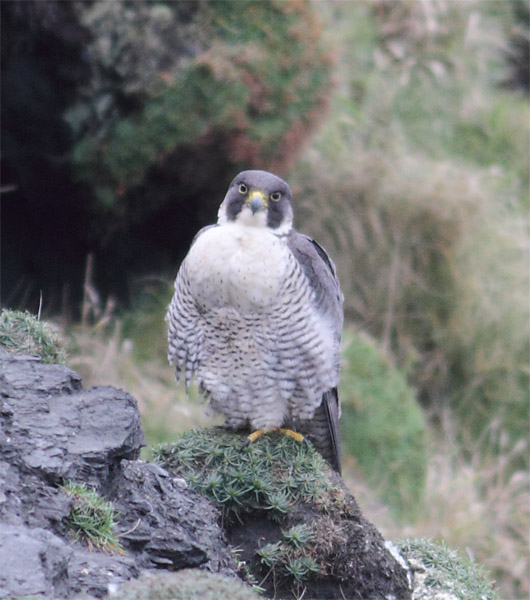
Sunday 31st March began with an early morning stroll around the cliffs at Boscastle, before being confined to the house for domestic duties. I started with a stroll through the scrub on The Stitches before settling down in a sheltered spot for a bit of sea watching on Willapark. The Stitches were predictably quiet with chaffinch, robin and dunnock being the most numerous species. The cliffs too were extraordinarily quiet with no fulmars or herring gulls settled on their usual nesting places, although the offshore islands were covered with birds. The sea was a bit more lively with fulmar, guillemot, razorbill and shags all present, a flyby male peregrine added to the excitement and a steady trickle of meadow pipits moved west. A sudden flurry of activity by the auks attracted a couple of sandwich terns, who made quick work of catching and swallowing their prey before the herring gulls got to them. As I was leaving I had the feeling I was being watched and suddenly noticed a peregrine sat watching me. It seemed more intrigued than perturbed by my presence, probably because it knew I no chance in getting too it on the unstable cliff face.

Peregrine Falcon - Boscastle

Monday 1st April began as Sunday with an early morning stroll around the cliffs at Boscastle, before packing up and heading home. This morning I did  the route in reverse, looking at the sea first before heading up to the scrub on the stitches. The sea was much as the day before, even with two sandwich terns feeding just offshore, but then a couple of close gannets and an adult kittiwake came into view. Two male peregrines were sat on the cliff face, one was calling constantly, presumably trying to scare off the intruder from its territory. This went on for about 10 minutes before the intruder took to the wing and flew north, watched all the way to the horizon by the other bird. It was nice to see that two fulmars had taken up residence on a suitable nesting site since yesterday morning, just maybe spring is on the way. The Stitches were as quiet as the previous day, with the only new species added being a jay and a couple of fly over linnets.

Northern Fulmars - Boscastle

Monday, 18 March 2013

From my Archive - New Zealand Storm Petrel

I was intrigued to read a report on the Birdguides Webzine about the recent discovery of the breeding ground of the critically endangered, and previously thought to be extinct, New Zealand Storm Petrel. This news took me back to January 2005, when I spent an exhausting but spectacular day out in the Hauraki Gulf in search of this species, so I thought I would share some of my photos. 

New Zealand Storm Petrel - Hauraki Gulf 

The species was re-discovered by two British birdwatchers, Bob Flood and Bryan Thomas, in 2003. As I was already planning a trip to New Zealand at that time, I jumped at the opportunity to try for it. I spent 16 hours out in the Hauraki Gulf, and was able to enjoy some fantastic views of this species, and loads of others.

New Zealand Storm Petrel - Hauraki Gulf

The list included fluttering, Buller's and flesh-footed sherwaters, fairy prion, Cook's, black, and grey faced petrels. However I think the most memorable images from the trip are the views of New Zealand and white faced storm petrels. 

New Zealand Storm Petrel - Hauraki Gulf 

The most surprising thing to me about reading this article, was the length of time it has taken to find the nesting site. Here we are 10 years after the species' rediscovery and it has only just been found. I think this really demonstrates the time and dedication researchers have to put in to tracking down some of these extremely rare species.

New Zealand Storm Petrel - Hauraki Gulf

Now that the breeding grounds have been discovered I hope that the New Zealand Government makes a better job of protecting it than it is currently doing protecting Maui's dolphin.

Saturday, 16 March 2013

Ageing Siskins

Back on January 29th I reported that during a garden ringing session I had captured a male Eurasian siskin. Not a particularly notable event for some ringers, but for me this was the first siskin I had ringed in my garden since 2006. In fact, when I looked back over time I had only previously ringed 23 in my garden, two in 1998, 12 in 2003, seven in 2004 and two in 2006. 

Since ringing that first siskin of the year, I have now ringed 32 new birds which has given me the ideal opportunity to brush up on siskin ageing and sexing...so here goes.

Male Siskin
Sexing siskins is really not that challenging, the male (above) has a black cap and bib, yellowish throat, upper breast and rump and heavily streaked lower flanks. The female (below) is much duller and greyer, lacking the black crown and bib and a white breast and belly which is heavily streaked. The mantle is lightly streaked and the rump whitish with light streaking in the plumage. There is very little size difference between males and females and in juvenile plumage birds cannot be sexed.

Female Siskin

Like many other passerine species adult and juvenile siskins have different moult strategies, with adults under going a complete moult post breeding, whereas juvenile birds undergo a partial post juvenile moult. However, there are always exception and Svensson states that young also occasionally undergo a complete post juvenile moult, and in Continental populations, occasionally a few primaries and all tail feathers and tertials are replaced by juveniles during their post juvenile moult.

Greater coverts of Adult male Siskin, note the colouration
and thickness of the yellow fringe of the greater coverts

Adult birds can be aged by way of the colouration and broadness of the of the outer edge of the greater coverts, and the lack of an obvious step (and contrast) between moulted and unmoulted feathers (above).

Greater coverts of First Winter male: Note the different colouration of the two
outermost greater coverts

First year birds usually show an obvious break in the greater coverts, which is evident by a difference in the length of the covert and the colouration and broadness of the fringe. The images above and below illustrate this perfectly, with the old greater coverts (OGCs) clearly visible.

Another Juvenile wing, again the three OGCs are very obvious due to different colouration and broadness of the fringe
The number of retained OGCs varied with each individual I ringed with one bird having just one and another bird having 7. Out of the 13 juvenile birds I have captured to date the average was 3.

Adult tail: Note the broad, dark and rounded tail feathers and lack of wear on the tips


Ageing birds using the tails feathers can be a useful feature, although a cautious approach should be adopted in spring when feathers can be worn. Typically and adult bird will have broad, dark and rounded tail feathers, as illustrated above.

First year tail feathers; note the pointed and worn tips


The tail feathers of first year birds are more pointed, thinner and generally not as robust and therefore they wear more quickly. The image above illustrates the shape and condition of the tail feathers of one first year bird, whereas the image below illustrates another. Note the difference in the colouration and the extent of wear on the tail tips on the image above but not the one below.

First year tail: Note the feathers are still pointed but are not heavily abraded as with the bird above

It does pay to be cautious with tail feathers in isolation though, for example the image below illustrates what looks like an adult type tail. The tips of the feathers are generally rounded, the feathers are broad and dark in colouration. But this bird had three retained greater coverts in the wing and therefore, given the species' moult strategy, must be a first year bird. The presumption with this bird is that it has either lost its tail and replaced it, or it has simply moulted its tail, as has been shown to occur in some Continental populations. In fact maybe it was a Continental bird!

Tail of first year bird: This bird had three OGCs in the wing
and therefore must be a first year, yet the tail looks distinctly  adult like.

Related Posts Plugin for WordPress, Blogger...