Showing posts with label Barley Bird. Show all posts

Saturday, 27 April 2013

In Search of the Barley Bird....

After a couple of days wandering around Botley Wood looking for common nightingales, the aim today was to try and catch some. The plan was to start at 6 AM, but after what can only be described as a slightly tardy start by Izzy, we eventually started at 6:45. It had been cold overnight and with the exception of blackcaps, chiffchaffs and willow warblers there was not much in song. 

We started at the first territory, and were soon listening to, and watching a male nightingale singing. That was expected, but the surprise was that this bird appeared to be paired, because a second bird was working its way to and fro along the hedgerow 'wheeting' and 'croaking'. Unfortunately neither bird ventured into the net.

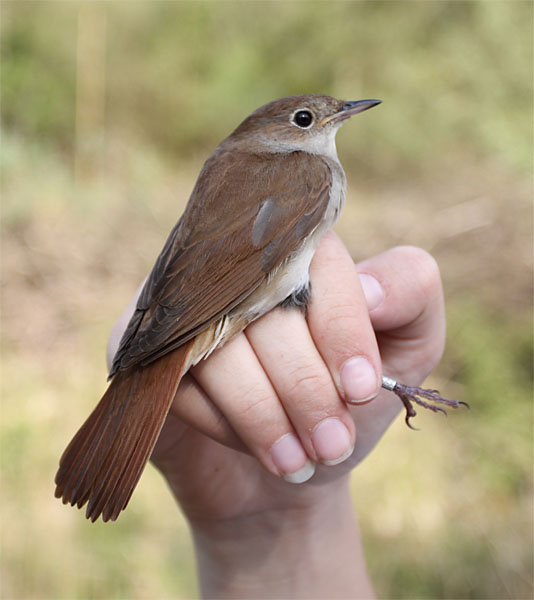
Adult Male Nightingale

Our next stop was the territory where I had managed good views of a singing male last week. This bird was again silent, but we could hear more 'wheeting' and 'croaking', perhaps indicating that this bird was also paired. I knew that this bird was unringed and soon we had captured and ringed it. The bird was an adult male with a wing of 85mm and a weight of 21.8 grams. I have been studying the species since 1998 and as part of the study I colour ring birds so that I can observe individuals in the field. 

Adult Male Nightingale - looking very dapper with his new colour rings

We waited in the hope that we might catch a female but unfortunately we failed. We packed away our nets and headed off in search of the next territory past one of the on-site ponds. Great crested newts breed at this site so we stopped to check for any evidence and soon found loads of leaves folded over in the distinctive newt way. Unfolding, one of the leaves we were able to confirm that inside were the eggs of great crested newt. At this point I should point out that you need to be licenced by Natural England to disturb great crested newts, and both Izzy and I are, and so we were not committing any offences.

We pressed on and went to check out an area of land which is not part of the reserve, but we have permission to enter. As were approached the area we immediately heard a drumming woodpecker, which sounded more prolonged and rapid for great spotted. We hurried to the area and soon found a male lesser spotted woodpecker drumming on a dead tree.

Male Lesser Spotted Woodpecker

This is a very difficult species to see these days, but one that I have seen at Botley Wood before, but only once. This bird was a great performer and gave us some prolonged views before flying off in a northerly direction.


Male Lesser Spotted Woodpecker

We spent a while searching the area looking for suitable nesting trees and a female but unfortunately we had no joy. Nonetheless we were so pleased to have found this bird, in fact I was planning an early start to look for them at Manor Farm Country Park tomorrow...maybe I will have a lie in!

Male Lesser Spotted Woodpecker

Whilst waiting for the bird to return Izzy started looking beneath some wooden cladding on a small shed, and before long she had found some bat droppings and a roosting pipistrelle bat....what a day!

Tuesday, 1 January 2013

Happy New Year and a Barley Bird in France

After a frustrating week without any broadband connection I would like to start this blog by wishing all readers of this blog my best wishes for 2013, and may your year be filled with many wildlife adventures.

I thought I would start this year with news of an interesting recovery of one of the nightingales that I had previously ringed at Botley Wood, Hampshire in April 2011. The bird was originally ringed on 21st April 2011, as a first year, therefore hatched in the summer of 2010. It was fitted with individually identifiable colour rings, but unfortunately it was not these that generated the recovery.

First Year Common Nightingale 21st April 2011

On the 27th June 2012 (433 days after its original ringing date), this bird was found freshly dead in the Vienne region of France 488 kilometres to the south of its original ringing site, having hit glass. This is the first foreign recovery of one of the Botley Wood ringed nightingales which is exciting in itself, but the date of the recovery is something that has got me thinking. 

Common nightingales typically arrive at Botley Wood from mid April and are usually paired up and nesting by mid May. Their chicks tend to hatch around early to mid June and by late June/early July they are fledging the nest. From mid to late July adults undergo a complete moult before migrating around early to mid August. Adult birds show a high degree of site fidelity, and will return to the same territory year after year, so seeing that this bird had been recovered in France in late June got me thinking what it was doing there.

My first thought was that the bird had failed to find a mate in the previous year and had decided to stay in France to breed during the 2012 breeding season. This strikes me as very unusual behaviour, given the level of site fidelity previously exhibited by the species at Botley Wood. Alternatively, it could be that this bird usually breeds in this region of France but had over shot the previous year and ended up at Botley Wood.

My second thought was that the bird had returned to Botley Wood but had not been a successful breeder during 2012 and therefore had began its autumn migration early. There are two reasons why this may have happened; the weather during 2012 was very bad and many species had poor breeding success, given that nightingales are only single brooded in the UK, a failure could instigate an early southward movement. This was certainly experienced with some species during 2012, whereas as other species stayed on their breeding grounds and had very late broods. The second reason may be due to a lack of habitat at the breeding site. During 2012 the National Grid replaced overhead power cables that pass over parts of the site, in doing this they removed all of the scrub where this bird was holding a territory in 2011. Therefore it may have returned and been unable to find a suitable nesting location and/or a mate and moved back south.

My third thought was that the bird had been held up on its northward migration due to bad weather over the Mediterranean in the spring, but a delay of two months from its normal arrival date is probably too much of a delay for this to be the case.

Unfortunately I will never know the answer but it is still a very interesting recovery that will keep me wondering for a while yet.

Monday, 25 April 2011

The Barley Bird has Returned - April 2011

Over the last week I have had the opportunity to carry out two ringing sessions, both at Botley Wood, and both carried out with the background accompaniment of common nightingale song. The first session was carried out on 17th April and ended with the grand total of 30 new birds and four re-traps. Two of the re-traps were great tits, that were captured on 31st May 2010. Other birds captured included two blackbirds, six blackcaps, two chiffchaffs, and a female bullfinch and a male song thrush.


The most striking bird captured was an adult Eurasian jay. It was aged by the broadness and shape of the tail feathers and the number of black bars on the outermost greater covert.

Adult Eurasian Jay, Botley Wood - April 2011 T. D. Codlin


The striking turquoise primary, alula and greater coverts, although visible in the field, are probably best appreciated when seen close up.


Open Wing of Eurasian Jay, Botley Wood - April 2011 T. D. Codlin


One of the target species for my ringing studies at Botley Wood is the marsh tit. This species is considered to be in decline, but at this site it is a species that I regularly capture. Individuals can be incredibly variable and subsequently can be difficult to separate from the closely related willow tit. Features such as the pale wing panel and glossy or matt cap, can appear regularly in both species. However, help is now at hand. A recent research paper studied both marsh and willow tits and identified two new features; the first being the contrast between the white ear coverts and brownish side to the neck, and the second being a white mark on the cutting edge of the upper mandible, near the base.......both features are clearly visible on the picture below.

Marsh Tit, Botley Wood - April 2011 T. D. Codlin

Only 22 birds were captured on the morning of the 21st April, but the numbers didn't matter as the highlight was the capture of my first two barley birds of the year. The first bird was an adult male that I first captured last year, when it was returning for its first summer. This bird was very vocal, and as well as its typical song, was emitting loads of croaking and wheeting calls. This behaviour is typical of a male which is courting a female, and sure enough, the second bird I captured was a probable female. This bird was a first summer bird with a maximum wing chord of 80mm; typically male birds have maximum wing chords of between 84 - 88mm, females are usually a couple of millimetres shorter, but as always there is some overlap.


Adult Male Common Nightingale, Botley Wood - April 2011 T. D. Codlin

The combination of the behaviour of the two birds, the soft contact calls and short wing length of the second bird are indicative of a female, but in the absence of any conclusive features, such a a brood patch, I could not be certain, so left the bird unsexed. 

Adult Male Common Nightingale, Botley Wood - April 2011 T. D. Codlin

The other species captured included more blackcaps, chiffchaffs, blackbirds, blue tits and great tits along with my first common whitethroat of the year. Common whitethroats are a regular summer visitor to the site; the captured bird was aged as a first summer due to its extremely worn wing and tail feathers and small amount of white in the outer tail feathers.

Common Whitethroat, Botley Wood - April 2011 T. D. Codlin

With ringing activities finished and all the nets down we headed back along the road towards our cars, and there in the middle of the road was an adder. Typically, it immediately coiled up and prepared to strike rather than run (well slither!).........

Adder, Botley Wood - April 2011 T. D. Codlin 

........but once it realised that we were not intimidated and only interested in taking pictures, it beat a hasty retreat back into the undergrowth.

Adder, Botley Wood - April 2011 T. D. Codlin

Related Posts Plugin for WordPress, Blogger...