Showing posts with label Eurasian Blackbird. Show all posts

Saturday, 9 June 2012

A Ripe Old Age for a Blackbird

Another weekend and another missed opportunity for ringing due to strong winds and heavy rain showers....will it never end! 

Barn Swallows Hirundo rustica


So with no hope of mist netting I popped over to the local stables to check on the status of the resident Barn Swallows. There are 20 stables at this site and it was pleasing to see that most of the horses were out in the paddocks so I would be able to check the nests. The swallows were back and settled in, but not in as many numbers as last year, but still eight nests had eggs in, and another five looked to be active so I will have to pop back.

With the weather deteriorating I decided to do some data entry and whilst entering details from my last ringing session at Manor Farm Country Park, on 27th May, I noticed the age of a male Blackbird I had retrapped. This bird was originally ringed at Manor Farm on 16th November 2003, a distant 8 years 193 days previously, as a first year male. Although the age of this bird is not a national longevity record, which currently stands at 14 years 2 months and 1 day, it was by far the oldest retrap of any birds I have ringed. The bird wasn't in very good body condition and was well below the usual body weight, weighing only 80.8 grams (the usual range is 87 - 127 grams), which I presume is a result of working overtime feeding chicks rather than old age. Interestingly, it was only the third time it had been captured since its ringing date, so it would appear it doesn't frequent the farm museum very often, or else it remembers what a mist net looks like!

Sunday, 29 April 2012

Curbridge and my first young Blackbird of the year

The weather has been appalling this weekend with torrential rain and gale force winds throughout, which has completed flawed my plans to spend the weekend in search of Nightingales. Friday was the best day weather wise so I nipped down to Curbridge reserve before putting a net up in the garden.

The tide was low and therefore ideal for looking for waders, and I immediately located a single Whimbrel feeding at the mouth of the first creek. Two Common Sandpipers, fluttered along the waters edge away from me, landing on the other side of the estuary next to three Greenshanks and another Whimbrel. As I scanned down the estuary I noticed a flock of 17 more Whimbrel dropping out of the sky, bringing the total to 19, and two Oystercatchers were feeding on the inter-tidal.

Juvenile Blackbird

Returning home I decided to open the net in my garden and immediately caught a juvenile blackbird, which had only just fledged the nest. The wing and tail feathers had not fully grown...

Juvenile Blackbird
                                                             
                                                                   .....but I was still able to sex the bird due to the black tail feathers, as opposed to brown in a female.

Partly Grown Juvenile Blackbird Tail

Other birds captured included three new Greenfinch's and a new Robin, but that was about it. 


I am off to Turkey tomorrow, leading an Ornitholiday's trip, to the the same region as last year, The Goksu Delta, Cukurbag, Biricek and Gaziantep, hopefully I will get some internet access during the trip, and if I do I will try to keep you posted.

Saturday, 19 November 2011

Dutch Ringed Blackbird and Buzzard in 2010

Back on 11th December 2010 I caught a Dutch ringed adult female Blackbird at Manor Farm Country Park, and eleven months later, I have finally received news of its original capture. The bird was originally ringed on 7th February 2010 at Westkapelle, Walcheren, Zeeland, The Netherlands, NL18, 307 days previously. Its journey had covered 335 kilometres in a westerly direction, and since it was not captured again, I assume it must have continued on its journey and away from the cold weather that was covering the UK at the time. Whilst this control did not shed any new information on the movement of blackbirds across Europe, it was a notable capture for me, since it was the first foreign ringed bird I had captured at Manor Farm since I began ringing there in 1995.

Juvenile Common Buzzard 11th December 2010 Manor Farm Country Park

Interestingly, the 11th December 2010 proved to be a bit of a red letter day, since I also captured the first Common Buzzard for the site on that day.  Don't ask me how it managed it, but this bird forced its way into the bottom shelf of a 9m net and then wrapped itself up in it.

Juvenile Common Buzzard 11th December 2010 Manor Farm Country Park

I was pleasantly surprised to find that despite its large size, the bird was extremely docile and easy to handle. Ageing was also relatively straight forward, as this bird lacked the broad terminal band on the tail which adults show, and therefore was clearly a juvenile.

Saturday, 22 October 2011

Titchfield Haven Ringing Update 21st/22nd October

After the excitement of last weekend we were slightly excited about the prospect of another good bird in the trapping area, but with the autumn migration nearly over, we were well aware that the chances were much reduced. Nonetheless we opened the nets on Friday 21st with cold, clear and still conditions, whilst the now usual passage of Eurasian Siskin's, Common Redpolls and occasional Bramblings passed overhead. It wasn't until we had closed our nets that we heard there was a Glossy Ibis at the top end of the reserve, and after a some searching of the reserve we eventually got some brief flight views.

The numbers of birds captured each session has reduced dramatically since the distant days of July, August and September, but there are still notable numbers to be had, and the 21st was the turn of Cetti's Warbler. In a previous post I reported how few we had captured, and that this was probably the result of two hard winters. But the number of birds captured has gradually increased, to the point where we caught six on the 21st, taking our total for the year to 31, which although not a record is more in line with our yearly average.

Cetti's Warbler - October 2011

Blackbird numbers too are also steadily increasing as birds arriving from the continent for the winter, swell the numbers present. Before this weekend we had only caught nine new birds, but our two days of ringing produced four new birds. 


Juvenile Blackbird - October 2011

Of the birds captured three were juvenile males and one was an adult female, but it was interesting to see the difference in bill colour between different individuals.

Juvenile Blackbird - October 2011

The birds were aged by the presence of retained juvenile flight feathers in the wing, that contrast with the moulted adult feathers.......


Wing of Juvenile Blackbird - October 2011

..............and by the presence of pointed tail feathers.

Tail of Juvenile Blackbird - October 2011

Song Thrush numbers have also started to increase, with two new birds captured this weekend and several birds recorded passing overhead. This might not seem like a particularly large increase in numbers, but since July we have only captured three birds. Both the new birds captured were juvenile, and as with the Blackbirds above, birds are aged by the presence of retained juvenile wing feathers, which in the case of Song Thrush there are distinctive thorns on the greater coverts.

Juvenile Song Thrush - October 2011

The image below shows a close up of the greater coverts, the inner two (left side) are adult, with the remainder (right side), showing distinctive thorns of juvenile greater coverts.

Greater Coverts of Song Thrush - October 2011

As with the Blackbirds above, junvenile tail feathers are more pointed and narrower than adult feathers.

Juvenile Song Thrush Tail - October 2011

Reed Buntings have also started to arrive in the ringing area, and this weekend we captured five new birds, two on Friday and three on Saturday.

Male Reed Bunting - October 2011

All of the birds captured were considered to be males due the extent of black on the crown feathers, some birds even showed an almost complete black head, as pictured below.

Male Reed Bunting - October 2011


Ageing is carried out by the amount of abrasion on the wing and tail feathers, with adult birds having very fresh plumage, whilst juvenile birds are more worn, in addition, juvenile tail feathers are more pointed.
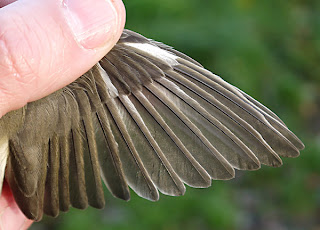
Blackcap with Albino Primary Coverts

During our ringing activities we have captured varying degrees of albinism or leucism in birds, in particular Blackcaps and Grasshopper Warblers, and Saturday 22nd produced another such example. This male Blackcap was not as striking as the previous birds but had three primary coverts that were almost completely white.
Related Posts Plugin for WordPress, Blogger...