Showing posts with label Bird Ringing. Show all posts

Thursday, 8 October 2015

Titchfield Haven Ringing Update - Early October 2015

Whilst I was galavanting around Fair Isle and Shetland, Barry and Duncan continued with the ringing sessions at the Haven, no doubt hoping to grip me off with a goody! They ringed on seven dates and had three days when they caught over 100 new birds, 116 on 17th September, 187 on 19th and 143 on 26th, otherwise the totals were below average. New species for the year included Lesser Redpoll, Firecrest and Spotted Flycatcher.  

My first session since, returning was 3rd October and we started with a haul of 202 birds, the next saw a total of 104, so still plenty of birds moving. As expected the Blackcap total continued to build and as of today it stands at a massive 885 new birds, beating the previous annual total by 79 birds, and well on the way to the 1000 target. On the flip side of that the Grasshopper Warbler total never recovered and now stands at a paltry 135 birds ringed. This is the lowest total for this species since 2003.

At one point we thought we were heading towards a record Reed Warbler total, but towards the end of September the numbers petered out and currently stands at 716. This is the highest total for the last six years and is only 62 birds short of the record; clearly a good year for this species. The Sedge Warbler total also remained low at 799, as did Garden Warbler at 44. The Willow Warbler total was good, although not as good as last year, and Whitethroat numbers have peaked at 112. Chiffchaff and Cetti's Warbler numbers remain quite high and assuming the weather holds we still have plenty of time to catch more.


The session of 2nd October as well as being very busy was also one of our public events. The visitors were very patient as we worked our way through the 106 Blackcaps and 64 Chiffs, and were rewarded with the capture of two Bearded Tits. Although Bearded Tits breed on the site, we rarely catch them in our ringing area since we outside of the main reed bed, these two birds were therefore greatly appreciated by all.

A Pair of Bearded Tits - Titchfield Haven
Visitors enjoying a Bearded Tit photoshoot (Photo Simon Ingram)

The last two sessions have also seen 25 new Goldcrests ringed bringing the total for the year so far to 36 and two new Robins bringing that total to 59. Having seen record numbers of Yellow-browed Warblers on Fair Isle it hopefully won't be too long before we catch another one down on the south coast.

Saturday, 12 September 2015

A hand-held Wryneck and mid-September bird ringing update

It has now been a few weeks since my last ringing update from the Haven, other than the Barred Warbler posts of course, so I thought it was time to do so. 

Our ringing totals have been steadily building and as is typical during September we have started to to see a shift from Acro's (Reed and Sedge Warblers) to Sylvia warblers, with the Blackcap being the commonest. Our daily ringing totals have been below average, with the highest total being 168 new birds on 7th August and 5th September. Grasshopper Warbler numbers have been more typical, but we have not recovered from the poor start, and the current total is 111 for the year. Our best days have been 18 on 28th August and 15 on 1st September.

A comparison of ringing totals from 2010 (up to 14th Sept 2010 - 2014, up to 11th Sept 2015) paints a very mixed picture with Reed Warbler numbers at their highest over the six year period, and already getting close to last years total of 693. That total was the second highest ever, the highest was 778 in 2002, but that was when we were ringing in two locations, and therefore cannot really be included in the comparison. 

Blackcap numbers are also very high and at this point in time are ahead of last years total, which ended up being our best year ever with 806 birds. Cetti's Warbler numbers are also above average for the time of year. Willow warbler, Chiffchaff, Whitethroat and Garden Warbler numbers are all slightly below average, but the biggest loser is the Sedge Warbler. To date its total is over 30% down and represents the second lowest total in the six year period, the lowest being the wet summer of 2012.


Summary of Ringing Totals for Key Species 2010 - 2015

We have of course had quite a few highlights this autumn, and as well as the obvious, we also caught our fourth ever Wryneck on 1st September. With so many being reported along the south coast, we had hoped it was only a matter of time before one turned up in our ringing area. Unfortunately, it turned up on a week day so Duncan and I were at work and Barry got to enjoy the stunning bird.

Wryneck - Titchfield Haven 1st September ( B. S. Duffin)

September 5th delivered our ninth ever Tree Pipit, a species which always provides a challenge for our trainees, to ID and to age. Based on a combination of pale fringed wing coverts and pointed tail helped us age this bird as a juvenile.

Tree Pipit - Titchfield Haven
Tree Pipit - Note the pale fringing to the medium and greater coverts identifying the bird as a juvenile
Tree Pipit - the pointed tail feathers are a typical feature of a juvenile

We have also caught three Lesser Whitethroats this year, which doesn't sound many, but for us it represents a good year. I have checked the wing formula of each one, but they have all proven to be European Lesser Whitethroats Sylvia curruca curruca. One bird was an adult so we were able to compare the tails of the two birds which was good value.

Lesser Whitethroat - Titchfield Haven
Lesser Whitethroat - adult tail
Lesser Whitethroat - juvenile Tail

To date we have ringed 2212 birds of 29 species, which is below average but on a par with last year. I will be heading up to Shetland and Fair Isle for 10 days with a team from the BTO on Thursday 17th and so am hoping that nothing too exciting turns up in the nets whilst I am away.

Thursday, 10 September 2015

Barred Warbler again

I woke early this morning and as I knew Barry was ringing again decided to nip down the the Haven before work. I don't know why, but just had a feeling that I ought to. The conditions were perfect for ringing, but the clear overnight conditions didn't bode well for the Barred Warbler still being there, but I did it all the same. There was an early flurry of activity with the a handful of Grasshopper Warblers, loads of Blackcaps and a scattering of other species in the first round. The same theme continued for the second round until we got to the jetty net, and there it was, the Barred Warbler. It was pretty much in the area where it had been released, which unfortunately is not really viewable from anywhere, not even our ringing area, so will be tough to pin down in the field.

The bird had lost weight from when it was originally caught two days ago, and had no fat and a muscle score of 1. In this condition I suspect it will need to feed up before moving on. Based on the colour of my hands after handling it, it has been gorging itself on blackberries, so may fatten up quite quickly.

It was a first winter bird with a grey iris as opposed to the yellow one of an adult. The large bill, with pale pink basel part of the lower mandible was extremely prominent. The wing coverts and tertials were pale fringed but not a prominently as some that I have seen, but overall it was a cracking bird. I think you can imagine how pleased I was to catch up with it.

Barred Warbler - Titchfield Haven
Barred Warbler tail - note the shorter, greyer and pale tipped adult feather
contrasting with the other juvenile feathers
Barred Warbler - undertail coverts showing darker centres with pale fringing

Tuesday, 8 September 2015

Barred Warbler - Titchfield Haven 8th September 2015

I has a strange feeling today that something good was going to be caught at the Haven, I don't know why, but just had a sixth sense. Barry was ringing and Duncan and I were both at work, but I kept my phone close just is case. 

Unbeknown to me Barry was feeling quietly optimistic, with south easterly winds and clear overnight skies, conditions were perfect for an arrival of autumn migrants. We have been  hoping for something big, after the Pallas' Grasshopper Warbler of last year and the influx of Western Bonelli's Warblers and Barred Warblers throughout the country this year and we (well Barry) were not disappointed. 

Barry quotes "As first light came at 5.30am the low scrub and reeds in our ringing area was alive with the calls of newly arrived warblers, mainly Blackcaps, Sedge Warblers and Reed Warblers, with lesser numbers of Chiffchaffs, Whitethroats and the trickling liquid calls of Grasshopper Warblers. Then whilst carrying out a net round at 8.45am, shortly before ending the morning's session, we came across a large warbler among a number of Blackcaps high up in one of the nets.  Identification was not immediate as the sun was in our eyes but on lowering the net for extracting the birds we were pleased to find the Haven's first Barred Warbler."

Barred Warbler - Titchfield Haven (Photo: B Duffin)

Unfortunately, at this point I was away from my phone and missed the text; being only 10 minutes away I could have easily have made it.

Not only is this the first recorded at the Haven, but also it is the first ever ringed in Hampshire, and a species that would have been new for me in the County........as you can imagine I was gutted to have missed it.

Friday, 28 August 2015

Titchfield Haven Bird Ringing - 28th August 2015

With a four day weekend ahead of me, it seemed like to perfect way to kick it off was a ringing session at The Haven. The end of August is now fast approaching and I will do a summary of where we are totals wise then, but as todays session was a pretty good one, I thought it warranted a short blog post. Barry had only been able to do one session so far this week because of the appalling weather, but yesterdays session had resulted in 10 new Grasshopper Warblers, so it was worth the effort.

The conditions looked ideal for another session this morning with a clear night, and a bright and wind less morning, and it was clear it was going to be good as our nets were dripping with birds first thing. As it happened things didn't end up as good numbers wise as we thought with under 180 birds were trapped, but we were treated to our first Common Redstart and Lesser Whitethroat of the year.


Juvenile Common Redstart

The Common Redstart was a juvenile and there was no evidence of a dark throat or grey feathers in the crown, so was probably a female. Whilst I had the Lesser Whitethroat in the hand I thought I would check the wing formula to make sure it was just of the European sub-species.....well you never know!


Lesser Whitethroat
The wing formula was spot on for European Lesser Whitethroat Sylvia curruca curruca with the second primary being shorter than the fifth but just longer than the sixth.

Wing of Lesser Whitethroat 

The bulk of our catch was made up of Reed and Sedge Warblers again but Blackcaps were't that far behind. We also caught another 18 Grasshopper Warblers, so 28 in two sessions, which is more like it. Good numbers of Whitethroats were also ringed, two of which were adults and one of those a control.

Adult Whitethroat

The bright orange iris and extent of pure white in the tail feathers were dead give aways for the age, as were the retained adult secondaries in both birds.

Tail of adult Common Whitethroat

The remainder of the catch was made up of Willow Warblers, notably four of which were adults, Chiffchaffs, Cetti's Warblers, Goldcrests, Garden Warblers, Long-tailed Tits, Dunnocks and a retrap Song Thrush.

Sunday, 23 August 2015

Titchfield Haven Bird Ringing - Late August update

It has been a very mixed bag this season at the Haven which has not been helped by the very changeable weather. Fortunately Barry is retired which means that he can do some sessions during the week in order to keep our effort constant, but Duncan and I are getting limited opportunities to ring at weekends. If we are lucky we may be able to get one session a week, which is great for catching up with sleep, or doing general birding, so we can't complain, but we would rather be ringing.

Despite the inconsistent weather conditions the overall ringing total for the year is holding up reasonably well, but unless there is going to be a very late surge in the numbers of migrants it is looking like this year the totals will be at best average. That said there are some notable exceptions; on the down side, the Grasshopper Warbler total remains exceptionally low with only 36 birds ringed to date. For the period 2010 to 2014 inclusive, by 23rd August the average is 143 birds, so this year's total is significantly lower that we would have expected. It won't be the lowest total since 1998 as we have already passed that, but could be within the bottom five.

Juvenile Grasshopper Warbler

On the flip side of that, the Reed Warbler total currently stands at 450, which is the highest total for the period 2010 to 2014 by 23rd August, and well above the average for that period which is 293. The overall total for all species for the period up to 23rd August stands at 1310 birds of 20 species. 

A summary of selected species from 2010 - 2015 up to 23rd August

The only unusual record is a Common Nightingale that is only the sixth ever ringed at the site. There has been very little evidence of visible migration over the last few weeks, with the odd Tree Pipit and Yellow Wagtail and on 2nd August a Marsh Harrier


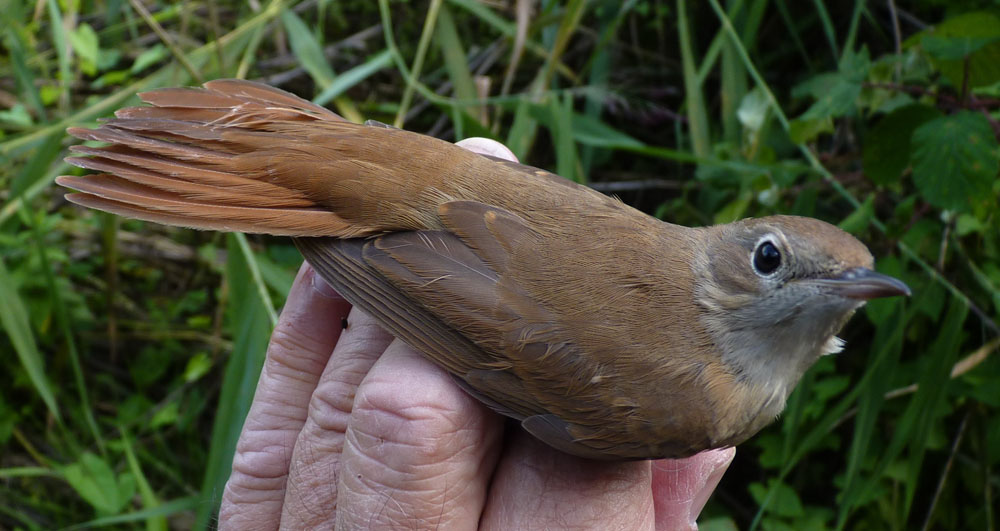
Common Nightingale - Note the pale tips to the tertials confirming this bird to be a juvenile, also the first primary can be seen extending 
beyond the longest primary covert, thereby confirming it as a Common not Thrush Nightingale (B. S. Duffin)

On the morning of 22nd August we held one of our public ringing events, which was well attended as usual. The session was steady, with 78 birds ringed, Reed and Sedge Warblers were as ever the most numerous species, but five Grasshopper Warblers were very welcome. Once again there was very little evidence of visible migration, the most notable species being Yellow Wagtail, with two birds and a single Common Swift. Just as we closed the nets a couple of sparring Sparrowhawks put in a great aerial display before drifting off to the east.

Sparring Sparrowhawks

After the session I stopped for a quick look off the sailing club at Hill Head with Simon Ingram, who had joined us for the mornings ringing session. There was a flock of around 100 terns roosting on the shingle but unfortunately, as is a common theme these days, the level of disturbance was very high with kayakers, fishermen and dog walkers continuously flushing the birds to the point where there was nowhere for them to settle. Simon was intent of finding a Black Tern and after a quick scan through the flock, looked out to sea, I concentrated of the roosting terns as there was a constant turnover of birds. It wasn't long before I picked out a cracking adult Roseate Tern, I quickly got Simon onto it and then we put the news out. The speed at which we did that enabled Graham Barrett, who was on the other side of the harbour, to get onto the bird, before once again, the flock was flushed, this time they did not return.

Friday, 7 August 2015

Bird Ringing at Titchfield Haven - Early August 2015 update

Despite my lack of posts on the subject the autumn bird ringing has been progressing steadily at Titchfield Haven, and when I say steadily I mean just that. Throughout July the numbers of birds ringed were low compared with last year, and the most noteworthy thing was that in that period we only caught one Grasshopper Warbler, by the end of July last year we had ringed 30. Last weekend things picked up a bit with 120 birds ringed on Saturday and 98 on Sunday, but today things really got going, with 181 birds ringed.

It was a busy session with just Barry and I ringing and Colin who was our scribe for the morning. Clear and still overnight conditions are the best for our site and it was evident by the first round that it would be a bit busy. As expected for this time of year Reed and Sedge Warblers made up a bulk of the catch with over 130 birds between them. Willow Warbler was the next most numerous with over 20 new birds ringed. 

Juvenile Willow Warbler

The numbers of Sylvia warblers is slowly starting to build and today we were surprised to catch 10 new Garden Warblers, including two adult birds, which are always nice for comparison. Common Whitethroats and Blackcaps, were also ringed but in much smaller numbers.

Juvenile Garden Warbler 

The other species included our second Grasshopper Warbler of the year, Chiffchaff, Greenfinch, Goldfinch, Bullfinch, Blackbird, Robin, Cetti's Warbler and a juvenile Reed Bunting. This year Bullfinch numbers have been at an all time high, but that is because they have bred in our ringing area for the first time this year.

Juvenile Reed Bunting

One of our net rides is set over a purpose built boardwalk that leads down the the river Meon. At this time of year it is one of our busiest rides since it cuts down through an area of Phragmites reed bed. The end of the ride is a great place to stand and get a view of the river, especially when mud is exposed. 


The jetty net ride

This morning it was evident that we had had an overnight visitor as there were two very fresh Otter spraints and the end of the jetty was still wet where it had hauled out of the river. Despite being on the site at very unsociable hours of a regular basis, I have not yet seen an otter here, hopefully I won't have to wait much longer.


Fresh Otter Spraint

Wednesday, 5 August 2015

It's getting late for ringing swifts

On Monday (3rd August) I popped down to a site at Lee-on-the-Solent to ring some Common Swift Apus apus chicks. You may recall the story from last year, but if not that post is here. You may notice that it is nearly six weeks later than the broods I ringed last year, and that is the result of some quite bizarre events. 

I had received the text from Mark, the house owner, back in June telling me that he again had a brood and that they had laid two eggs, and were happily incubating. But on 20 days things went a bit pear-shaped, when what was presumed to be a bird from a different pair entered the box. A scuffle ensued, during which the eggs were displaced from the cup, both birds then left the box. Mark quickly grabbed his ladder and put the eggs back in the cup and before long a bird returned and began incubating. He thought that things were back on track, but then the incubating bird got a bit agitated and kicked the eggs out from under it, breaking one of the shells....all was lost he thought.

Common Swift nestling

Amazingly, the pair or another then relaid, incubated the full term and now have chicks that are three weeks old, so we decided to go ahead a ring them. Two healthy chicks were ringed, one weighing 45 grams and the other 50. Typically swifts fledge after a 22 day incubation period and a 47 day nestling period, which suggests that these chicks will not fledge the nest for another three weeks yet, the latter part of August, by which time they would normally have left the country. It will be interesting to see how these birds fair, and fortunately with the camera in the nest box at Mark's house we will be able to keep an eye on them.

Common Swift nestling

On the way home a made a quick detour to the Haven and bumped into Dan Houghton. There were a few bits a bobs around, the most notable being the 3cy Yellow-legged Gull that has been hanging around for a while, 2 Common Scoter and 48 Mediterranean Gulls of various ages. 

Industrial view of Fawley Oil Refinery from Hill Head

Monday, 20 July 2015

Where has the last month gone?

I can only apologise for what has been a month since my last post, which has in part been due to a new and very busy role at work, but also due to an extremely busy social calendar. In fact, things have been so busy that there was a period of seven days when I didn't even lift my binoculars, something I cannot remember happening before, and my camera has almost been mothballed.

Bird ringing activities have also been limited, but I have managed a couple of sessions. One was a ringing event on the Leckford Estate for Trustees of the John Spedan Lewis Trust and Hampshire and Isle of Wight Wildlife Trust on 21st June. It was a bit of a breezy day but we managed to catch 34 birds of 11 species. Given that the visitors arrive at 11:00 and leave at 15:00, I am always glad to catch anything, and the crowd pleaser's were undoubtedly the two Kingfishers and single Great Spotted Woodpecker. The supporting cast included two Marsh Tits (one a retrap from last year), 13 Great Tits, five Wren's, 3 Robins, two of each Blackcap, Chiffchaff and Goldcrest and single Blue Tit and Chaffinch, the latter a superb male.


Another session was at Manor Farm Country Park as part of my RAS project on 27th June. We ringed 46 birds of four species, 42 House Sparrows, three of which were retraps, two Blackbirds and single Robin and Wren. So plenty of target birds but very few retraps which was disappointing. In the afternoon I opened a net in my garden and caught 15 birds of five species, including six Great Tits, three Goldfinch's, 4 Blue Tits and single Chiffchaff and Robin.


Ringing at the Haven has also commenced for the autumn and to date we have ringed 131 birds of 16 species. Unsurprisingly Reed Warbler has been the most numerous species with 67 birds ringed, no doubt the local breeding population. Ten Cetti's Warblers, nine Blackcaps, eight Robins, five Chiffchaffs, four Dunnocks, three each Blackbird and Bullfinch, two Bearded Tit, Long-tailed Tit and Reed Bunting and single Wren, Song Thrush and Willow Warbler.


Juvenile Avocet, Titchfield Haven (Geoff Jones)

On the afternoon of the 18th July I received an email from the Haven with a picture taken by Geoff Jones, one of the Havens volunteers and a keen photographer. The image was of a juvenile Avocet wearing a yellow colour ring on its right tibia, and a yellow flag with the letters AC on it, on its left tibia. I knew that it was not one of the Haven birds as they have not been ringed, and based on the juvenile dispersal from the west of the county last year, I suspected it might be one of Graham Giddens' birds. 

Graham responded to my email immediately and it was indeed a chick he had ringed at a site in the west of the the county on 3rd June. It was disappointing to learn that this was the only bird to fledge from his site this year, the others being predated by large gulls and Grey Herons. The lack of success for Graham is not mirrored at the Haven where I understand over 25 chicks have fledged, the best ever year for breeding Avocet at the site.

Friday, 12 June 2015

A Hudsonian Whimbrel and Kestrel Pulli

For the second time this year the British Isles has been graced by the presence of a Hudsonian wader. In May I twitched the Hudsonian Godwit in Somerset, which was a cracking bird and not a species I thought that I would ever see in the UK. This week news broke of a possible Hudsonian Whimbrel at Pagham Harbour in West Sussex. It was not long before it was confirmed and so being only 25 minutes down the road I had to go. 

Hudsonian Whimbrel is a species I have seen many times in the USA and Canada, but this was only the 9th record in the UK, so not a species I had expected to see, and so close to home. It is a cryptic species, that is very similar to Eurasian Whimbrel, but with good views is actually quite straightforward to identify.  In flight the back, rump and upper-tail coverts are concolourous with the mantle and therefore very different from Eurasian Whimbrel that has a white rump and the distinctive 'V' up its back. The underwing, auxiliaries and flanks are also densely barred with a ground colour that is warmer than that of Eurasian Whimbrel. When not in flight the striking head pattern should be the first clue to a bird being a Hudsonian Whimbrel, since it is much stronger, with the pale/white supercilium and crown stripe contrasting strongly with the darker feathers. 

I nipped down to see this bird on Wednesday morning, and it was interesting to see how obvious the head markings were. I was unable to get any photos of it unfortunately but as it is still there I hope to pop down again for a second look and may get some.

Today (12th June) I popped into Manor Farm Country Park to check the Kestrel boxes and see how they were getting on. If you remember, two weeks ago the chicks were too small in one box so I didn't check the other. Today, the chicks in the first box were doing very well, and we were able to ring four very healthy chicks. There were five much younger chicks in the second box, one of which was half the weight of the others, and may not survive, but they were all big enough to ring, so fingers crossed they will all fledge.

A brood of four Kestrels - Manor Farm Country Park
A brood of five (smaller) Kestrels - Manor Farm Country Park

After ringing and a quick stroll around the woods I headed home and opened a net in the back garden. It had been a dull and humid morning and by mid afternoon, when I got home, there was a little bit of moisture in the air but no wind, so almost ideal. I only ended up catching about ten birds, which included juvenile Blue and Great Tits and Great Spotted Woodpecker, also adult Greenfinch, Robin and Nuthatch. In recent weeks I have had four Stock Doves feeding in the garden, today one strayed into my net, as did a Wood Pigeon for comparison. The iridescent green on the side of a Stock Dove's neck really is quite striking and it lacks the white that is present on Wood Pigeon. Note also the iris and bill colour.

Stock Dove - Funtley
Wood Pigeon - Funtley

Whilst waiting for birds to fly into the net I worked my way through the moth trap, that I had left out overnight. I had caught over 100 moths with nothing particularly of note. The highlights for me were Marbled Brown, which is not that regular in my garden and a few migrant species, Diamond Back Moth and Rush Veneer. The main highlight though was a Dusky Cockroach, a species that I have occasionally caught in the past, but never that frequently. This is one of three native cockroach species in the UK, the others being Tawny and Lesser Cockroach. There are of course pest species that have colonised so it is always worth checking if you find one in your house, to make sure it's not a native species.

Dusky Cockroach - Funtley

Saturday, 16 May 2015

Lapwings and Skylarks

I was recently contacted by Barrie Roberts, a trainee bird ringer working towards his pulli (nestling) licence, about doing some Lapwing pulli ringing. Barrie has been doing plenty of other nestling birds with his trainer but had yet to ring many ground nesting birds. This morning I took him down to the site near Havant where I normally ring Lapwing chicks, to see what was happening there. It is always difficult to predict what stage the chicks will be at and I had seen that Lapwing chicks had hatched nearly a month ago on some sites, but he was keen to go. There are usually only low numbers of Lapwings at the site, despite the extensive amount of habitat and in recent years it has been increasingly difficult to find the birds that are there because the site is not grazed anymore and subsequently it is becoming dominated with rush. 

We arrived on site at 9am and almost immediately picked up two adult Lapwing on the edge of the rush pasture. At this point patience is required, because if the adults are spooked, they will alert the chicks, and they will sit tight. After a few minutes the first chick came into view and began feeding near one of the adults. I jumped the gate and edged my way along hedge keeping an eye on it. I was about 50m away when I picked up a second chick, but at the same time the adults saw me and began alarm calling. I kept a fix on the first bird whilst also occasionally glimpsing at the second bird; before long we had two Lapwing chicks for Barrie to ring.

The usual strategy of the chicks is to run for a bit of dense cover and then tuck themselves under it, although if there is no dense cover they will nestle down into a shallow depression. When settled down it is amazing how similar they look to a bit of horse dung and even though you have seen where they have gone down, it can take a few minutes to find them.

Can you see the Lapwing chick
A closer view of the second chick hiding from us
Juvenile Lapwing - one of two ringed

Once we had finished ringing the chicks we continued on with a circuit of the field, regularly scanning for more birds, but it appears that there was just the one pair this year, and only the two chicks. As well as Lapwings there are also fantastic numbers of Skylarks and Meadow Pipits on the site. I have never ringed these species here, but this morning we decided to spend a bit of time looking for nests. There were so many Skylarks that it was difficult to assess the number of breeding territories, but none of the birds we watched seemed to be carrying prey. We did eventually find a nest, but that was more by luck than judgement; we were stood watching a bird on the ground when one flew off the nest just in front of us. The patience and skill required to find a nest is very evident when you look at the image below. A clutch of four eggs were in the nest, so we recorded it for the BTO nest Recording Scheme and quickly moved on.

Skylark nest is located centrally in the image
Cutch of Skylark eggs

We spent a good hour or so wandering around the site with the notable species recorded being Mistle Thrush (3), Stonechat (3), Yellowhammer (1 pair), Red Kite (1), Buzzard (2), Kestrel (2), Whitethroat (1), Linnet (several pairs) and Tawny Owl (1). A Dingy Skipper was the butterfly highlight.

Tuesday, 12 May 2015

Bird Ringing again at Botley Wood

After what has seemed like an absolute age I finally got my act together and arranged to do a bit of bird ringing over the last few days. The first session was on Sunday 10th May at Botley Wood; Chris and I started at 6am and set a few nets along the road in our usual net rides. It was a fairly slow session with only 16 birds ringed, but they were all quality birds. The most numerous species was Garden Warbler, one of which was a retrap from last year.


Garden Warbler - Botley Wood

The next most numerous species were Chiffchaff and Bullfinch with three birds trapped, unfortunately one of the Bullfinches could not be ringed due to growths on it's leg. All three birds were first winter birds, the buff coloured tips to the greater coverts are very obvious on the bird below.

Make Bullfinch - Botley Wood

The other species were two Blackcaps, one a retrap from last year, and single Great Tit, Blackbird, Long-tailed Tit, Dunnock and Whitethroat

Later in the afternoon I opened a net in the garden and ringed eight new birds, four Greenfinches, and single House Sparrow, Dunnock, Nuthatch and Great Spotted Woodpecker. The Ring-necked Parakeet was hanging around the area but fortunately did not come into the garden.

After work on Monday Rob and I decided to head back to Botley Wood for another ringing session. It had been a while since Rob had last done any ringing so he was ken to get out and the weather looked good. We set four nets within what I thought were Nightingale territories and hoped for the best. As it turned out my hunch was right, and we eventually caught two Nightingales, both adults and both males (based on the fact they sang once released). There was one other Nightingale singing on a territory where I had caught one last year so I presume it to be that same bird, hopefully I will find out over the next couple of weeks.

Male Nightingale - Botley Wood

The session included two Blackcaps, one a retrap from last year, a Wren, Long-tailed Tit, Chiffchaff and Coal Tit. Over the three sessions we ringed 33 birds of 15 species, so not a bad few days.
Related Posts Plugin for WordPress, Blogger...