Showing posts with label Hazel Dormouse. Show all posts

Friday, 19 October 2012

A Yellow-browed Warbler and loads of Sleepy Dormice

Today I had a busy day planned doing some more hazel dormouse training for the rangers at Titchfield Haven. I had considered doing some ringing prior to the training, but instead opted for an extra hours slept....what a mistake! As I was just rounding the double bend at the back of the haven I received the image below from Ed Bennett, one of the rangers I would be training. Given the number of yellow-browed warblers in the country at the moment the biggest surprise was that none had been caught, well not any more, I will be down there ringing tomorrow so maybe there will be another, or even something better!

Yellow-browed Warbler, Titchfiled Haven (Ed Bennett)

Since we were at the haven we started our dormouse survey by checking there first. There are a mixture of tubes and boxes around the ringing area, with a few bird nest boxes thrown in for good measure. The dormice aren't really choosy about which box they use, as they have been previously recorded in all of them, not this time though, a few old nests was all that was on offer. The ringing area has been saturated this year so it not surprising we recorded none here, its probably just too wet.

Hazel Dormouse

Our next site was to the west of Titchfield Haven, a site where we recorded five animals last year, and one earlier this year. This year we got off to a great start with three individuals, one adult female and two juveniles, in the first box. These were a feisty bunch with one of the juveniles appearing not to have read the dormouse handbook, and duly gave Nick a nip on the finger. The third box was similar to the first, with three individuals in it, this time it appeared that there was an adult male and female, and one juvenile. Two more active dormice in another box, before we came across the two below.

Two Torpid Dormice

The Hazel Dormouse is a lazy species spending around six months of the year in hibernation, in a woven nest at ground level. But even in the summer months they will enter torpor, particularly when its raining or their food supply is short. When torpid they can be readily handled without waking, and can even be heard to snore!

Torpid Dormouse

The Hazel Dormouse is strictly nocturnal and predominantly arboreal, and during the summer is active from dusk until around 3 - 4 am. During September and October, when it is fattening up for hibernation they will be active all night.

Torpid Dormouse

Prior to hibernation adults can weigh between 25 - 35 grams, with the heaviest recorded in the wild weighing 43 grams, juveniles weighing less than 12 grams will be unlikely to survive the winter. Today we recorded weights of between 16 - 27 grams, so all of them appear to be in good health, and will hopefully be well placed to survive the winter.

Torpid Dormouse


By the end of the session we had recorded 11 dormice in five nests...our highest total ever, and found inactive nests in other parts of the site where we had previously recorded none. This is excellent news all round, since it would seem to suggest that the species is doing well despite the very changeable weather we have had this year. It also shows that the management of this particular woodland by the Rangers at Titchfield Haven is also benefiting the species, long may it continue. The plan is to register this site on the National Dormouse Monitoring Programme so that the population can be studied and its long term survival can be maintained at this site.

Tuesday, 7 August 2012

A Dormouse in Wiltshire

I was out all of today carrying out a Dormouse survey in Wiltshire, and started early since there were over 180 boxes to check. It was a long day and made slightly more unpleasant by the onset of heavy rain from mid afternoon. I had not surveyed this site before myself, but was aware that Dormice had been recorded before, and about two-thirds of the way through the checks a gorgeous female was found, along with two, approximately 15 day old, young.

Female Hazel Dormouse


We did find another nest in another box with no Dormouse in it, but the majority of the boxes had been used by Blue and Great Tits for nesting, and the occasional Yellow-necked Mouse and Common Shrew.

Friday, 15 June 2012

What's in the Box?

Had a busy day planned today checking nest boxes at Manor Farm and then doing some dormouse monitoring at Titchfield Haven, and so a 5:30 start was the order of the day.

There are eight owl boxes at Manor Farm, which are situated in a variety of locations, and many have been used over the last few years. We started down near the farm museum and were instantly rewarded with a brood of six Common Kestrels. The chicks were very well advanced and had almost fully grown wings, but we still managed to ring them.

Juvenile Kestrel

The weights of the different birds ranged from 189 to 210 grams so they were all healthy, the parents must have worked so hard to rear six chicks.

A Cosy Brood of Kestrels

The next box that we checked is located in the farmland in the middle of the park and last year there was evidence of a roosting Barn Owl but no sign of breeding. However during the early spring, when in search of Woodcocks, we had heard Barn Owls calling, so I was quietly hopeful that we would be in luck. Sure enough as I looked in the box there were two chicks nestled in the bottom. The larger chick weighed 380 grams and was beginning to grow its feathers but the smaller one weighed only 300 grams, but it did have a very full stomach. It must be so difficult for Barn Owls to provide enough food when we have weather as bad as we've been having in the UK recently. I will go back and check on them in a couple of weeks to see how they are doing.


Barn Owl Chicks

The next box we checked had been occupied by Grey Squirrels in previous years, but this year there was another brood of Kestrels. Well when I say a brood, one chick, one long dead chick and an addled egg. So a much smaller brood than in the other box, but success all the same! This chick was smaller than the smallest chick in the other brood, but only just, weighing 182 grams.

Juvenile Kestrel

The next two boxes were empty, but then success again, this time a brood of two Stock Doves. These birds were just starting to grow their primary feathers but one was still quite downy, and weight wise they were very similar at 238 and 242 grams. I have not ringed this species at the park before so it was a nice addition to the ringing list.

Stock Dove Chicks


The final box was also occupied by Stock Doves, but the eggs had not hatched yet. Before leaving we popped into the stables to check on the resident Barn Swallows. Five chicks were in the nest but they were too small to ring so we will have to go back next week. 

My next stop was a visit Titchfield Haven for some dormouse monitoring. I have been helping out with the monitoring for a couple of years now whilst also training the rangers towards a Natural England licence. We started at a site to the west of the main reserve where 30 boxes are up, and had several other rodent species, Yellow-necked and Wood Mouse and Bank Vole, before we found our first dormouse. The nest was classic, stripped bark on the inside with very fresh, green leaves around the outside, it was so clean and tidy we felt bad disturbing it .

Dormouse Nest
The animal inside was a female and she was a good size, weighing 18.5 grams, and seemed to be quite unperturbed by the handling experience.

Female Dormouse

In fact, she was so relaxed that she seemed to find it a struggle to stay awake.......bless!

Sleepy Female Dormouse


Our final stop was Titchfield Haven and the boxes around the bird ringing area. There is a mix of nest tubes and boxes here, but only around 20 in total. We found a couple of nests which had been made this year, but no animals other than another Bank Vole, a nest with young Bank Voles in and another Yellow-necked Mouse.

Friday, 14 October 2011

Titchfield Haven Ringing Update 14th October 2011

Well today was an interesting day, and it started with an early morning ringing session at Titchfield Haven. Although, when I say early morning, a 7am start was very civilised compared with the 4am starts of earlier in the season. Bird numbers have been lower over the last couple of weeks so despite only two ringers being present we opened all of the nets and waited with eager anticipation.

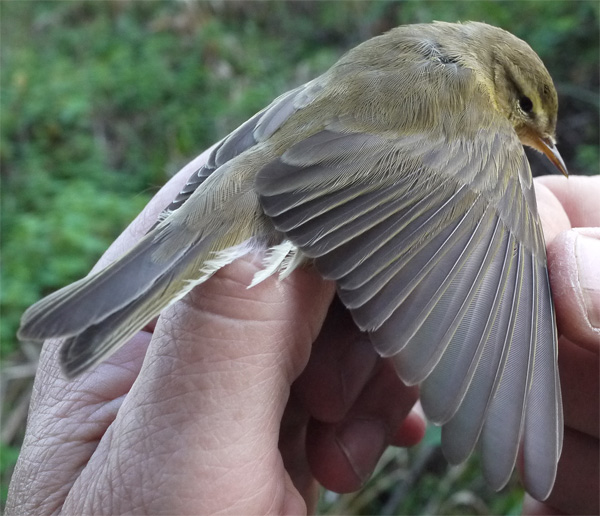
The first bird was somewhat of a surprise in the form of an unseasonably late Willow Warbler. It has been over a month since we last caught one but there was no mistaking its identity.

Juvenile Willow Warbler - October 2011

However given the late date of this bird we checked and double checked its identity, but it was just a Willow Warbler! Its wing measured 67mm, it was emarginated on only the 3rd, 4th and 5th primaries, and its wing point was formed by the 3rd and 4th primaries...this may well prove to be the last Willow Warbler record from Hampshire this year!


Juvenile Willow Warbler Showing Wing Formula

Other species captured included the usual Blackcaps and Robins, whilst Chiffchaffs continued to smash the previous annual total for the species, and by the end of today we have ringed 797 birds. Our previous highest total was recorded in 2000, when 449 birds were captured. Our annual total for Kingfishers stands at four, and today we recaptured one of those birds.


Juvenile Kingfisher

Cetti's Warbler numbers continued to struggle after two harsh winters, and the new bird captured today brought our total for the year to 25, 71 birds down on our record total....

Cetti's Warbler, Titchfield Haven October 2011

.....and a lone Treecreeper was only our second of the year and one of only 39 birds ringed at the site since 1973.

Treecreeper, Titchfield Haven October 2011

By the end of the session we had captured and ringed just short of 70 birds, a very respectable total given the time of year. 

Being the holder of a Natural England European Protected Species licence in respect to dormice, I offered to help out with ongoing survey work for the species, whilst training staff at the Haven. And so after finishing our ringing session we set about checking the dormouse boxes. Our first boxes were situated around out ringing site, and the first four boxes produced three nests, one of which had four animals, an adult female and three youngsters, in it.......instant success!!

Hazel Dormouse, Titchfield Haven 2011

We have found the species in the ringing area before, but were pleasantly surprised by the presence of four animals in one box.

Hazel Dormouse, Hampshire - October 2011

We then continued onto the next site, which is still managed by the same Hampshire County Council team. Last year we found several dormouse nests but no actual animals. This year however things were very different.......out of 30 boxes we found a total of five dormice in three different boxes...

Two Hazel Dormice, Hampshire 2011

                               ...... and five other boxes with nests indicating that the boxes had been used by dormice. So all in all a cracking day, and our best ever total of dormice at both sites, maybe they have had a good year too!!!!
Related Posts Plugin for WordPress, Blogger...