Showing posts with label Dunlin. Show all posts

Monday, 29 December 2014

Ice Cold in Hampshire

If the weatherman is to be believed, and I have no reason to doubt him, last night was the coldest night of the year. The sub-zero temperature had produced a heavy frost and I was unable to get the solid ice out of the bird baths, and so had to fill up some saucers with water and place them around the garden. 

It was frozen at Titchfield Haven too, the first time I think I have seen that this year, and the waders and gulls were roosting on the ice at the southern  end of the River Meon. However, it was not the roosting gulls that drew my attention, but the waders feeding on the intertidal. In the 35+ years that I have been visiting Hill Head, things have changed, the intertidal area has become more sandy, and this in turn has attracted small flocks of Sanderling. The numbers remain fairly small, this morning I counted only nine birds, that were feeding with a single Dunlin and a handful of Ringed Plovers. Because the beach is well used for recreation at low tide the birds are generally quite approachable, and these were no exception.

Sanderling - Hill Head
Dunlin - Hill Head

I spent a good half an hour with the Sanderling, despite having only seen, and photographed them recently at Southsea, and then moved on around the foreshore. There wasn't much of note to report, Oystercatchers were common, as were Ringed Plovers and Turnstones, but other than the Sanderlings, Dunlin and single Grey Plover and Redshank, there wasn't much else.

Black-tailed Godwits - Titchfield Haven

Before heading off I had a quick scan over the frozen river, there were mainly Black-headed, but also Common and Herring Gulls. Four Black-tailed Godwits were also present, but they must of got cold feet and flew up the valley. A cheeky Fox was soaking up the sun on a south facing slope. It was clearly visible from the roadside viewing area and seemed unperturbed by my presence, although it did occasionally have a quick peak to see who was watching it.

Fox - Titchfield Haven

After my visit to the Haven I headed up to a site in East Hampshire where there was meant to be a Red Kite roost. Apparently up to 40 birds have previously been recorded there but recently it has numbered around the low 20's. It was still bitterly cold but the clear sky meant the light was excellent. I parked up on the corner of a farm track and almost immediately three Red Kites drifted over. Several Common Buzzards were also milling around, at one point I counted seven, but there was most likely more.


Red Kite - East Hampshire

As I waited for more kites to show I was entertained by a couple of Robins, who were being typically territorial, and several Brown Hares that were showing occasional signs of their March madness.

Robin - East Hampshire
Brown Hare - East Hampshire

There were several Red Kites coming into the roost by now but most of them were distant, which was a bit disappointing, the local Buzzards were coming much closer and enabled me to get the odd photo. The kites were generally just flying leisurely towards the roost and perching up, but just when I though that they had settled down, they would all take flight and chase each other briefly before settling back down.

Common Buzzard - East Hampshire
Red Kites - East Hampshire
Roosting Red Kites - East Hampshire

As the light, and the temperature dropped the kites settled down, and so did the level of bird activity, although a male Pied Wagtail continued to feed on the frozen farm pond. It seemed to be a very unlikely place to be feeding, when the farm yard appeared to have much more to offer, but it was actively picking up little morsels from the surface. Eventually it too flew off to roost, but as it did the moon put on a spectacular show.

Skating Pied Wagtail - East Hampshire
The Moon

Friday, 28 November 2014

Bunny Meadows Revisited...Again - November 2014

Having been confined to the office for most of the week, it was nice to be out in the fresh air again today. I must apologise if there is a feeling of deja vu with this post, but as the tide was rising when I ventured out, I headed down to Bunny Meadows again. It was about two hours off high tide when I arrived so there was still some intertidal visible, and wading birds were starting to accumulate on and around the small islands. However, it was not a wader that first caught my eye but a tern, a Sandwich Tern. Occasionally this species does winter in Hampshire, particularly in Langstone Harbour and around Hayling Island. Time will tell whether this bird stays for the winter, or was just a late migrant.

Sandwich Tern - Bunny Meadows

With the tide pushing up I was able to get some nice views of the hundreds of birds present and continue to test out my new camera. Dunlin was by far the most numerous species with over 600 birds present, Grey Plover next with 35. Four of the Grey Plovers were colour-ringed, probably by Pete Potts, so will hopefully be able to let you know the details soon. It was interesting to note that all four of the colour-ringed birds used the same staging point, before moving onto the main roost; presumably they feel like they all have something in common.


Grey Plovers - Bunny Meadows

The other wader species present were Eurasian Curlew (5), Common Ringed Plover (3), Oystercatcher (3), Common Redshank (9) and one Red Knot


Common Redshank - Bunny Meadows

The Eurasian Wigeon has to be amongst my favourite ducks and there were just shy of 50 birds on the marsh. Disturbance levels were much lower at Bunny Meadows during this visit and the wigeon were much more chilled out. As well as the wigeon, around 30 each, Eurasian Teal and Dark-bellied Brent Geese were also present.

Eurasian Wigeon - Bunny Meadows

Several Ruddy Turnstones were doing what they do, turning stones and chattering away to each other. One of these birds was also colour-ringed, again probably a bird ringed by Pete Potts. I have recorded a colour-ringed turnstone here before, but this bird was not that bird, so once again will let you know the info when I find out.

Ruddy Turnstone - Bunny Meadows

As the tide continued to rise the Dunlin started to move around in tight flocks seeking out the last remaining patches of mud. Although there were only 600 birds it is always a pretty spectacular sight to see flocks of waders wheeling around.


Dunlin - Bunny Meadows

Once the waders had settled down to roost I started to head back to the car. A Great Cormorant had settled on one of the rails, using the late afternoon sun to dry its wings, and I took advantage of the the tame Black-headed Gulls to further test out my new camera.

Cormorant - Bunny Meadows
Black-headed Gull - Bunny Meadows

Friday, 14 November 2014

Calshot Marshes and Spit - November 2014

This morning I headed to Calshot Marshes and spit with Simon Colenutt in the hope of seeing the Snow Bunting that had been frequenting the area for a few days. It had not been seen since Wednesday, but we decided to go and have a look just in case. Heavy overnight rain delayed our start, but by the time we arrived on site it had cleared through and sun was breaking out. We spent a couple of hours pottering around the area but unfortunately had no luck with the Snow Bunting, there were however plenty of birds around to keep us occupied. 

Several Rock Pipits were feeding around the puddles on the access road, one individual was particularly tame and allowed me to get close enough for some half decent images. A flock of around 20 Greenfinches were feeding on the beach, these were proving pretty flighty and wouldn't settle down. Off shore there were several Cormorants, Great-crested Grebes and a Grey Seal, which was a bit of a surprise.

Rock Pipit, Calshot - November 2014

A good selection of waders were on the marsh including, Dunlin, Redshank, Black-tailed Godwit, Grey Plover, Turnstone, Ringed Plover, Curlew and Oystercatcher.

Two Dunlin, Calshot - November 2014

The tide was going out and in the shallow channels several Little Egrets were feeding, at least six were present. Their energetic feeding style was entertaining to watch and in the glorious sun we spent a few minutes watching and photographing them.

Little Egret, Calshot Marshes - November 2014
Little Egret and Dunlin, Calshot Marshes - November 2014

Fifteen Black-headed Gulls were roosting on the exposed mud, two of them were ringed with metal rings. One bird flew off and we were unable to get the ring number, the other one frustrated us by only allowing us to read half of the ring numbers before it too flew off. Whilst trying to read the ring number on the Black-head an adult Mediterranean Gull dropped in. It settled down and meticulously preened, spending an amazingly long amount of time on its primaries.

Adult Mediterranean Gull preening, Calshot Marsh - November 2014

It never ceases to amaze me how these pure white gulls keep their feathers so clean, especially when they spend much of their time in such dirty environments, this bird looked immaculate when it had finished.

Adult Mediterranean Gull, Calshot Marshes - November 2014

After Calshot we headed to Lepe where we spent most of our time in the small copse and looking over the Dark Water. There was very little of note to report, the highlight being a Firecrest, and couple of Bullfinches and a Coal Tit.

Friday, 22 August 2014

Bunny Meadows and Curbridge - August 2014

The autumn migration is in full swing now and as I had a day off I decided to spend at least parts of the day birding a few local sites in the hope of finding some migrants. I started at Bunny Meadows around mid morning to coincide with the high tide, as this is usually a good site for waders. As I arrived it was just off high tide and a few waders and gulls were taking advantage of the last remaining areas of intertidal, whereas others were already roosting on the vegetated Islands.

Black-headed Gull - Bunny Meadows

Black-headed Gulls were the most numerous gull species with 104 present, Great Black-backed (3) and Herring (7) were also present but only in small numbers. At this time of year the islands are well vegetated and some waders were making the most of this cover, whilst others roosted on patches of bare mud. Black-tailed Godwits were the most numerous wader species present with at least 148 birds present.

Black-tailed Godwits - Bunny Meadows

Most of the godwits present were adults and moulting into their winter plumage but there were also a few juveniles present too. 

Black-tailed Godwits - Juvenile in middle and adults

As well as the godwits there was also a good selection of other waders present. Curlew (2), Redshank (5), Dunlin (1), Turnstone (1), Ringed Plover (24) and a Whimbrel were the species that I found, but some were difficult to identify in the tall vegetation.


Two Ringed Plover and Dunlin - Bunny Meadows 
Whimbrel - Bunny Meadows

I continued past the islands to the remains of the old causeway, another good bird roosting location. There were good numbers of waders here too, with Redshank (60), Black-tailed Godwit (2), Greenshank (2), Oystercatcher (5), Lapwing (5) and Grey Plover (5) present. Two of the Grey Plovers were adults and three were juveniles, one of the adults had colour rings on its legs, and eventually it put both legs down so I could get the combination. The bird was ringed at Hamble Point by Farlington Ringing Group in January 2009, the subsequent sightings are provided below the image.

Grey Plovers - Both adults, with one bird colour-ringed (see inset) - Bunny Meadows

First Ringed        02-Jan-09 Hamble Point, Southampton Water, Hampshire, S England
Resighted           26-Dec-11 Bunny Meadows, Warsash, River Hamble, Hampshire, S England
Resighted           27-Dec-11 Bunny Meadows, Warsash, River Hamble, Hampshire, S England
Resighted           18-Nov-12 Bunny Meadows, Warsash, River Hamble, Hampshire, S England
Resighted           18-Nov-12 River Hamble, Hampshire, S England
Resighted           16-Sep-13 Hook Links scrape, Hook-with-Warsash, Southampton Water, Hampshire, S England
Resighted           04-Feb-14 Bunny Meadows, Warsash, River Hamble, Hampshire, S England
Resighted           22-Aug-14 Bunny Meadows, Warsash, River Hamble, Hampshire, S England

With the tide now dropping fast my next stop was Curbridge, further up the Hamble Estuary. Curbridge has been good to me in recent weeks and today was no exception. I started at the Horse and Jockey pub entrance and immediately picked up three Common Sandpipers and a couple of Kingfishers. There were small numbers of Curlew (2) and Whimbrel (2) and a handful of Little Egrets (5). There were at least 600 gulls present on the intertidal, which is not unusual, but the fact that at least 287 of them were Mediterranean Gulls was astonishing. Flocks of several hundred post breeding Mediterranean Gulls often form on the arable fields around Titchfield Haven, but I have never seen this many at Curbridge before. One of the adult birds had a green colour ring on its left tarsus, but unfortunately it was too far away to see if any letters were on it.

Mediterranean Gulls, Adults and Juveniles and Black-headed Gulls - Curbridge

Thursday, 7 August 2014

Farlington Marshes - 7th August 2014

The tides weren't ideal but we decided to start this autumns wader ringing sessions anyway. The priority species, as last year, was Common Sandpiper. Any individuals captured were to be colour-ringed in the hope of learning a bit more about their migration patterns, and how they use the marsh. We arrived on site at around 18:30 and went out to set the nets straight away; we intended to put up five nets and on the scrape only. 

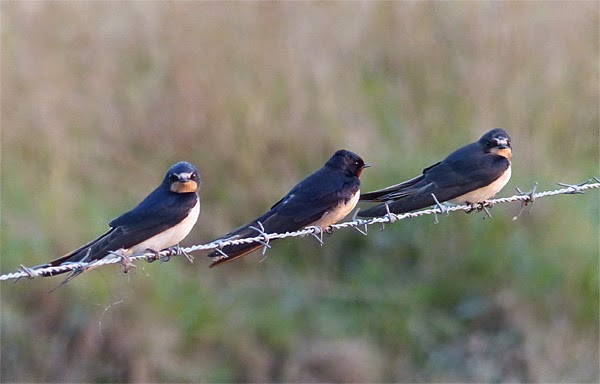
Once the nets were set it was a waiting game, so we took advantage and did a bit of birding. It was a bit of a breezy evening but there were plenty of Barn Swallows and Common Swifts around to keep us occupied. The swallows were feeding over the meadows and gathering around the reed bed in readiness for roosting.

Barn Swallows gathering in readiness to roost

Bearded Tits were very evident in the reed bed, constantly pinging as the flew back a forth across the reed bed. The stream was the best place for waders, with about 25 Black-tailed Godwits, 15 Northern Lapwing, five Common Sandpipers and a couple of Common Redshank and Common Teal.

Black-tailed Godwits, Common Teal and Mute Swans on the Stream

As the sun set over Portsmouth Harbour the wind began to drop and the tide neared its peak. The five Common Sandpipers on the stream began to call and circled around before heading out into the mid-marsh.

Sunset over Portsmouth Harbour

Our first net round produced two birds, and Dunlin and a Common Sandpiper, both of them juveniles. As I mentioned earlier the Common Sandpiper was a target species for us and was fitted with a combination of colour rings that would allow for the bird to be individually identified in the field.

Common Sandpiper with colour rings

This juvenile bird was aged due to the generally brown but extensively buff tips and dark subterminal bands to the upper parts, and the coverts, were brown and with very heavy dark brown and bright rufous-brown barring.

Juvenile plumage of Common Sandpiper showing extensive barring.

Our second and final round produced four birds, three Dunlin and a Common Redshank, all the birds were once again juveniles. This time last year we were commenting on how we were only catching adult birds, so it was a refreshing change to be catching juveniles.

Dunlin 

The chestnut fringes on the wing and body feathers age this bird as a juvenile. Some juvenile feathers will be retained through to the next summer so birds should still be able to be aged up to that point.

Juvenile Dunlin showing buff fringing to feathers

The upperparts and coverts of the Redshank were extensively fringed buff and warm brown, thereby ageing it as a juvenile. The bill was a dull reddish colour, darkening towards the tip again a juvenile feature.

Juvenile Common Redshank with obvious buff tips to plumage

Saturday, 16 November 2013

Another American Wader In Hampshire!

Whilst many hardcore British twitchers were heading north to Pembrokeshire in search of the probable Western Orphean Warbler, I headed west along the south coast of Hampshire to Lepe Country Park in search of yet another American Wader. This bird, a lesser yellowlegs, had been found on a brackish pool last Sunday, 10th November, but Friday 15th was the first chance I had to go.

I arrived at the site around 09:30 and headed off towards the scrape located to the east of the car park. I had been confused by the directions, since despite having lived in Hampshire all my life, I hadn't know of this scrapes existence, or if I had I'd forgotten about it, which is a distinct possibility. I was part way to the scrape when I met a couple of birders that I knew, they were off to look at another patch of water to the west of the car park and know as 'Dark Water' since the bird was not on the scrape.

I tagged along, since I figured three pairs of eyes searching would be better than one. Apparently the Dark Water river and marsh drains Beaulieu Heath, and reaches the sea via a tunnel and sluice gate. The river is flanked on either side by a large expanse of reed bed and wetland habitat, a large body of water and other scattered pools. Viewing is difficult as there are loads of areas where birds can loiter out of sight, but there are three main areas to try. The first is from the road, where birds are distant but identifiable, from the west from a footpath which crosses an adjacent field, and from the east, from a boardwalk that passes through a small area of woodland.

We started from the road and recorded common redshanks, black-tailed godwit, common snipe, wigeon, common teal, lapwings, black-headed and Mediterranean gulls...but no lesser legs! After a good hour and half of scanning from the road and the footpath to the west, I decided to head back east to check out the other pool. The tide was high and as I wandered back a noticed a small, mixed flock of waders on the beach. They were trying to roost right in front of the car park, but were being continually disturbed by dog walkers.

Roosting Dunlin Calidris alpina and lone Turnstone Arenaria interpres

There were about 100 birds in the flock, pretty much equally split between dunlin, turnstone and ringed plover. While the others headed back to the eastern scrape I spent a few minutes scanning through the flock.

Roosting Turnstone and lone Dunlin
Despite my best efforts there was nothing unusual in the flock, but it was nice to see a few juvenile birds in the flock. When I eventually got to the scrape there was still no sign of the lesser legs, but six Med gulls, a grey plover, a couple each of black-tailed godwit and redshank kept me entertained for a while. After about another half an hour I decided to wander again. There is a small patch of woodland that runs along the western bank of Dark Water. It consists of mainly broad-leaved species including oak, a small area of beech,  willow, yew and holm oak. The wood was fairly quiet, with a few goldcrests, coal tit, treecreeper and blue and great tit, but just as I was coming to the end of the trail, a couple of firecrests jumped out.

Lesser Yellowlegs Tringa flavips

Just as I got to the end of the woodland trail, new broke that the lesser legs had just flown back onto the scrape. I quickly headed back over and there it was, the closest bird to the shore. It was feeding along the south-western edge of the scrape, and with the sun behind me the bright yellow legs really stood out. 


Lesser Yellowlegs

In comparison with the nearby common redshank, the yellow legs had greyer upperparts, a shorter and finer bill, which was mainly dark, but slightly paler at the base. The bird also gave the impression of being daintier, more elongated and elegant than the redshanks.


Lesser Yellowlegs

The upperparts seem fairly plain, with faint spotting along the feather edges and therefore this bird looks like an adult to me, as juveniles are usually more distinctly marked. There have been several previous records of lesser yellowlegs in Hampshire, but the last one I saw was at Farlington Marshes in 1986. I have of course seen the species regularly on my many visits to America and Canada, but it's always nice to catch up with one on home turf.
Related Posts Plugin for WordPress, Blogger...