Showing posts with label Turnstone. Show all posts

Tuesday, 3 March 2015

La Palma, Canaries Islands - 21st - 28th February (Days 5 - 8)

Day 5 (25th Feb) - Birding took second fiddle today as we planned to walk to Santa Cruz and spend much of the day there. There were of course things to see on the way, but the most spectacular event was the enormous sea and the gigantic waves that were crashing ashore, and giving the island a real pounding. 

Crashing Waves - Santa Cruz, La Palma

Bird wise there were the usual species at the hotel, Blackbird, Collared Dove, Canary, Yellow-legged Gull, Sardinian Warbler, and of course the abundant Canary Island Chiffchaff. The same species were recorded throughout the day, with chiffchaffs even common in the city centre. Other species recorded were Red-billed Chough (5), Kestrel (3) and Turnstone (2). The day was somewhat soured by news of a drake Surf Scoter, back in my home County (Hampshire, England), a county tick for me, but never mind, there will be another. A couple of hours sea-watching from the apartment proved successful with 152 Cory’s and 31 Manxie’s past in 45 minutes.

Day 6 (26th Feb) - It was another dull and dreary day around Los Cancajos and so we decided to head inland to the National Park of Caldera de Taburiente. But before heading off we were treated to two new species for the trip, both fly-by’s; Little Egret and Sparrowhawk. The other regular species were of course also still present, although a scan out to sea produced only Yellow-legged Gulls.

We set off to the sight of the volcano at Caldera de Taburiente shrouded in cloud and as we headed up the mountain-side the temperature dropped from 18 on the coast to only 9 centigrade. We had wrapped up warm expecting the worst but as we exited the tunnel we were greeted to full sun and a very acceptable 26 centigrade.....which we weren't dressed for. We arrived at the visitors centre and enquired about taking our car to the viewing area at La Cumbrecita. It was a 2.5 hour wait so we booked in and headed off to El Paso and beyond for some birding. 

West Canaries Lizard (male) - El Paso

After a bit of exploring we eventually found ourselves heading south on the LP-212 towards San Nicolas de Abajo. Approximately a kilometre out of the village we pulled over and took a path which was signposted Coladas de San Juan (PR - LP14-1). This was a steep unmade path next to an old larva flow, that was full of Western Canaries Lizards, well actually, every where we stopped was! As we set off a flock of over 50 Red-billed Choughs took flight in the distance, and circled overhead. At least five Kestrels were also present, along with Canaries and Chiffchaffs. I followed the track for about a kilometre into some pines and picked up a couple of Barbary Partridges, and as I turned to head back to the car a flock of at least 30 Plain Swifts passed over. There were also at least three species of butterfly present here, Small White, Canary Speckled Wood and a blue that would just not settle.

With time now ticking on we headed back to the Information Centre in readiness for our slot to drive to the viewpoint. The car park at the centre was full lizards, including some cracking males with full blue throats; whilst watching them a Grey Wagtail briefly landed on the roof of the information centre. The drive to La Cumbrecita was uneventful, in fact I don’t recall seeing a single bird, but that is probably because I was concentrating on the road which was narrow and winding. We arrived at the car park and were greeted by two Berthelot’s Pipits, the first of the trip, and a Chaffinch. A few Chough’s were calling in the distance and a couple of Ravens circled overhead.

Berthalot's Pipit - La Cumbrecita

Back at our resort I finished the day with another scan out to sea, this time just a brief one, which resulted in 19 Cory’s and six Manxie’s.

Day 7 (27th Feb) - We awoke to dull, dreary and wet weather this morning which was brightened slightly by the appearance of a single House Martin. With the weather looking so grim we decided to go back over the mountain to El Paso in the hope that it was sunny. I was also keen to catch up with Tenerife Goldcrest, which despite being reported as common in pine woodlands I was yet to connect with on this trip. The trip up the mountain was wet and even when we emerged the other side, it was still shrouded in cloud. Back at the information centre though it was sunny, but very windy. We headed down the road to La Cumbrecita, but stopped in the first area of pine forest past the crossroads. Several Chaffinch’s, Chiffchaffs and three Kestrels were present, but no Goldcrests. Two Red-billed Chough’s and a Raven drifted over at one point, but there was nothing else to report.

Our next stop was the town of Tazacorte, primarily for a coffee, but also because we had not been there before. We found a small square near the centre where we ordered our coffee and enjoyed the 27 centigrade temperature. According to a couple of locals, the west coast is usually warmer as the mountain holds back the bad weather, so if it is sun you want El Paso or Tazacorte may be the places for you. The only birds of note were a Grey Wagtail, and a Blackcap, both the second of the trip.

After Tazacorte, we decided to travel down the west coast of the island along the LP - 2 and re-visit the salt pans at Fuencaliente. It was a long and winding road and we stopped several times en route where the habitat looked good for Goldcrests. Several Canary’s, Chough’s, Chaffinch’s, Kestrels and a couple of Buzzards were seen, but the most notable species was a flock of 30+ Plain Swifts, but once again no Goldcrests.

Plain Swift - Mirador de Charo on LP-2
Plain Swift - Mirador de Charo on LP-2

It was so windy at Faro de Fuencaliente and so any sensible passerine would have been keeping low. A few waders were once again present, but the same species as my last visit; Sanderling (1), Turnstone (15) and Ringed Plover (1), there were also several Yellow-legged Gulls loitering.

Ringed Plover - Salt Pans at Fuencaliente
Turnstone - Salt Pans at Fuencaliente

We were back at Los Cancajos for 6pm and so I decided to have another scan of the sea, since it was my last night. I scanned for 1.5 hours and recorded 342 Cory’s Shearwaters, 43 Manx Shearwater and 10 Northern Gannets.

Day 8 (28th Feb) - Our final day so we decided to spend the time walking around the Los Cancajos resort. We headed south out of the resort, then north along the footpath beside the main LP-2, before heading back down into the town. Before starting, a scan out to sea produced around 20 Cory’s Shearwaters, all heading south this time and the usual Yellow-legged Gulls. The typical species were once again present around the resort with Canary Island Chiffchaff the most obvious and Canary and Sardinian Warbler also present. 
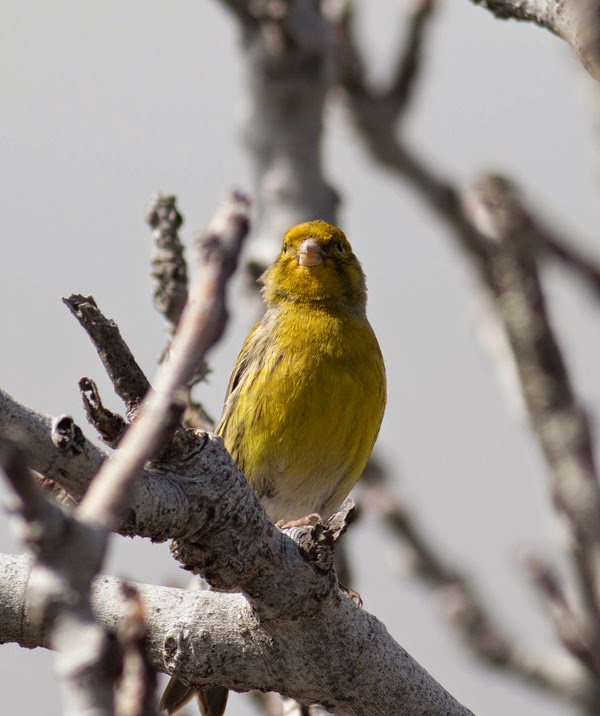
Canary - Los Cancajos

We stopped off at a small banana plantation where a female Blackcap showed briefly, and then headed back to the coast. The most notable species was Grey Heron, with a flock of eight heading south, followed by a single bird about 10 minutes later. A male Blackcap was singing in the hotel grounds just as we were leaving, and a final look out to sea produced another handful of Cory’s Shearwaters.

Grey Heron (5 of the flock of 8) - Los Cancajos

By the end of the trip we had recorded 33 species, including most of the target species, but the notable exception being Tenerife Goldcrest. Some species that had been reported as common, such as Berthelot’s Pipit I found decidedly scarce, whereas others, Red-billed Chough appeared to be everywhere. To make my trip complete, I returned back to Hampshire to find that the drake Surf Scoter was still present, so an early morning start on Sunday 1st March and it was on my Hampshire list!

Species List and Locations

Birds

Barbary Partridge - 2 (26/2 - San Nicolas de Abajo at PR LP14.1)

Cory’s Shearwater - 100+ from Hotel, Los Cancajos 22/2, 30 - 23/2, 2 - 24/4 (in morning), 152 - 25/2 (45 mins), 19 - 26/2 (10 mins), 342 - 27/2 (1.5 hrs)

Manx Shearwater - 30+ (22/2 Los Cancajos), 2 - 23/2, 31 - 25/2, 43 - 27/2

Northern Gannet - 10 (27/2 Los Cancajos)

Grey Heron - 9 (28/2 Los Cancajos)

Little Egret - 1 (26/2 Los Cancajos)

Buzzard - 2 (24/2) Los Tilos

Sparrowhawk - 1 (26/2 Los Cancajos)

Kestrel - Seen daily

Ringed Plover - 3 (23/2), 1 (27/2) Salt pans at Punta Fuencaliente

Sanderling - 1 (23/2), 1 (27/) Salt pans at Punta Fuencaliente

Turnstone - 12 (23/2), 15 (27/2) Salt pans at Punta Fuencaliente, 2 (25/2) Los Cancajos

Lesser Black-backed Gull - 5 (24/2) Laguna de Barlovento

Yellow-legged Gull - Common

Rock Dove/Feral Pigeon - Common

Bolle’s Pigeon - 7 (24/2) Los Tilos

Laurel Pigeon - 20+ (24/2) Los Tilos

Collared Dove - Common

Plain Swift - 30+ (26/2 - San Nicolas de Abajo at PR LP14.1), 30+ (27/2 Lp - 2 Mirador el Charo)

House Martin - 1 (27/2 - Los Cancajos)

Berthelot’s Pipit - 2 (26/2 - La Cumbrecita)

White Wagtail - Los Cancajos (22/2)

Grey Wagtail - 1 (26/2 Centro de Visitantes del Parque National Caldera de Taburiente), 1 - 27/2 Tatacorte

Blackbird - seen daily

Sardinian Warbler - seen daily

Blackcap - 3 (22/2, 2 on 28/2) Los Cancajos, 1 (27/2 Tazacorte)

Canary Islands Chiffchaff - Common

Blue Tit (la Palma) - 10+ (24/2 Los Tilos), 2 (26/2 La Cumbrecita)

Red-billed Chough - Seen daily - 50 (23/2) Los Canarios, 50+ (26/2 - San Nicolas de Abajo at PR LP14.1)

Raven - 1 (24/2 Los Tilos), 2 (26/2 La Cumbrecita), 1 (27/2  information centre near El Paso)

Chaffinch (La Palma) - 30+ (24/2 Los Tilos), 2 (26/2 La Cumbrecita), several by information centre near El Paso

Serin - 2 (23/2) San Antonio Volcano area

Canary - Los Cancajos, San Anotino Volcano area, 50+ Laguna de Barlovento (24/2) generally common

Butterflies/moths

Red Admiral - 2 (22/2 Los Cancajos Information centre), 2 - (27/2 - El Paso)

Small White - 1 (24/2 Laguna de Barlovento), 2 (26/2 - San Nicolas de Abajo at PR LP14.1), 2 (27/2 - Tazacorte)

Monarch - 1 (25/2, 28/2 Los Cancajos)

Canary Islands Speckled Wood - 1 (26/2 - San Nicolas de Abajo at PR LP14.1)

Canary Islands Brimstone - 1 (23/2)

Reptiles

Western Canaries Lizard (Gallotia Galloti palmae) - Common everywhere

Other Bits

Mottled Shore Crab (Grapsus grapsus) - common on coast

Saturday, 6 December 2014

Colour Ring Sightings Update

You can tell from my lack of posting this week that I have not been out in the field, although I did manage a couple of 30 minute ringing sessions in the garden at work. The result was four birds, a Blue Tit, retrap Nuthatch and Robin on Wednesday 3rd and a Firecrest on Friday 5th December. The Firecrest is the 5th I have ringed so far this year, hopefully there will be a few more yet.

I did hear back from Pete Potts regarding the colour ringed Grey Plovers and Turnstone that I had seen at Bunny Meadows on 28th November. As suspected all of the birds were ringed by Pete, and one of them, DD51882, I had seen back on 22nd August, also at Bunny Meadows. The details of each bird are provided below.


Friday, 28 November 2014

Bunny Meadows Revisited...Again - November 2014

Having been confined to the office for most of the week, it was nice to be out in the fresh air again today. I must apologise if there is a feeling of deja vu with this post, but as the tide was rising when I ventured out, I headed down to Bunny Meadows again. It was about two hours off high tide when I arrived so there was still some intertidal visible, and wading birds were starting to accumulate on and around the small islands. However, it was not a wader that first caught my eye but a tern, a Sandwich Tern. Occasionally this species does winter in Hampshire, particularly in Langstone Harbour and around Hayling Island. Time will tell whether this bird stays for the winter, or was just a late migrant.

Sandwich Tern - Bunny Meadows

With the tide pushing up I was able to get some nice views of the hundreds of birds present and continue to test out my new camera. Dunlin was by far the most numerous species with over 600 birds present, Grey Plover next with 35. Four of the Grey Plovers were colour-ringed, probably by Pete Potts, so will hopefully be able to let you know the details soon. It was interesting to note that all four of the colour-ringed birds used the same staging point, before moving onto the main roost; presumably they feel like they all have something in common.


Grey Plovers - Bunny Meadows

The other wader species present were Eurasian Curlew (5), Common Ringed Plover (3), Oystercatcher (3), Common Redshank (9) and one Red Knot


Common Redshank - Bunny Meadows

The Eurasian Wigeon has to be amongst my favourite ducks and there were just shy of 50 birds on the marsh. Disturbance levels were much lower at Bunny Meadows during this visit and the wigeon were much more chilled out. As well as the wigeon, around 30 each, Eurasian Teal and Dark-bellied Brent Geese were also present.

Eurasian Wigeon - Bunny Meadows

Several Ruddy Turnstones were doing what they do, turning stones and chattering away to each other. One of these birds was also colour-ringed, again probably a bird ringed by Pete Potts. I have recorded a colour-ringed turnstone here before, but this bird was not that bird, so once again will let you know the info when I find out.

Ruddy Turnstone - Bunny Meadows

As the tide continued to rise the Dunlin started to move around in tight flocks seeking out the last remaining patches of mud. Although there were only 600 birds it is always a pretty spectacular sight to see flocks of waders wheeling around.


Dunlin - Bunny Meadows

Once the waders had settled down to roost I started to head back to the car. A Great Cormorant had settled on one of the rails, using the late afternoon sun to dry its wings, and I took advantage of the the tame Black-headed Gulls to further test out my new camera.

Cormorant - Bunny Meadows
Black-headed Gull - Bunny Meadows

Saturday, 22 November 2014

Golden Plovers at Bunny Meadows - November 2014

The weather forecast for this weekend was for rain, rain and more rain and so I didn’t make any arrangements for ringing on Saturday, instead I thought I would venture out and play with my new Canon 7D MK2. My initial plan was to go to Blashford Lakes, but I ended up staying local, birding at Bunny Meadows before heading down to the sea front at Hillhead.

It was a dull and overcast day with light drizzle, and so not ideal light conditions for trying out your new camera, but at least it wasn’t the predicted heavy rain. The tide was high so I headed down to the old wooden jetty, the best place for roosting birds. There was a good selection of wetland birds present, with a scattering along the main causeway en-route to the causeway. Eurasian Wigeon, Eurasian Teal, Mallard and Dark-bellied Brent Geese were present in small numbers and a lone Little Egret fed on the tide line. A single roosting Eurasian Curlew was the only wader present along the main causeway.

The wader roost at the old jetty was as expected with a fine selection of waders present. The totals included over 400 Dunlin, nine Greenshank, 38 Grey Plover, 32 Redshank, 16 Black-tailed Godwit, four Grey Plover and 10 Golden Plover. The Golden Plovers were roosting on the end of the small spit on the main causeway side, making them very susceptible to disturbance, but at the same time very close. They were nestled down in the vegetation and therefore could not be easily seen, in fact I only picked them up because a slight movement caught my eye.

Golden Plovers - Bunny Meadows
Golden Plovers hidden amongst Sea Purslane - their gold spangled plumage providing the perfect camouflage

Unfortunately, disturbance levels on this stretch of the Hamble estuary are very high and today was no exception, despite the bad weather. Numerous dogs were running out of control off the lead, as were many children, although admittedly they are not normally kept on a lead. I spent a good 30 minutes with the goldies but as I was watching them, a man with three children came along the causeway. The children immediately began throwing sticks and stones into the water near me and shouting loudly and I had to bite my tongue so I didn't tell them to shut up. The commotion unsettled the goldies and they moved from the shelter of the vegetation to the water’s edge, whilst I scowled with disapproval. The man eventually told them to be quiet but they paid little attention, fortunately they gradually moved off, allowing the goldies to settle back down.

Golden Plovers, Bunny Meadows
Golden Plover, Bunny Meadows
Golden Plover, Bunny Meadows - This shot was digiscoped with my Panasonic Lumix GF2 and Swarovski scope. I enjoyed photographing these birds so much that I thought I would make the most of it.

After Bunny Meadows, I headed to Hillhead; I didn’t go into the Haven but spent my time scanning offshore. There was nothing of note out there but in the harbour the Turnstones were feeding on the tideline and roosting on the groynes. A further opportunity to test out my new camera, so I took it.

Ruddy Turnstone, Hillhead

Saturday, 16 November 2013

Another American Wader In Hampshire!

Whilst many hardcore British twitchers were heading north to Pembrokeshire in search of the probable Western Orphean Warbler, I headed west along the south coast of Hampshire to Lepe Country Park in search of yet another American Wader. This bird, a lesser yellowlegs, had been found on a brackish pool last Sunday, 10th November, but Friday 15th was the first chance I had to go.

I arrived at the site around 09:30 and headed off towards the scrape located to the east of the car park. I had been confused by the directions, since despite having lived in Hampshire all my life, I hadn't know of this scrapes existence, or if I had I'd forgotten about it, which is a distinct possibility. I was part way to the scrape when I met a couple of birders that I knew, they were off to look at another patch of water to the west of the car park and know as 'Dark Water' since the bird was not on the scrape.

I tagged along, since I figured three pairs of eyes searching would be better than one. Apparently the Dark Water river and marsh drains Beaulieu Heath, and reaches the sea via a tunnel and sluice gate. The river is flanked on either side by a large expanse of reed bed and wetland habitat, a large body of water and other scattered pools. Viewing is difficult as there are loads of areas where birds can loiter out of sight, but there are three main areas to try. The first is from the road, where birds are distant but identifiable, from the west from a footpath which crosses an adjacent field, and from the east, from a boardwalk that passes through a small area of woodland.

We started from the road and recorded common redshanks, black-tailed godwit, common snipe, wigeon, common teal, lapwings, black-headed and Mediterranean gulls...but no lesser legs! After a good hour and half of scanning from the road and the footpath to the west, I decided to head back east to check out the other pool. The tide was high and as I wandered back a noticed a small, mixed flock of waders on the beach. They were trying to roost right in front of the car park, but were being continually disturbed by dog walkers.

Roosting Dunlin Calidris alpina and lone Turnstone Arenaria interpres

There were about 100 birds in the flock, pretty much equally split between dunlin, turnstone and ringed plover. While the others headed back to the eastern scrape I spent a few minutes scanning through the flock.

Roosting Turnstone and lone Dunlin
Despite my best efforts there was nothing unusual in the flock, but it was nice to see a few juvenile birds in the flock. When I eventually got to the scrape there was still no sign of the lesser legs, but six Med gulls, a grey plover, a couple each of black-tailed godwit and redshank kept me entertained for a while. After about another half an hour I decided to wander again. There is a small patch of woodland that runs along the western bank of Dark Water. It consists of mainly broad-leaved species including oak, a small area of beech,  willow, yew and holm oak. The wood was fairly quiet, with a few goldcrests, coal tit, treecreeper and blue and great tit, but just as I was coming to the end of the trail, a couple of firecrests jumped out.

Lesser Yellowlegs Tringa flavips

Just as I got to the end of the woodland trail, new broke that the lesser legs had just flown back onto the scrape. I quickly headed back over and there it was, the closest bird to the shore. It was feeding along the south-western edge of the scrape, and with the sun behind me the bright yellow legs really stood out. 


Lesser Yellowlegs

In comparison with the nearby common redshank, the yellow legs had greyer upperparts, a shorter and finer bill, which was mainly dark, but slightly paler at the base. The bird also gave the impression of being daintier, more elongated and elegant than the redshanks.


Lesser Yellowlegs

The upperparts seem fairly plain, with faint spotting along the feather edges and therefore this bird looks like an adult to me, as juveniles are usually more distinctly marked. There have been several previous records of lesser yellowlegs in Hampshire, but the last one I saw was at Farlington Marshes in 1986. I have of course seen the species regularly on my many visits to America and Canada, but it's always nice to catch up with one on home turf.

Thursday, 2 August 2012

Bunny Meadows - 29th July 2012

There was no bird ringing for me today, partly because I was just too tired, and partly because I would have been the only one there, so potentially a lot of effort for little return, well based on the last few sessions anyway. Instead I opted for a 7am start and a stroll along Bunny Meadows on the rising tide. There have been a few good autumn waders in the west of the county at Pennington Marshes, so I was hopeful that it would be my turn to find one.

The tide was already pretty high when I arrived and the Turnstones had been pushed up close to the sea wall, so I was able to get excellent views of them doing what they do best....turning stones.

Turnstone - Bunny Meadows

In all there were 32 just scattered along the foreshore, they were so confiding that I was able to spend a bit of time photographing them and enjoying their incessive chitter chatter as the bickered over a tasty morsel. It was interesting to see that whilst some birds were busy turning stones, another standing nearby would pretend to be doing the same, but as a grub was exposed it would run in a snatch it from beneath the others stone....very sneaky!

Turnstone - Bunny Meadows


Last time I was here there were good numbers of waders present, despite it being very early in the season, and this visit was the same. In total I counted 45 Common Redshank, three Greenshank, 14 Eurasian Curlew, 11 Whimbrel, two Grey Plover, seven Lapwing and a single Dunlin. Black-tailed Godwits were again present in good numbers, with at least 43 present, but it was difficult to count this species as some were nestled right down in the tussocks.


Black-tailed Godwits

I would normally expect to see a few colour-ringed birds amoung the scattered groups, but unfortunately this time there were none, which was a shame, but I will keep looking. Three birds were roosting on the edge of a sea locked island, and although they were over 50 metres away they were very wary, and kept a close eye on my movements.

Black-tailed Godwits

Black-headed Gulls were the most numerous species, with 147 roosting on the islands, along with single first summer Mediterranean Gull and Common Tern, and as I was counting the gulls an adult sandwich tern flew by.

Black-headed Gulls and Common Tern

Continuing on I soon came across a pair of Oystercatchers, who were incredibly wary and constantly 'Kleeping' at me, I assumed it was because I was paying them an un-necessarily high amount of attention because they were both wearing colour rings.....but as it turned out that was not the case.

Colour-ringed Oystercatcher - Bunny Meadows

I think I have seen both of these birds before, but on looking through my records I could not find any detail, so I will contact the person who ringed them and let you know when I find out, although I suspect they were ringed at either Hamble Point or Cracknore Hard, but we will see.

Colour-ringed Oystercatcher - Bunny Meadows

Anyway, going back to why these birds were so alarmed was suddenly evident. My attention was so focused on making sure I had got the right colour combinations, that I hadn't noticed the fluffy little brown chick, gingerly wandering around on the top of the tiny island.

Newly Hatched Oystercatcher
I must admit I am not really sure how late Oystercatchers normally breed, but I presume this is a new attempt after a failiure, rather than a second brood. This chick was on a tiny island very close to the shore and I could have easily walked out and picked it up, so it is going to be extremely vulnerable to both predators and an out of control dog!...I will try and keep you posted on its progress.

Friday, 23 December 2011

Colour Ringed Turnstone - Bunny Meadows

Popped down to Bunny Meadows again the other day with the optimistic hope of catching some Turnstone with spring traps. Unfortunately, I had misjudged the height of the tide and most of the birds had already gone to roost. We did find one bird that was very confiding, which on closer inspection turned out to be colour ringed, so no point in catching this one!

Colour Ringed Turnstone

I contacted a mate who I know has colour ringed Turnstone in the past and it was indeed one of his birds. The bird was originally ringed at Weston Shore in Southampton on 15th March 2008,   3 years and 9 months previously. When captured it was aged as an adult so we will never know this birds true age, but it was nice to see that it was still wintering on Southampton Water, albeit 6 kilometres downstream. It would be nice to get some summer sightings to see where this bird is breeding.

Saturday, 5 February 2011

Norfolk - In Search of Winter Birds - 28th - 31st January 2011

Winter visits to Norfolk in search of birds has been a feature of January for many years now, and each time four mates and I get the chance to catch up, eat some good food, drink whiskey and wine and spend a few days birding. Because most of us come from the south coast, we start our weekend at a convenient meeting point enroute to the north Norfolk coast. This year was no different and we began our trip with a visit to the RSPB reserve of Lakenheath Fen.


Lakenheath Fen has been a good starting point for us in the past as we have seen bittern, common crane and great grey shrike, but the highlight must be the penduline tit that we found in 2009.

Penduline Tit Lakenheath Fen 26th January 2009 


This year the reserve seemed fairly quiet except for a selection of tits and finches on the feeders, including brambling and lesser redpoll. A stroll around the reserve produced the usual marsh harriers, little egret and a couple of Egyptian geese and then we heard common cranes calling. We usually hear them during our visits, but despite their large size, they can be a difficult species to locate. This time though, five birds were present, a pair with their offspring of last year and two other birds which we presumed to be another pair.


Family Party of Common Cranes at Lakenheath Fen January 2011


We continued our journey north, with our next stop being the Wildlife and Wetland Trust reserve of Welney. Welney guarantees whooper swans and the surrounding fields usually guarantee Bewick's; this year large numbers of both species were present, on the reserve and the surrounding fields.

Whooper Swan at Welney January 2011


A quick scan from the hide produced more Egyptian geese and loads of tufted ducks and pochards; other ducks included goldeneye and single long-tailed duck, which apparently is only the fifth for the reserve. We were quite surprised to learn that it was only the fifth record, but went you think about it, long-tailed duck is more of a coastal species, and therefore does not venture to inland lakes that often......probably utter rubbish but we were happy with that theory.


Drake Pochard at Welney January 2011


Hiding amongst the other ducks, with their heads tucked back, were three ruddy ducks. The cull of this species as protection for the white headed duck in Spain, has made it a difficult species to catch up with in recent years, I wonder how long these three have left?


With time moving on we headed north to the village of East Beckham, where we had booked a cottage for the weekend. After unloading the cars we settled down to discuss our plans for the weekend, wearing our new BTO beanie hats.


The team sporting our new BTO beanie hats January 2011


Saturday 29th began with a quick trip to Sheringham in search of purple sandpipers, our search was in vain but we did see several red throated divers on the sea and flying past. The stubble fields at Weybourne were our next stop, in search of lapland buntings. After trudging around for about half an hour a flock of lappys flew over us and landed in the field right next to the car.....unfortunately due to the height of the stubble and the size of the birds we never did manage to relocate them. 


The RSPB reserve of Titchwell proved to be a much more rewarding place; the sea was full of divers and sea duck. Common scoters were present in their thousands along with red-breasted mergansers and goldeneyes, but viewing was difficult due to the choppy seas and moderate north-easterly breeze....it was freezing looking out to sea. 


One of our target birds for this trip was the northern harrier which has been present for much of the winter, we were lucky enough to get prolonged views of this bird on two occasions as it hunted over the freshwater marsh to the west of the reserve. The reserve itself hosted a selection of finches and wading birds; a very obliging spotted redshank fed next to the path providing an ideal photo opportunity.

Spotted Redshank at Titchwell January 2011

Amongst the dry weedy areas on the scrape a mixed flock of skylarks and twite were feeding. In previous years we have seen twite at Thornham, so it was nice to catch up with them here and save on travelling time. As I was watching the twite feeding I noticed that one bird had been ringed with a single metal ring and three colour rings (one on the right tarsus and two on the left). I quickly took down the colour combination, and passed it onto a friend who works for the BTO. This bird was first ringed as a chick on 4th June 2010 in The Pennines, it was sighted again in on 8th August 2010 at a quarry 3 kilometres to the north-east of the original ringing site, and has not been seen subsequently. Our sighting was 195 kilometres south-east of the ringing site and 239 days later. I think this is an excellent example of the value of ringing/colour ringing birds; I will certainly be looking out for this individual next year!


Burham Overy Staithe was our next stop in search of rough legged buzzards, three had been reported in the area but with the light fading fast we didn't hold out much hope of seeing one. However a scan of the tops of the bushes rewarded us with distant views of an absolutely classic rough leg. As we were watching this bird a second flew past, before both birds headed into the nearby wood to roost. We ended the day at Lady Anne's Drive, Holkham to watch the pink-footed geese come in, which is always a spectacle worth seeing. As we waited barn owls hunted over the marsh and woodcocks emerged from the woods to feed.


Pink feet falling from the skies at Holkham


Sunday 30th was a calmer, brighter but colder day. After a brief stop at Sheringham in search of the purple sands, no luck again, we headed off the Cley and Salthouse. The snow buntings in the car park at Salthouse proved to be easy, as once again they were being fed...I never tire of seeing these cracking birds.......


Snow Bunting Salthouse


........the excellent light provided me with the opportunity to practice my photography and take some more turnstone shots.


Roosting Turnstone at Salthouse January 2011


It was the east bank at Cley which produced the best birds of the day, 10 stunning shore larks. These birds are another species which are one of the reasons we come to Norfolk in the winter since they are very unusual on the south coast of England.

Shore Lark on the Beach at Cley ©T. D. Codlin


At least four of these birds had very bright black and yellow heads, others were much duller. Apparently the sexes are similar, therefore it is probable that the duller birds were juveniles...


Shore Lark on the Beach at Cley ©T. D. Codlin


......at one point the whole flock crouched down low to the ground and were clearly looking up, I looked up to see what was bothering them and soaring overhead was a peregrine falcon. As we wandered back to the car we were greeted with views of a fly-by spoonbill, four ruff and five pied avocet, the sea was extremely calm, in stark contrast to the previous day. A single eider duck was just off shore along with over 40 red throated divers and a single fly-by black throated diver. Along the east bank, enroute back to the car, a single drake American wigeon fed with its Eurasian counterparts.


Choseley Farm was our next stop, in search of corn buntings and a single waxwing. There have been so many waxwings around this winter, and in such large flocks, that it was sad to see this lone individual surveying its surroundings.


Lone Waxwing at along road to Choseley Farm


The day ended with a visit to Warham Greens to see the harrier roost. As we pulled up in the car park a large flock of dark-bellied brent geese, with at least 15 light-bellied's were feeding in the adjacent field. The harrier roost was the best we had seen for years with at least 10 hen harriers,  three marsh harriers and single peregrine and merlin; a chorus of singing grey partridge rounded off the evening.


Monday 31st and time to head home. We started again at Sheringham where three of us finally caught up with a purple sandpipier, before it disappeared. We then headed south to Cantley Marshes in the hope of catching up with the lesser white-fronted goose that had been there. No such luck with this bird but we did catch up with around 30 Taiga bean geese, three white-fronted....which got us going for a few minutes, and another ringtail hen harrier. But the most surprising bird for me was the hooded crow, this species used to winter more on the east coast, but in recent years they have been few and far between.


Well that thats all folks! The end of another great weekends birding in Norfolk where we saw 123 species in four days, which we thought was a reasonable total given our laid back approach. Lets hope the weather and the birds are as good next year.

Related Posts Plugin for WordPress, Blogger...