Showing posts with label Bullfinch. Show all posts

Tuesday, 12 May 2015

Bird Ringing again at Botley Wood

After what has seemed like an absolute age I finally got my act together and arranged to do a bit of bird ringing over the last few days. The first session was on Sunday 10th May at Botley Wood; Chris and I started at 6am and set a few nets along the road in our usual net rides. It was a fairly slow session with only 16 birds ringed, but they were all quality birds. The most numerous species was Garden Warbler, one of which was a retrap from last year.


Garden Warbler - Botley Wood

The next most numerous species were Chiffchaff and Bullfinch with three birds trapped, unfortunately one of the Bullfinches could not be ringed due to growths on it's leg. All three birds were first winter birds, the buff coloured tips to the greater coverts are very obvious on the bird below.

Make Bullfinch - Botley Wood

The other species were two Blackcaps, one a retrap from last year, and single Great Tit, Blackbird, Long-tailed Tit, Dunnock and Whitethroat

Later in the afternoon I opened a net in the garden and ringed eight new birds, four Greenfinches, and single House Sparrow, Dunnock, Nuthatch and Great Spotted Woodpecker. The Ring-necked Parakeet was hanging around the area but fortunately did not come into the garden.

After work on Monday Rob and I decided to head back to Botley Wood for another ringing session. It had been a while since Rob had last done any ringing so he was ken to get out and the weather looked good. We set four nets within what I thought were Nightingale territories and hoped for the best. As it turned out my hunch was right, and we eventually caught two Nightingales, both adults and both males (based on the fact they sang once released). There was one other Nightingale singing on a territory where I had caught one last year so I presume it to be that same bird, hopefully I will find out over the next couple of weeks.

Male Nightingale - Botley Wood

The session included two Blackcaps, one a retrap from last year, a Wren, Long-tailed Tit, Chiffchaff and Coal Tit. Over the three sessions we ringed 33 birds of 15 species, so not a bad few days.

Monday, 6 April 2015

Easter Break Birding and Ringing - 3rd - 6th April

Since returning from Norway I have had little time to get out in the field, until that is this weekend. The Easter break meant four days off and the chance to get back out in the field, well at least for a bit of it. The weather was not great on Friday, and as I had a few things to do around the house I didn't venture out. I was hoping to do some ringing with Rob on Sunday morning, and so on Saturday I nipped out to look at a few sites to see what was around. Being Easter Sunday, Manor Farm was likely to be too busy, so I ended up at Botley Wood. It was again a cool and overcast day and there was very little to report on the migrant front, singing Chiffchaffs being about it. There were of course other resident species present, the most obvious being the pair of Ravens, but also several Buzzards, Bullfinch, Green Woodpecker, Stock Dove, and Blackbird. As I was working my way back to the car I heard a Lesser Spotted Woodpecker calling, but was unable to find the bird.

As there was not much happening at Botley Wood, we decided to have a ringing session in my garden. There had been a good mix of species coming into the garden during the week so it seemed like the best option. We opened a net at 7:30 and it was not long before we had a few birds to work on. We had a steady session that resulted in the capture of 22 birds of eight species, Goldfinch (9), Blue Tit (5), Greenfinch (3) and Bullfinch, Dunnock, Goldcrest, Blackbird and Chaffinch.

Female Bullfinch - this bird was a 2cy bird with retained juvenile greater coverts, which are visible in the image above

Adult Male Greenfinch - There is no disputing how stunning male Greenfinch's are, this bird was a retrap that was ringed in my garden 2 years earlier.

The Chaffinch was a 2cy male, it had one retained juvenile greater covert and also retained primary coverts and alula; the central tail feathers were also juvenile. Unfortunately, we were unable to ring the bird since it had growths on its legs, and I therefore just went through the ageing with Rob. The growth of the legs is caused by one of two things, mites of the genus Knemidocoptes or the Fringilla papillomavirus. Details of both can be found on the British Trust for Ornithology website

Growths on leg of male Chaffinch

The weather on Monday morning was glorious, and almost cloudless sky, warm and sunny. There were no plans to ring but I had heard that there had been a bit of a fall along the coast and so nipped down to Lee-on-Solent for a stroll. I did not see many birds, but did pick up my first Wheatear of the year on the beach. I next headed back to Botley Wood to see if any migrants had arrived, but bird wise it was pretty much the same as Saturday. On the invertebrate front things were better though, as I saw four species of butterfly, Brimstone, Peacock, Green-veined White and Comma, Green Tiger-beetle, and several Bee-flies. Several Common Lizards were also basking in the grassland, which were my first reptiles of the year.

A very spring like Botley Wood 

Saturday, 12 January 2013

January Ramblings

A combination of a busy social calendar and short days has meant I have had little time for birding and blogging activities, and to be honest there has not been much to report. I did manage a bit of a New Years Day bash around a few local sites, which produced about 70 species, including a red-throated diver in Stoke's Bay, Gosport, very close to the shore, an adult Mediterranean Gull at Walpole Park, and of course the regular ring-billed gull that winters at this site. I cannot remember exactly how many years this bird has been returning to this site, but I think this is its 10th year, which is quite amazing.

Looking Down the Throat of a Ring-billed Gull

The light was fantastic the morning of New Years Day, and so I had the opportunity to get more photos of this very confiding bird. At one point the bird was trying to swallow some food stuck in its gullet, and gave some interesting views of the inside of its bill and throat, unfortunately in my haste to get the shot my focus was slightly off, but you can still get the picture.

Adult Ring-billed Gull

Identifying an adult ring-billed gull is as straight forward as it gets, the pale iris, yellow legs and bill, and broad black band across the upper and lower mandible, are all good features which will clinch the species' ID.

Adult Ring-billed Gull

Bird ringing activity has been limited to four mist netting sessions one nocturnal wander around Manor Farm Country Park in search of woodcocks. There was no joy with the latter, in fact, I did not see a single woodcock, in stark contrast to last year when there was a peak of 12 birds on one visit.

Eurasian Nuthatch - A retrapped bird from early December 2012

Two garden ringing sessions have produced the usual blue and great tits, a retrap nuthatch, coal tit, a large flock of long-tailed tits and a few goldfinches.

Long-tailed Tit - One of 12 Birds Captured Today

Ringing sessions at Manor farm have been relatively quiet numbers wise, but have provided a bit of diversity including blackbirds, song thrushes, redwings, chaffinches and goldcrests. A stunning adult male pied wagtail was caught out by my single shelf nets, the only one of over 12 birds feeding in the fields.


Adult Male Pied Wagtail

With no contrast in the greater coverts, its very dark upperparts and pure white forehead, this bird was easy to age and sex.


All dark rump and back of adult male Pied Wagtail

So far this year I have caught five bullfinches, four females and one male, all of them were first winter birds. One of the birds was infected with the mite Knemidocoptes mutans making the leg very crusty and too large to take and A size ring, so I had to let it go un-ringed.

Bullfinch leg infected with the mite Knemidocoptes mutans 

Of all the birds captured, several were retraps, the most notable being an adult goldcrest that was first ringed as a first year bird in November 2010, 2 years and 58 days previously.

Tuesday, 23 October 2012

Titchfield Haven, Bird Ringing Update - 23rd October 2012

Bird ringing at The Haven was very quiet today, with a total of 22 birds ringed, the commonest species being European robin, with five new birds ringed. This is typical of this time of year, as continental birds cross the North Sea to winter in the United Kingdom, in fact regular readers of this blog may remember a previous post, The fruits of our Labour - August 2012, where we received a recovery of a robin that was ringed at The Haven in October 2010, and retrapped in Germany in October 2011...maybe one of today's will head the same way.

European Robin (B. S. Duffin)

We also caught our fifth Bullfinch of the year, this bird being a juvenile male. As I have previously described, young bullfinches are quite straightforward to age since they usually retain some of their outer greater coverts, as can be clearly seen with the bird below (indicated by the arrow).

Juvenile Male Bullfinch (B. S. Duffin)

Other species ringed included two more goldcrests, three chiffs, three wrens, a song thrush, blue and great tits, and our first lesser redpoll of the year. We have heard the occasional redpoll pass over the ringing area this autumn, but this is the first to have been low enough to  be captured.

Lesser Redpoll (B. S. Duffin)
This is the 28th lesser redpoll to have been ringed at The Haven, 12 of those have been ringed in the last four years.

Monday, 26 March 2012

A Room with a View and Botley Wood

Well you will have probably realised from my lack of posting over the last week that I have not had much to write about, which in part was due to me being stuck up in the Docklands part of  London manning a stand at the Excel Exhibition Centre, and also because I have been very busy with other things recently. The exhibition was Ecobuild, which was very interesting, as I got to meet some very interesting people and at the same time got to see some of the latest attempts to make development greener. I was based on the biodiversity pavilion and got to meet representatives from the Bat Conservation Trust, Swift Conservation and The Wildlife Trusts as well as numerous general visitors. As you may well have guessed, there were not many birds to see around the centre, other than hundreds of Feral Pigeons. Breaks were few and far between, but I was able to do a little bit of birding in the morning from the window of my accommodation. My room was on the eighth floor which gave me great views over the soon to be Olympic Village, from my window I managed to see a Pied Wagtail, Great Black-backed Gull, Black-headed Gull and a Carrion Crow....oh yes nearly forgot, and more Feral Pigeons!!

The Olympic Village

As you can imagine, on returning home I was pretty keen to get out, and so returned to Botley Wood for a bit of ringing. The weather this past week was amazing and the warmer temperatures have certainly brought things on. Butterflies were evident, with Brimstone, Peacock and Small Tortoiseshell recorded, along with my first Slender Groundhopper and Green Tiger Beetle of the year.

Slender Groundhopper

There also appeared to have been a mass arrival of Chiffchaffs as they were singing everywhere, so it was hardly surprising that I caught one. Interestingly though, this bird was a retrap that was originally captured in July 2011, whilst undergoing its post breeding moult.

Adult Male Chiffchaff

Knowing that this bird was an adult gave me the ideal opportunity to look at its features and make sure I know how to age them. So, the first thing to remember is that both adult and juvenile birds undergo a partial moult in the winter, which may involve the replacement of tertials, but will never involve the replacement of the primaries and secondaries in sequence. According to Svensson (1992), due to the durable quality of adult feathers, both primary and tail feathers should be well kept, dark grey and glossy, and the tips of the primary converts broad and neatly edged greenish.

Adult Chiffchaff Wing
Well, the primary tips were chipped and bleached but were not excessively worn, and the primary coverts were broad, rounded and neatly edged green. In addition the tertials were very fresh, thereby indicating that they had been replaced on the wintering grounds.

Adult Chiffchaff Tail

The tail feathers were also broad, rounded, dark and generally in good condition, although the outer tail feathers were more abraded. So an interested exercise, hopefully I will catch a first year bird next week for comparison.

Another species which was very obvious was the Bullfinch. I must have seen at least six different birds, all of course in pairs, before eventually catching a stunning adult male. This bird was immaculate and a real treat to handle, seeming to be completely unperturbed by the ringing experience.

Adult Male Bullfinch

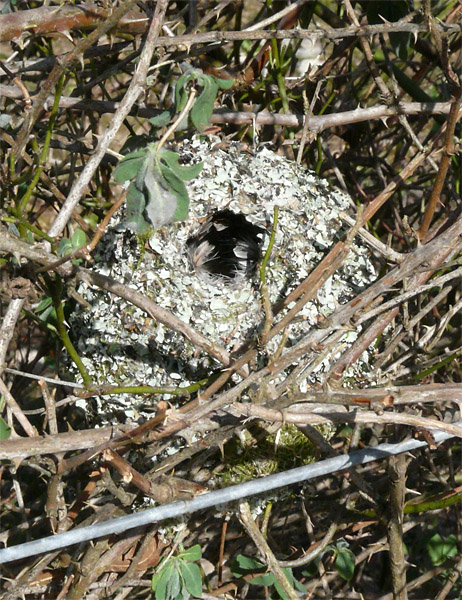
Just as I was leaving I noticed a Long-tailed Tit nest in a bush by the gate. Contractors working at the site have been clearing back vegetation, which seems a ridiculous thing to be doing in the bird breeding season. They had obviously noticed this nest, and highlighted its location, then cleared all the vegetation from around it leaving it completely exposed in a narrow strip of vegetation. I popped my finger into the entrance and could feel at least five eggs, I suspect that if the birds are still using this nest, the resident magpies will feast on the chicks as they get bigger!

Long-tailed Tit Nest

It would have been nice to think that whoever had cleared back the vegetation would have had the commonsense to leave a bit of cover for these birds.....but sadly that was not the case!!

Sunday, 31 July 2011

Bullfinch Bonanza at Botley Wood

An early morning ringing session on 29th July, did not produce the same number of birds as would be expected at Titchfield Haven, but the aim of the session was to try to catch any remaining Common Nightingales before they departed. Well, I failed on that count but still managed a total of 27 birds of 9 species. The species captured included 5 Robins, 2 Blackcaps, both juveniles, 3 Goldcrests, 2 Chiffchaff and a Nuthatch, but the most numerous was the Bullfinch, with 8 different birds captured. I have never had a ringing session where bullfinch was the most numerous species, and to make it even more interesting, the haul included a range of different ages and both sexes.

Male birds are stunning, with their bright pinkish-red underparts and their glossy black primaries, crown and tail. The mantle and back is ash grey, and the rump is white and is most obviously visible in flight.

Male Bullfinch

Females have the same glossy black primaries, crown and tail, but lack the pinkish-red underparts, instead they are brownish in colouration.

Female Bullfinch

Juveniles on the other hand lack the black crown, until they have undergone their post juvenile moult, which is usually completed by September/October.

Juvenile Bullfinch

The moult strategy for Bullfinch's is fairly straight forward, with adults undergoing a complete moult of all their feathers, whereas juveniles have a partial moult and therefore do not replace their wing and tail feathers. In the image below, all of the feathers are of the same generation, with no retained juvenile feathers visible.

Adult Bullfinch Wing

In the image below, a retained juvenile carpel covert and the alula covert can be seen to have a brownish fringe. I have inset a close up of these to feathers in the top right corner for ease of viewing. This bird would have been hatched in the summer of 2010, and is showing retained juvenile feathers, these will be moulted out following completion of its post nuptial moult in the next few months.

Second Calendar Year Bullfinch

The image below is a fully juvenile wing, prior to the start of its post juvenile moult. The brownish colouration to the tips of the greater coverts is clearly visible, in contrast to the greyish tone in the image above.

Juvenile Bullfinch

One of the male birds captured was a re-trap, which was originally captured on 6th June 2010 at the same site. This bird was originally aged as a second calendar year bird, which would have originally been hatched in the summer of 2009. 

All in all a good mornings ringing and I suspect that it will be a while before I catch 8 Bullfinch's in a single session again.
Related Posts Plugin for WordPress, Blogger...