Showing posts with label Common Sandpiper. Show all posts

Thursday, 7 August 2014

Farlington Marshes - 7th August 2014

The tides weren't ideal but we decided to start this autumns wader ringing sessions anyway. The priority species, as last year, was Common Sandpiper. Any individuals captured were to be colour-ringed in the hope of learning a bit more about their migration patterns, and how they use the marsh. We arrived on site at around 18:30 and went out to set the nets straight away; we intended to put up five nets and on the scrape only. 

Once the nets were set it was a waiting game, so we took advantage and did a bit of birding. It was a bit of a breezy evening but there were plenty of Barn Swallows and Common Swifts around to keep us occupied. The swallows were feeding over the meadows and gathering around the reed bed in readiness for roosting.
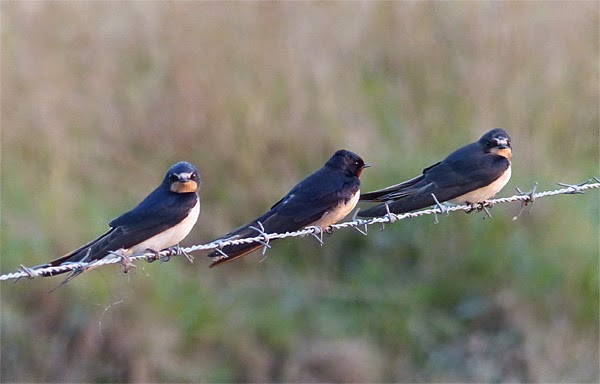
Barn Swallows gathering in readiness to roost

Bearded Tits were very evident in the reed bed, constantly pinging as the flew back a forth across the reed bed. The stream was the best place for waders, with about 25 Black-tailed Godwits, 15 Northern Lapwing, five Common Sandpipers and a couple of Common Redshank and Common Teal.

Black-tailed Godwits, Common Teal and Mute Swans on the Stream

As the sun set over Portsmouth Harbour the wind began to drop and the tide neared its peak. The five Common Sandpipers on the stream began to call and circled around before heading out into the mid-marsh.

Sunset over Portsmouth Harbour

Our first net round produced two birds, and Dunlin and a Common Sandpiper, both of them juveniles. As I mentioned earlier the Common Sandpiper was a target species for us and was fitted with a combination of colour rings that would allow for the bird to be individually identified in the field.

Common Sandpiper with colour rings

This juvenile bird was aged due to the generally brown but extensively buff tips and dark subterminal bands to the upper parts, and the coverts, were brown and with very heavy dark brown and bright rufous-brown barring.

Juvenile plumage of Common Sandpiper showing extensive barring.

Our second and final round produced four birds, three Dunlin and a Common Redshank, all the birds were once again juveniles. This time last year we were commenting on how we were only catching adult birds, so it was a refreshing change to be catching juveniles.

Dunlin 

The chestnut fringes on the wing and body feathers age this bird as a juvenile. Some juvenile feathers will be retained through to the next summer so birds should still be able to be aged up to that point.

Juvenile Dunlin showing buff fringing to feathers

The upperparts and coverts of the Redshank were extensively fringed buff and warm brown, thereby ageing it as a juvenile. The bill was a dull reddish colour, darkening towards the tip again a juvenile feature.

Juvenile Common Redshank with obvious buff tips to plumage

Sunday, 19 August 2012

Wader Ringing - Farlington Marshes 18th August 2012

With the tide again right, and the weather set fair, we headed off to Farlington Marshes for another wader mist-netting session. We arrived early and set a couple of nets on the scrape in the hope of catching another Common or Green Sandpiper, before heading off to the lake, and our main ringing site for the evening. A Spotted Crake had been reported earlier, so on the way to the lake we stopped to chat to a couple of local birders, and timed it just right to catch up with the Spotted Crake, plus a Little Stint, several Green Sands and a Spotted Redshank, but a reported Wood Sand was not in view. Whilst some of the group set the nets on the main lagoon, I headed back to the scrape and was pleased to see a new Common Sandpiper in the net along with six Starlings, not what was expected on a wader ringing session.

Colour-ringed Common Sandpiper

The Common Sand was colour-ringed, the third of the autumn to be so, and it was released to go on its way. 

We were fairly optimistic tonight, the tide was high, and there was no moon, but as the sun set the wind picked up and a heavy sea mist drifted in, which was certainly not expected. Presumably the conditions weren't right for some birds, such as Dunlin since we only caught one, and there were none on the lake, when normally it would be teaming with them. However, it was better for others; Common Redshank was the most numerous species with 12 new birds and one retrap, all adults again, but for me the bird of the night was Greenshank. This species has long been a favourite of mine, and tonight we caught three; all adults and all colour-ringed as part of an on-going study.

Adult Common Greenshank

Adult Common Greenshank

Being adults they were of course in primary moult, which is usually carried out in a progressive manner, in that one feather is dropped and starts to grow before the next is dropped. One bird however had dropped all of its secondaries, and was moulting its primaries, and so didn't have many feathers left in the wing to fly with!

Wing of Adult Greenshank

Our total also included a Black-tailed Godwit, a Ringed Plover and Eurasian Curlew, the latter two species were also colour-ringed, so I hope that readers of this blog will keep their eyes peeled for any colour-ringed waders and make sure you report them to the BTO.

Adult Curlew

Ringed Plover (Duncan Bell)

We ended our session on 27 birds, which included six starling, so a lower total than expected, but a much better variety, and a 3am finish, which was earlier than I expected.

Sunday, 5 August 2012

Wader Ringing, Farlington Marshes - 4th August 2012

The wind did drop as predicted and so it was off to Farlington Marshes for some wader ringing. High tide was not until 02:00, so we started with a wander around potential sites for catching Common Sandpipers, since Farlington Ringing Group, have just registered a colour ringing project on this species. It was not our intention to target this species to tonight, but hopefully we will later in the week. We set our nets after dark, and then laid back and waited for the incoming tide to bring in the birds. Our first birds were the expected Dunlin and by the end of the session we had ringed 18, all were adult birds and no re-traps

As is often the case with bird ringing, each session can include a surprise, and this time it was our first Common Sandpiper. An adult bird which was duly fitted with its colour rings and sent on its way. So if you are out and about looking for waders keep an eye out for a Common Sand with the below colour combination, hopefully there will be many more to come.

Adult Common Sandpiper with Colour Rings Fitted

Common Redshank was equally as numerous as Dunlin with 18 birds captured, but this total included two retraps. The majority of the birds were adults and in heavy primary moult, but we did catch one juvenile, so at least one breeding pair have been successful. 

Juvenile Common Redshank

The next surprise was in the form of an Oystercater, a species that is captured in small numbers each year, but last night we ringed five.

Adult Oystercatcher

The adult birds have a long and predominantly orange bill, and pink legs, whereas juveniles have a shorter bill, with a black tip and greyish-pink legs. The adult birds were just finishing their post breeding moult, in the image below it is possible to see the old outermost primary, contrasting with the new fresh feathers on the rest of the wing, and if you look closely you can see the replacement second primary protruding past the primary coverts.

Wing of Adult Oystercatcher Showing Primary Moult

By the end of the session we had ringed 42 birds, 18 Dunlin, and 18 Redshank, five Oystercatchers and one Common Sandpiper, not a bad start to the wader ringing season.
Related Posts Plugin for WordPress, Blogger...