This last week I have been on a family break in Cornwall. I was hoping to connect with some good birds whilst down here, and at the very least see some migrants. We were based at St Merryn, on the north coast and within walking distance of Trevose Head and the Stepper Point/Crugmeer area.
 |
| Booby's Bay - Cornwall |
The first spot I birded at was Booby's Bay, which is located on the Trevose Head peninsula. There was limited bush cover on the headland itself, but there was plenty around Booby's Bay and the nearby golf course. Birding was tough and there were very few migrants to be found, in fact the most numerous species was Northern Wheatear, with four birds present one evening, otherwise it was just a scattering of Chiffchaffs.
 |
| Northern Wheatear's - Booby's Bay |
Around 30 Oystercatchers, a Curlew and a Turnstone were feeding regularly on the rocks in the bay and Northern Gannets were present offshore. Whilst scanning over the bay I noticed a dead seal pup being washed in on the rising tide. On closer inspection it appeared to have been in the water for a while as fur had started to lift from its skin, particularly around the head and face. Blood was still present from what appeared to be its umbilical cord, suggesting that it might have been still born. Looking at the head shape it looked like it was a Grey Seal pup.
 |
| Dead Seal Pup - Booby's Bay |
The Crugmeer/Stepper Point area was my favoured birding area. The meadows were full of Meadow Pipits, Linnets and Skylarks, and there were plenty of Stonechats present. A small wooded valley that leads to Harbour Cove, had lots of potential for migrants and the adjacent cabbage field was popular with Meadow Pipits and Linnets. There was a report of a Lapland Bunting on one day, but I couldn't find it.
 |
| Stonechat - Crugmeer/Stepper Point |
Despite the lack of birds there was a good variety of butterflies present, Small Copper, Clouded Yellow, Small and Large White, Red Admiral, Speckled Wood, Small Tortoiseshell, Peacock and Painted Lady were recorded regularly, but the most numerous species was Wall Brown, a species which is quite uncommon in Hampshire these days.
 |
| Small Copper - Crugmeer/Stepper Point |
 |
| Wall Brown - Crugmeer/Stepper Point |
 |
| Wall Brown's - Crugmeer/Stepper Point |
On the 2nd October I met up with a mate and spent the day birding the valleys west of Penzance. We visited Porthcurno, Polgigga, Porthgwarra, Nanquidno, Kenidjack, Bottalack Head and Pendeen. There was little to report of note, Chiffs were present at most places, we had a few Goldcrests, a Blackcap, six Jays at Polggiga was apparently notable, but for me the best birds were two Choughs at Kenidjack and a couple of Balearic Shearwaters past Pendeen. A Buff Tip caterpillar provided a bit of a distraction from the birding, and Clouded Yellows were recorded at most places.
 |
| Buff Tip Caterpillar - Kenidjack Valley |
We ended the day with a visit to Ryan's Field at Hayle where two Little Stints, a Curlew Sandpiper, 100+ Dunlin and two Curlews were present.
Another good birding area was Park Head, which we visited on the 3rd October. We walked from Porthcothan along the cliff, there were good numbers of Gannets feeding offshore, at least 40 Great Black-backed Gulls and 15 Oystercatchers roosting on one of the offshore islands. On shore there were at least 100 Meadow and 20 Rock Pipits, 50 Linnets, six Stonechats, two Wheaters and a Chiffchaff.
 |
| Northern Wheatear - Park Head |
On our final day and the way home I decided to make a slight detour and call into Davidstow Airfield. I was hopeful that the overnight rain would have brought in a good yankee wader, but alas that was not to be. At least 20 Pied Wagtails were feeding over the grassland, along with a flock of around 35 Linnets and 15 Meadow Pipits.
 |
| Pied Wagtail - Davidstow Airfield |
Common Ravens are regular at Davidstow, this time there were just the two, and half a dozen Northern Wheaters were still present.
 |
| Northern Wheatear - Davidstow Airfield |
A mixed flock of large gulls was made up of mostly Lesser Black-backed, about 25 and five Herring Gulls. It is often quite easy to get close to the birds roosting on the airfield as it is possible to drive right up to them, as was the case with these birds. Two of the Lesser Black-backs were ringed, one with just a metal ring, that I couldn't read, and the other a black darvic ring, with white numbers and letters on it.
 |
| Adult Winter Lesser Black-backed Gull - Davidstow Airfield |
The darvic ringed bird was an adult and having carried out a bit of research it appears likely that it is a bird ringed by Paul Veron on the Channel Islands. I will let you know when I find out the details.
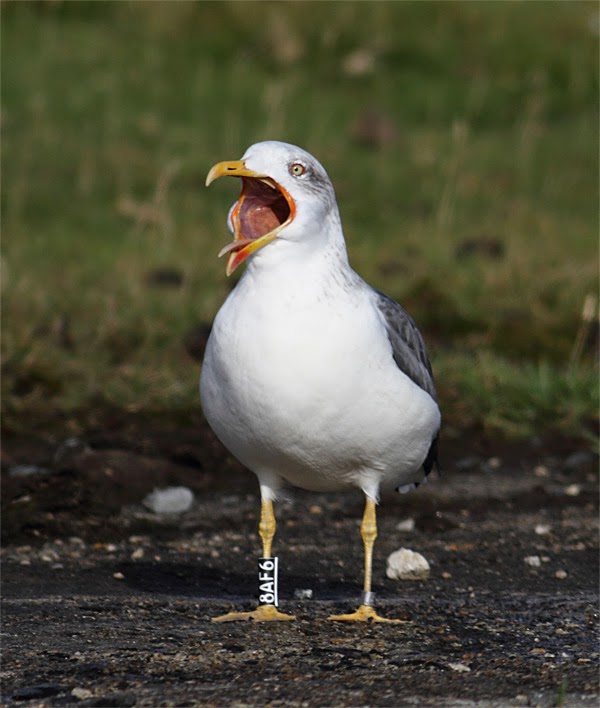 |
| Adult Winter Lesser Black-backed Gull - Davidstow Airfield |


