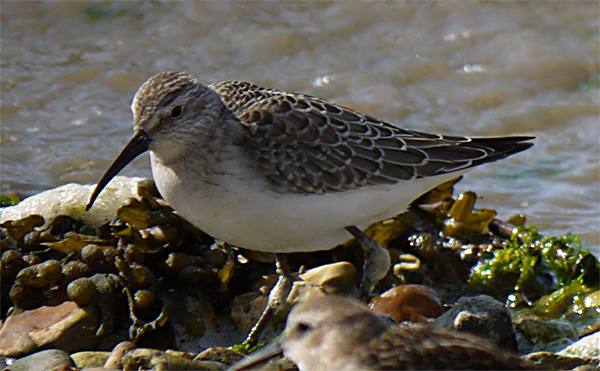
Day 5 (25th Feb) - Birding took second fiddle today as we planned to walk to Santa Cruz and spend much of the day there. There were of course things to see on the way, but the most spectacular event was the enormous sea and the gigantic waves that were crashing ashore, and giving the island a real pounding.
 |
| Crashing Waves - Santa Cruz, La Palma |
Bird wise there were the usual species at the hotel, Blackbird, Collared Dove, Canary, Yellow-legged Gull, Sardinian Warbler, and of course the abundant Canary Island Chiffchaff. The same species were recorded throughout the day, with chiffchaffs even common in the city centre. Other species recorded were Red-billed Chough (5), Kestrel (3) and Turnstone (2). The day was somewhat soured by news of a drake Surf Scoter, back in my home County (Hampshire, England), a county tick for me, but never mind, there will be another. A couple of hours sea-watching from the apartment proved successful with 152 Cory’s and 31 Manxie’s past in 45 minutes.
Day 6 (26th Feb) - It was another dull and dreary day around Los Cancajos and so we decided to head inland to the National Park of Caldera de Taburiente. But before heading off we were treated to two new species for the trip, both fly-by’s; Little Egret and Sparrowhawk. The other regular species were of course also still present, although a scan out to sea produced only Yellow-legged Gulls.
We set off to the sight of the volcano at Caldera de Taburiente shrouded in cloud and as we headed up the mountain-side the temperature dropped from 18 on the coast to only 9 centigrade. We had wrapped up warm expecting the worst but as we exited the tunnel we were greeted to full sun and a very acceptable 26 centigrade.....which we weren't dressed for. We arrived at the visitors centre and enquired about taking our car to the viewing area at La Cumbrecita. It was a 2.5 hour wait so we booked in and headed off to El Paso and beyond for some birding.
 |
| West Canaries Lizard (male) - El Paso |
After a bit of exploring we eventually found ourselves heading south on the LP-212 towards San Nicolas de Abajo. Approximately a kilometre out of the village we pulled over and took a path which was signposted Coladas de San Juan (PR - LP14-1). This was a steep unmade path next to an old larva flow, that was full of Western Canaries Lizards, well actually, every where we stopped was! As we set off a flock of over 50 Red-billed Choughs took flight in the distance, and circled overhead. At least five Kestrels were also present, along with Canaries and Chiffchaffs. I followed the track for about a kilometre into some pines and picked up a couple of Barbary Partridges, and as I turned to head back to the car a flock of at least 30 Plain Swifts passed over. There were also at least three species of butterfly present here, Small White, Canary Speckled Wood and a blue that would just not settle.
With time now ticking on we headed back to the Information Centre in readiness for our slot to drive to the viewpoint. The car park at the centre was full lizards, including some cracking males with full blue throats; whilst watching them a Grey Wagtail briefly landed on the roof of the information centre. The drive to La Cumbrecita was uneventful, in fact I don’t recall seeing a single bird, but that is probably because I was concentrating on the road which was narrow and winding. We arrived at the car park and were greeted by two Berthelot’s Pipits, the first of the trip, and a Chaffinch. A few Chough’s were calling in the distance and a couple of Ravens circled overhead.
 |
| Berthalot's Pipit - La Cumbrecita |
 |
| Berthalot's Pipit - La Cumbrecita |
Back at our resort I finished the day with another scan out to sea, this time just a brief one, which resulted in 19 Cory’s and six Manxie’s.
Day 7 (27th Feb) - We awoke to dull, dreary and wet weather this morning which was brightened slightly by the appearance of a single House Martin. With the weather looking so grim we decided to go back over the mountain to El Paso in the hope that it was sunny. I was also keen to catch up with Tenerife Goldcrest, which despite being reported as common in pine woodlands I was yet to connect with on this trip. The trip up the mountain was wet and even when we emerged the other side, it was still shrouded in cloud. Back at the information centre though it was sunny, but very windy. We headed down the road to La Cumbrecita, but stopped in the first area of pine forest past the crossroads. Several Chaffinch’s, Chiffchaffs and three Kestrels were present, but no Goldcrests. Two Red-billed Chough’s and a Raven drifted over at one point, but there was nothing else to report.
Our next stop was the town of Tazacorte, primarily for a coffee, but also because we had not been there before. We found a small square near the centre where we ordered our coffee and enjoyed the 27 centigrade temperature. According to a couple of locals, the west coast is usually warmer as the mountain holds back the bad weather, so if it is sun you want El Paso or Tazacorte may be the places for you. The only birds of note were a Grey Wagtail, and a Blackcap, both the second of the trip.
After Tazacorte, we decided to travel down the west coast of the island along the LP - 2 and re-visit the salt pans at Fuencaliente. It was a long and winding road and we stopped several times en route where the habitat looked good for Goldcrests. Several Canary’s, Chough’s, Chaffinch’s, Kestrels and a couple of Buzzards were seen, but the most notable species was a flock of 30+ Plain Swifts, but once again no Goldcrests.
 |
| Plain Swift - Mirador de Charo on LP-2 |
 |
| Plain Swift - Mirador de Charo on LP-2 |
It was so windy at Faro de Fuencaliente and so any sensible passerine would have been keeping low. A few waders were once again present, but the same species as my last visit; Sanderling (1), Turnstone (15) and Ringed Plover (1), there were also several Yellow-legged Gulls loitering.
 |
| Ringed Plover - Salt Pans at Fuencaliente |
 |
| Turnstone - Salt Pans at Fuencaliente |
We were back at Los Cancajos for 6pm and so I decided to have another scan of the sea, since it was my last night. I scanned for 1.5 hours and recorded 342 Cory’s Shearwaters, 43 Manx Shearwater and 10 Northern Gannets.
Day 8 (28th Feb) - Our final day so we decided to spend the time walking around the Los Cancajos resort. We headed south out of the resort, then north along the footpath beside the main LP-2, before heading back down into the town. Before starting, a scan out to sea produced around 20 Cory’s Shearwaters, all heading south this time and the usual Yellow-legged Gulls. The typical species were once again present around the resort with Canary Island Chiffchaff the most obvious and Canary and Sardinian Warbler also present.
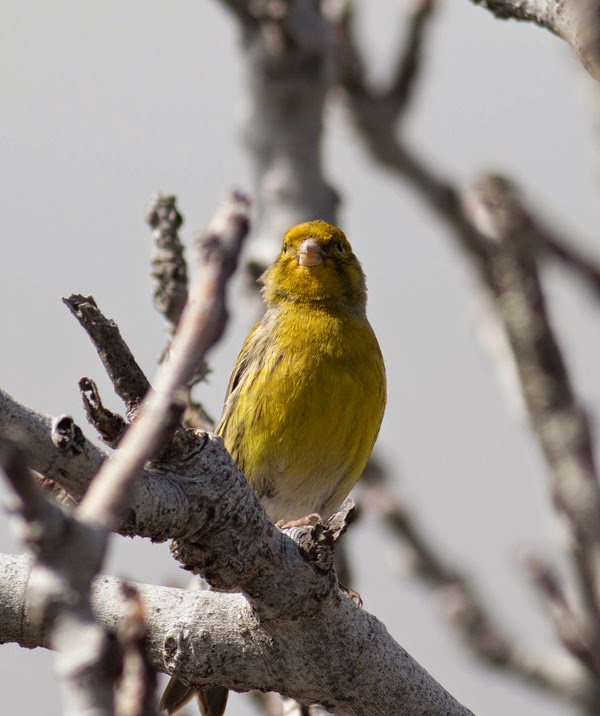 |
| Canary - Los Cancajos |
We stopped off at a small banana plantation where a female Blackcap showed briefly, and then headed back to the coast. The most notable species was Grey Heron, with a flock of eight heading south, followed by a single bird about 10 minutes later. A male Blackcap was singing in the hotel grounds just as we were leaving, and a final look out to sea produced another handful of Cory’s Shearwaters.
 |
| Grey Heron (5 of the flock of 8) - Los Cancajos |
By the end of the trip we had recorded 33 species, including most of the target species, but the notable exception being Tenerife Goldcrest. Some species that had been reported as common, such as Berthelot’s Pipit I found decidedly scarce, whereas others, Red-billed Chough appeared to be everywhere. To make my trip complete, I returned back to Hampshire to find that the drake Surf Scoter was still present, so an early morning start on Sunday 1st March and it was on my Hampshire list!
Species List and Locations
Birds
Barbary Partridge - 2 (26/2 - San Nicolas de Abajo at PR LP14.1)
Cory’s Shearwater - 100+ from Hotel, Los Cancajos 22/2, 30 - 23/2, 2 - 24/4 (in morning), 152 - 25/2 (45 mins), 19 - 26/2 (10 mins), 342 - 27/2 (1.5 hrs)
Manx Shearwater - 30+ (22/2 Los Cancajos), 2 - 23/2, 31 - 25/2, 43 - 27/2
Northern Gannet - 10 (27/2 Los Cancajos)
Grey Heron - 9 (28/2 Los Cancajos)
Little Egret - 1 (26/2 Los Cancajos)
Buzzard - 2 (24/2) Los Tilos
Sparrowhawk - 1 (26/2 Los Cancajos)
Kestrel - Seen daily
Ringed Plover - 3 (23/2), 1 (27/2) Salt pans at Punta Fuencaliente
Sanderling - 1 (23/2), 1 (27/) Salt pans at Punta Fuencaliente
Turnstone - 12 (23/2), 15 (27/2) Salt pans at Punta Fuencaliente, 2 (25/2) Los Cancajos
Lesser Black-backed Gull - 5 (24/2) Laguna de Barlovento
Yellow-legged Gull - Common
Rock Dove/Feral Pigeon - Common
Bolle’s Pigeon - 7 (24/2) Los Tilos
Laurel Pigeon - 20+ (24/2) Los Tilos
Collared Dove - Common
Plain Swift - 30+ (26/2 - San Nicolas de Abajo at PR LP14.1), 30+ (27/2 Lp - 2 Mirador el Charo)
House Martin - 1 (27/2 - Los Cancajos)
Berthelot’s Pipit - 2 (26/2 - La Cumbrecita)
White Wagtail - Los Cancajos (22/2)
Grey Wagtail - 1 (26/2 Centro de Visitantes del Parque National Caldera de Taburiente), 1 - 27/2 Tatacorte
Blackbird - seen daily
Sardinian Warbler - seen daily
Blackcap - 3 (22/2, 2 on 28/2) Los Cancajos, 1 (27/2 Tazacorte)
Canary Islands Chiffchaff - Common
Blue Tit (la Palma) - 10+ (24/2 Los Tilos), 2 (26/2 La Cumbrecita)
Red-billed Chough - Seen daily - 50 (23/2) Los Canarios, 50+ (26/2 - San Nicolas de Abajo at PR LP14.1)
Raven - 1 (24/2 Los Tilos), 2 (26/2 La Cumbrecita), 1 (27/2 information centre near El Paso)
Chaffinch (La Palma) - 30+ (24/2 Los Tilos), 2 (26/2 La Cumbrecita), several by information centre near El Paso
Serin - 2 (23/2) San Antonio Volcano area
Canary - Los Cancajos, San Anotino Volcano area, 50+ Laguna de Barlovento (24/2) generally common
Butterflies/moths
Red Admiral - 2 (22/2 Los Cancajos Information centre), 2 - (27/2 - El Paso)
Small White - 1 (24/2 Laguna de Barlovento), 2 (26/2 - San Nicolas de Abajo at PR LP14.1), 2 (27/2 - Tazacorte)
Monarch - 1 (25/2, 28/2 Los Cancajos)
Canary Islands Speckled Wood - 1 (26/2 - San Nicolas de Abajo at PR LP14.1)
Canary Islands Brimstone - 1 (23/2)
Reptiles
Western Canaries Lizard (Gallotia Galloti palmae) - Common everywhere
Other Bits
Mottled Shore Crab (Grapsus grapsus) - common on coast