Showing posts with label Titchfield Haven. Show all posts

Sunday, 11 September 2016

Looking for the palmations

When news broke last night (10th September) of a Semi-palmated Sandpiper on the south scrape at Titchfield Haven I was surprised that I hadn’t received a text from one of usual crew who circulate news, however it soon became apparent why not. There had been several reports throughout the course of the day of two Little Stints on the south scrape and one of those birds had evidently been re-identified from photos posted on the Hampshire Ornithological Society website as a Semi-p. I was planning to go ringing at the Haven in the morning so if it was still there I thought I would go and have a look. I don’t actually know how many Semi-p’s have now been recorded in Hampshire, but with the exception of one that I caught at Farlington Marshes in 1995 (then the second for the County) most have been in the west of the County at Pennington/Keyhaven. 

Adult Semi-palmated Sandpiper - Farlington Marshes 1995

There were clearly a few local birders who were a bit miffed at having overlooked this bird, but let’s face it they are tricky birds to ID and it is very easy to just take someones word that a bird is what it is and just enjoy it without really questioning its ID, I am sure most birders have done it, and will do so again. It is also quite easy to get hooked up on looking for obvious (or not so) features, such as black or pale legs on a Chiffchaff or Willow Warbler, or palmations between toes on a semi-p to separate it from Little Stint, rather than look at actual features, such as feather patterns or primary projections. But with some species there are only subtle differences and as such with limited experience they can be easily overlooked.

I was fortunate in that the bird was still present today and so after what turned out to be one on the busier ringing sessions of the season so far, the ringing team trudged over to the south scrape for a look. Initially the bird was preening on island I, but eventually it settled on the mud in the north-west corner of the scrape just in front of the hide and began to feed. I spent the first twenty minutes or so just grilling the bird, noting the short primary projection, the strongly streaked dark crown, which was sharply demarcated from the distinct supercilium, the dark ear coverts, the well defined and finely streaked side of the breast and short bill. 

Juvenile Semi-palmated Sandpiper - Titchfield Haven 2016

Juvenile Semi-palmated Sandpiper - Titchfield Haven 2016

Juvenile Semi-palmated Sandpiper - Titchfield Haven 2016

There was evidence of a slight ‘V’ on the mantel from some angles, but it was much reduced from that present on the accompanying Little Stint, and no evidence of the split supercilium, which again is usually evident on Little Stint. At times the bird was very close and yet despite my best efforts I could not make out the palmations.
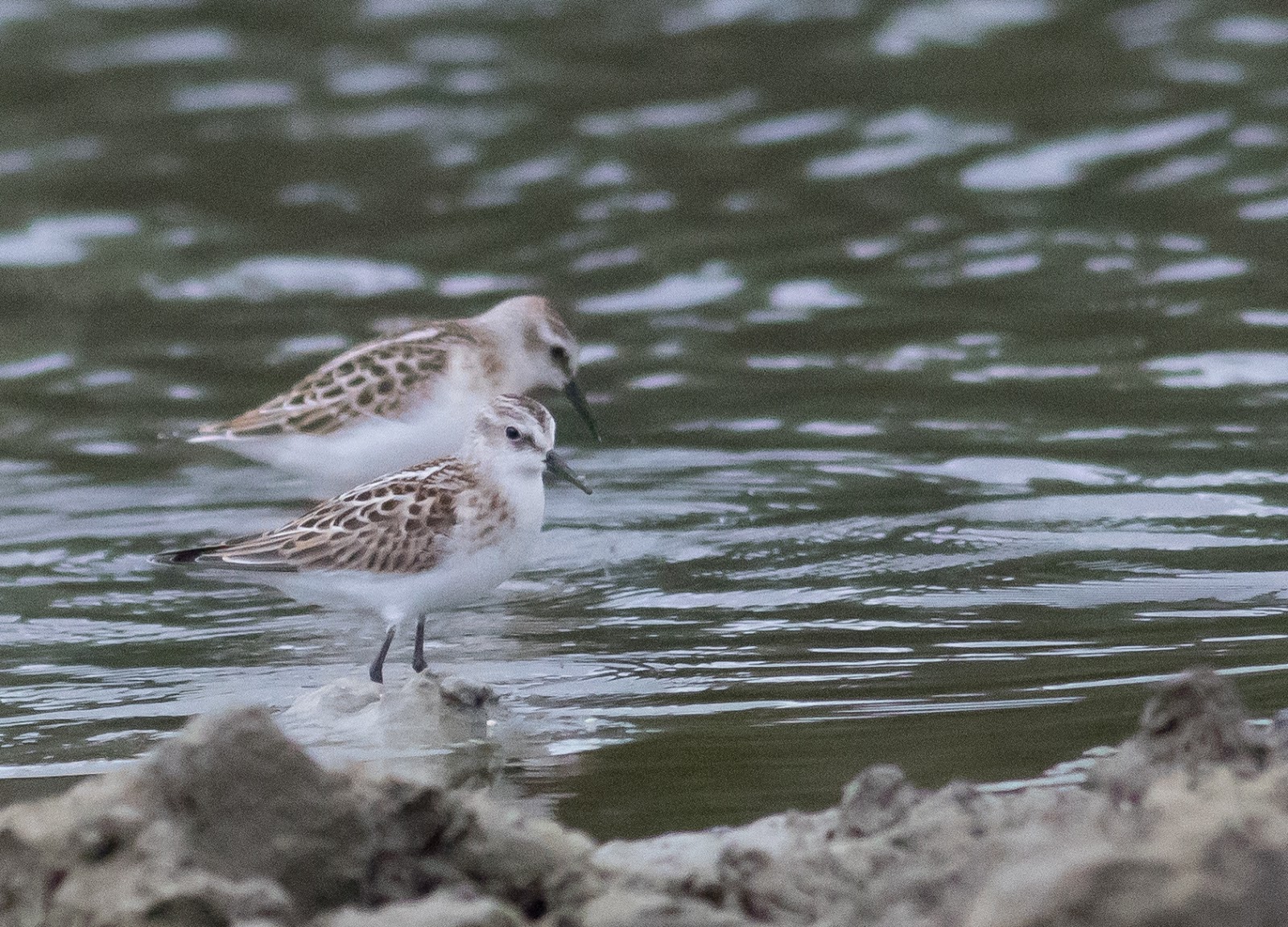
For comparison a Little Stint - Farlington Marshes 2016 

As I eluded to above in many circumstances the palmations can be very difficult to see, so it is not really a feature worth looking for, unless circumstances allow. In the hand, like the bird at Farlington Marshes in 1995, they were very obvious (see below). 

Palmations of Adult Semi-palmated Sandpiper - Farlington Marshes 1995 
They were also obvious on a Western Sandpiper roosting on a rock in California that I saw in 2012. 

Western Sandpiper - California
Note the palmations and also the length and shape of the bill compared with the Semi-p

I have got one shot where it looks like a palmation is present, but with the bird feeding in soft mud they were generally difficult to make out.

Juvenile Semi-palmated Sandpiper - Titchfield Haven 2016. 
It appears just about possible to see one of the palmations on the birds left leg.


All in all it was a cracking morning with just shy of 150 birds ringed, including our first Firecrest of the autumn followed by a superb Semi-p with a Little Stint as a supporting cast.

Friday, 11 December 2015

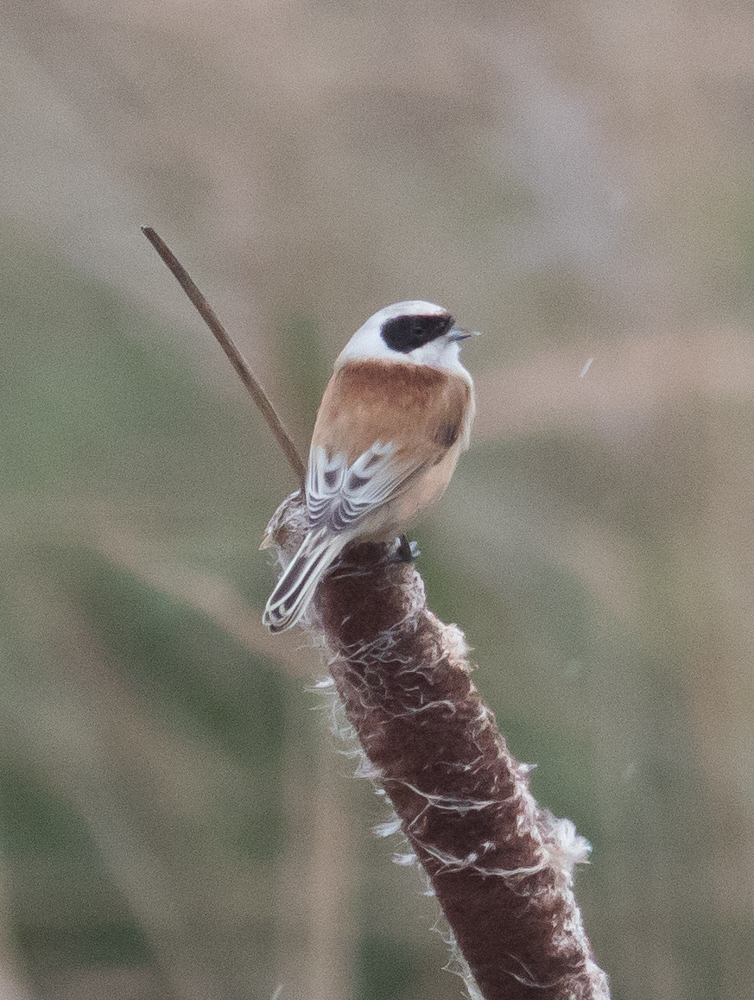
Penduline Tit - Titchfield Haven

Today was the first day for a while that I was at home and with some time to get out. I was keen to go birding somewhere, as it was too windy for ringing, and so decided to head down to the Haven, in the hope that one of the three Penduline Tits would still be around. I arrived at the West Hide to see birders gathered outside the door watching it perched in willows. Unfortunately as I approached it flew and so all I saw was its tail end heading away. I headed into the hide and began to scan the reedmace, initially there was no sign, but within five minutes it appeared and performed brilliantly for the half hour I stayed. 

There were three birds together when they were found, apparently a male and two females, but this male was the only one showing today. It was a cracking bird and the first I have seen in the County since 1991, when two birds were present at Farlington Marshes. 

Male Penduline Tit
Male Penduline Tit
Male Penduline Tit
Male Penduline Tit
Male Penduline Tit
Male Penduline Tit
Male Penduline Tit
Male Penduline Tit

Monday, 23 November 2015

Titchfield Haven - End of Season Update

The ringing season is now all but finished for us at the Haven, although there may be the odd session to target certain priority species. Overall it ended up being a pretty good season, which was not immediately apparent at the start of the season. A total of 3960 new birds were ringed of 38 species, a further 177 birds were retrapped or controlled, a handful of the resident species, several times.


The anticipated eastern mega turned out to be a Barred Warbler, which for many counties is a regular vagrant, but not for Hampshire, where it was the first ever ringed in the county. The total is a little misleading in that it shows two birds being caught, but that is due to it being retrapped two days after the original capture, fortunately for me. Other highlights include a Wryneck, our 3rd ever, Tree Pipit our 8th ever and our first ever Grey Wagtail for the site. It was surprising not to catch a Yellow-browed Warbler this year, given how many were recorded on the east coast, but the expected record total of Goldcrests did materialise. A total of 158 new birds were ringed, beating the previous best total by 49, a couple of controls were also trapped, so the actual total of birds not previously trapped at the Haven will be 160. Other new high totals included Lesser Redpoll, with 23 new birds ringed, and Blackcap with an amazing 973 new birds ringed, well above the 495 average.


I have previously posted about the selected species comparisons, so there is no need to cover that ground again in detail. So to summarise, the Grasshopper Warbler total remained low, with only 135 new birds ringed and well below the average of 264. The Sedge Warbler total also low at 799 new birds, again will below the average of 841. By contrast however, the Reed Warbler total was well above the 459 average; the Willow Warbler total was also above the 125 average. Whitethroat, Chiffchaff, Cetti's Warbler and Robin totals were also all above average.


Our sixth year without an Aquatic Warbler is setting a very worrying trend.

Thursday, 8 October 2015

Titchfield Haven Ringing Update - Early October 2015

Whilst I was galavanting around Fair Isle and Shetland, Barry and Duncan continued with the ringing sessions at the Haven, no doubt hoping to grip me off with a goody! They ringed on seven dates and had three days when they caught over 100 new birds, 116 on 17th September, 187 on 19th and 143 on 26th, otherwise the totals were below average. New species for the year included Lesser Redpoll, Firecrest and Spotted Flycatcher.  

My first session since, returning was 3rd October and we started with a haul of 202 birds, the next saw a total of 104, so still plenty of birds moving. As expected the Blackcap total continued to build and as of today it stands at a massive 885 new birds, beating the previous annual total by 79 birds, and well on the way to the 1000 target. On the flip side of that the Grasshopper Warbler total never recovered and now stands at a paltry 135 birds ringed. This is the lowest total for this species since 2003.

At one point we thought we were heading towards a record Reed Warbler total, but towards the end of September the numbers petered out and currently stands at 716. This is the highest total for the last six years and is only 62 birds short of the record; clearly a good year for this species. The Sedge Warbler total also remained low at 799, as did Garden Warbler at 44. The Willow Warbler total was good, although not as good as last year, and Whitethroat numbers have peaked at 112. Chiffchaff and Cetti's Warbler numbers remain quite high and assuming the weather holds we still have plenty of time to catch more.


The session of 2nd October as well as being very busy was also one of our public events. The visitors were very patient as we worked our way through the 106 Blackcaps and 64 Chiffs, and were rewarded with the capture of two Bearded Tits. Although Bearded Tits breed on the site, we rarely catch them in our ringing area since we outside of the main reed bed, these two birds were therefore greatly appreciated by all.

A Pair of Bearded Tits - Titchfield Haven
Visitors enjoying a Bearded Tit photoshoot (Photo Simon Ingram)

The last two sessions have also seen 25 new Goldcrests ringed bringing the total for the year so far to 36 and two new Robins bringing that total to 59. Having seen record numbers of Yellow-browed Warblers on Fair Isle it hopefully won't be too long before we catch another one down on the south coast.

Tuesday, 15 September 2015

Mid-September Ringing Update

I wasn't intending to do another mid-September update as the weather last weekend didn't look that great and so I thought any ringing was unlikely. However, as it turned out the conditions on Sunday 13th were perfect. It was evident first thing that it was going to be a good day as the nets were 'dripping' with birds on the first round. We were so busy that Barry and I alternated extracting and ringing whilst Maggie patiently scribed. By the end of the session we had ringed 267 new birds and had two controls, one Chiffchaff and one Blackcap and our second Common Redstart of the year, which was a cracking male.

Of course having caught so many birds, it dramatically altered the totals for the year to year comparisons, so I thought I should update the blog to reflect this, and bring it in line with the September 14th date used in previous years. The story with Sedge Warbler is still down, and well down at that, with this years total 40% below our average for the time of year. By contrast, the Reed Warbler is having a fantastic year, and the total is 58% up on the average, and heading towards our highest ever annual total. 

Summary of Key Species Ringing Total up to 14th September

Grasshopper Warbler numbers are still trickling along, but with the total now standing at 118 numbers are over 260% below average. Other species totals below average are Willow Warbler, at 7% down, Garden Warbler at 34% down and Whitethroat at 2% down. 

The winners, as well as Reed Warbler, are Chiffchaff at 38% above average and the real winners Blackcap with a total of 448 birds ringed so far. This total is 116% above the average for the time of year, and if the pattern continues could see Blackcap elevated to the most numerous species ringed this year. In total we have ringed 2472 birds of 29 species, to date.

Friday, 28 August 2015

Titchfield Haven Bird Ringing - 28th August 2015

With a four day weekend ahead of me, it seemed like to perfect way to kick it off was a ringing session at The Haven. The end of August is now fast approaching and I will do a summary of where we are totals wise then, but as todays session was a pretty good one, I thought it warranted a short blog post. Barry had only been able to do one session so far this week because of the appalling weather, but yesterdays session had resulted in 10 new Grasshopper Warblers, so it was worth the effort.

The conditions looked ideal for another session this morning with a clear night, and a bright and wind less morning, and it was clear it was going to be good as our nets were dripping with birds first thing. As it happened things didn't end up as good numbers wise as we thought with under 180 birds were trapped, but we were treated to our first Common Redstart and Lesser Whitethroat of the year.


Juvenile Common Redstart

The Common Redstart was a juvenile and there was no evidence of a dark throat or grey feathers in the crown, so was probably a female. Whilst I had the Lesser Whitethroat in the hand I thought I would check the wing formula to make sure it was just of the European sub-species.....well you never know!


Lesser Whitethroat
The wing formula was spot on for European Lesser Whitethroat Sylvia curruca curruca with the second primary being shorter than the fifth but just longer than the sixth.

Wing of Lesser Whitethroat 

The bulk of our catch was made up of Reed and Sedge Warblers again but Blackcaps were't that far behind. We also caught another 18 Grasshopper Warblers, so 28 in two sessions, which is more like it. Good numbers of Whitethroats were also ringed, two of which were adults and one of those a control.

Adult Whitethroat

The bright orange iris and extent of pure white in the tail feathers were dead give aways for the age, as were the retained adult secondaries in both birds.

Tail of adult Common Whitethroat

The remainder of the catch was made up of Willow Warblers, notably four of which were adults, Chiffchaffs, Cetti's Warblers, Goldcrests, Garden Warblers, Long-tailed Tits, Dunnocks and a retrap Song Thrush.

Sunday, 23 August 2015

Titchfield Haven Bird Ringing - Late August update

It has been a very mixed bag this season at the Haven which has not been helped by the very changeable weather. Fortunately Barry is retired which means that he can do some sessions during the week in order to keep our effort constant, but Duncan and I are getting limited opportunities to ring at weekends. If we are lucky we may be able to get one session a week, which is great for catching up with sleep, or doing general birding, so we can't complain, but we would rather be ringing.

Despite the inconsistent weather conditions the overall ringing total for the year is holding up reasonably well, but unless there is going to be a very late surge in the numbers of migrants it is looking like this year the totals will be at best average. That said there are some notable exceptions; on the down side, the Grasshopper Warbler total remains exceptionally low with only 36 birds ringed to date. For the period 2010 to 2014 inclusive, by 23rd August the average is 143 birds, so this year's total is significantly lower that we would have expected. It won't be the lowest total since 1998 as we have already passed that, but could be within the bottom five.

Juvenile Grasshopper Warbler

On the flip side of that, the Reed Warbler total currently stands at 450, which is the highest total for the period 2010 to 2014 by 23rd August, and well above the average for that period which is 293. The overall total for all species for the period up to 23rd August stands at 1310 birds of 20 species. 

A summary of selected species from 2010 - 2015 up to 23rd August

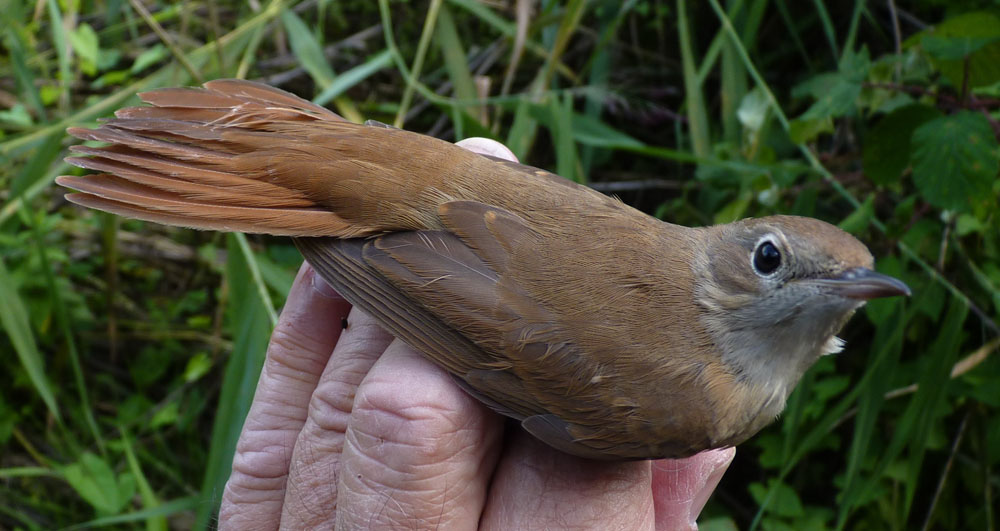
The only unusual record is a Common Nightingale that is only the sixth ever ringed at the site. There has been very little evidence of visible migration over the last few weeks, with the odd Tree Pipit and Yellow Wagtail and on 2nd August a Marsh Harrier


Common Nightingale - Note the pale tips to the tertials confirming this bird to be a juvenile, also the first primary can be seen extending 
beyond the longest primary covert, thereby confirming it as a Common not Thrush Nightingale (B. S. Duffin)

On the morning of 22nd August we held one of our public ringing events, which was well attended as usual. The session was steady, with 78 birds ringed, Reed and Sedge Warblers were as ever the most numerous species, but five Grasshopper Warblers were very welcome. Once again there was very little evidence of visible migration, the most notable species being Yellow Wagtail, with two birds and a single Common Swift. Just as we closed the nets a couple of sparring Sparrowhawks put in a great aerial display before drifting off to the east.

Sparring Sparrowhawks

After the session I stopped for a quick look off the sailing club at Hill Head with Simon Ingram, who had joined us for the mornings ringing session. There was a flock of around 100 terns roosting on the shingle but unfortunately, as is a common theme these days, the level of disturbance was very high with kayakers, fishermen and dog walkers continuously flushing the birds to the point where there was nowhere for them to settle. Simon was intent of finding a Black Tern and after a quick scan through the flock, looked out to sea, I concentrated of the roosting terns as there was a constant turnover of birds. It wasn't long before I picked out a cracking adult Roseate Tern, I quickly got Simon onto it and then we put the news out. The speed at which we did that enabled Graham Barrett, who was on the other side of the harbour, to get onto the bird, before once again, the flock was flushed, this time they did not return.

Friday, 7 August 2015

Bird Ringing at Titchfield Haven - Early August 2015 update

Despite my lack of posts on the subject the autumn bird ringing has been progressing steadily at Titchfield Haven, and when I say steadily I mean just that. Throughout July the numbers of birds ringed were low compared with last year, and the most noteworthy thing was that in that period we only caught one Grasshopper Warbler, by the end of July last year we had ringed 30. Last weekend things picked up a bit with 120 birds ringed on Saturday and 98 on Sunday, but today things really got going, with 181 birds ringed.

It was a busy session with just Barry and I ringing and Colin who was our scribe for the morning. Clear and still overnight conditions are the best for our site and it was evident by the first round that it would be a bit busy. As expected for this time of year Reed and Sedge Warblers made up a bulk of the catch with over 130 birds between them. Willow Warbler was the next most numerous with over 20 new birds ringed. 

Juvenile Willow Warbler

The numbers of Sylvia warblers is slowly starting to build and today we were surprised to catch 10 new Garden Warblers, including two adult birds, which are always nice for comparison. Common Whitethroats and Blackcaps, were also ringed but in much smaller numbers.

Juvenile Garden Warbler 

The other species included our second Grasshopper Warbler of the year, Chiffchaff, Greenfinch, Goldfinch, Bullfinch, Blackbird, Robin, Cetti's Warbler and a juvenile Reed Bunting. This year Bullfinch numbers have been at an all time high, but that is because they have bred in our ringing area for the first time this year.

Juvenile Reed Bunting

One of our net rides is set over a purpose built boardwalk that leads down the the river Meon. At this time of year it is one of our busiest rides since it cuts down through an area of Phragmites reed bed. The end of the ride is a great place to stand and get a view of the river, especially when mud is exposed. 


The jetty net ride

This morning it was evident that we had had an overnight visitor as there were two very fresh Otter spraints and the end of the jetty was still wet where it had hauled out of the river. Despite being on the site at very unsociable hours of a regular basis, I have not yet seen an otter here, hopefully I won't have to wait much longer.


Fresh Otter Spraint

Wednesday, 5 August 2015

It's getting late for ringing swifts

On Monday (3rd August) I popped down to a site at Lee-on-the-Solent to ring some Common Swift Apus apus chicks. You may recall the story from last year, but if not that post is here. You may notice that it is nearly six weeks later than the broods I ringed last year, and that is the result of some quite bizarre events. 

I had received the text from Mark, the house owner, back in June telling me that he again had a brood and that they had laid two eggs, and were happily incubating. But on 20 days things went a bit pear-shaped, when what was presumed to be a bird from a different pair entered the box. A scuffle ensued, during which the eggs were displaced from the cup, both birds then left the box. Mark quickly grabbed his ladder and put the eggs back in the cup and before long a bird returned and began incubating. He thought that things were back on track, but then the incubating bird got a bit agitated and kicked the eggs out from under it, breaking one of the shells....all was lost he thought.

Common Swift nestling

Amazingly, the pair or another then relaid, incubated the full term and now have chicks that are three weeks old, so we decided to go ahead a ring them. Two healthy chicks were ringed, one weighing 45 grams and the other 50. Typically swifts fledge after a 22 day incubation period and a 47 day nestling period, which suggests that these chicks will not fledge the nest for another three weeks yet, the latter part of August, by which time they would normally have left the country. It will be interesting to see how these birds fair, and fortunately with the camera in the nest box at Mark's house we will be able to keep an eye on them.

Common Swift nestling

On the way home a made a quick detour to the Haven and bumped into Dan Houghton. There were a few bits a bobs around, the most notable being the 3cy Yellow-legged Gull that has been hanging around for a while, 2 Common Scoter and 48 Mediterranean Gulls of various ages. 

Industrial view of Fawley Oil Refinery from Hill Head

Monday, 20 July 2015

Where has the last month gone?

I can only apologise for what has been a month since my last post, which has in part been due to a new and very busy role at work, but also due to an extremely busy social calendar. In fact, things have been so busy that there was a period of seven days when I didn't even lift my binoculars, something I cannot remember happening before, and my camera has almost been mothballed.

Bird ringing activities have also been limited, but I have managed a couple of sessions. One was a ringing event on the Leckford Estate for Trustees of the John Spedan Lewis Trust and Hampshire and Isle of Wight Wildlife Trust on 21st June. It was a bit of a breezy day but we managed to catch 34 birds of 11 species. Given that the visitors arrive at 11:00 and leave at 15:00, I am always glad to catch anything, and the crowd pleaser's were undoubtedly the two Kingfishers and single Great Spotted Woodpecker. The supporting cast included two Marsh Tits (one a retrap from last year), 13 Great Tits, five Wren's, 3 Robins, two of each Blackcap, Chiffchaff and Goldcrest and single Blue Tit and Chaffinch, the latter a superb male.


Another session was at Manor Farm Country Park as part of my RAS project on 27th June. We ringed 46 birds of four species, 42 House Sparrows, three of which were retraps, two Blackbirds and single Robin and Wren. So plenty of target birds but very few retraps which was disappointing. In the afternoon I opened a net in my garden and caught 15 birds of five species, including six Great Tits, three Goldfinch's, 4 Blue Tits and single Chiffchaff and Robin.


Ringing at the Haven has also commenced for the autumn and to date we have ringed 131 birds of 16 species. Unsurprisingly Reed Warbler has been the most numerous species with 67 birds ringed, no doubt the local breeding population. Ten Cetti's Warblers, nine Blackcaps, eight Robins, five Chiffchaffs, four Dunnocks, three each Blackbird and Bullfinch, two Bearded Tit, Long-tailed Tit and Reed Bunting and single Wren, Song Thrush and Willow Warbler.


Juvenile Avocet, Titchfield Haven (Geoff Jones)

On the afternoon of the 18th July I received an email from the Haven with a picture taken by Geoff Jones, one of the Havens volunteers and a keen photographer. The image was of a juvenile Avocet wearing a yellow colour ring on its right tibia, and a yellow flag with the letters AC on it, on its left tibia. I knew that it was not one of the Haven birds as they have not been ringed, and based on the juvenile dispersal from the west of the county last year, I suspected it might be one of Graham Giddens' birds. 

Graham responded to my email immediately and it was indeed a chick he had ringed at a site in the west of the the county on 3rd June. It was disappointing to learn that this was the only bird to fledge from his site this year, the others being predated by large gulls and Grey Herons. The lack of success for Graham is not mirrored at the Haven where I understand over 25 chicks have fledged, the best ever year for breeding Avocet at the site.

Sunday, 31 May 2015

Birding in black and white at Titchfield Haven

Over the course of the weekend I have made a couple of visits to the Haven, for no other reason than to enjoy the present spectacle of breeding gulls and waders. There is also the long-staying Greater Yellowlegs which is always worth a look if its showing, but I don't tend to seek it out if its not. As well as the breeding birds there are always plenty of other species on hand and this weekend there were Dunlin, Black-tailed Godwit, Oystercatcher, Redshank and a couple of marauding Lesser Black-backed Gulls. Single Curlew Sandpiper and Little Stint have also been seen this week and over the weekend, but I didn't manage to catch up with either.

Whilst walking around it was evident that the majority of the birds I was watching were mainly black and white, well at least it appeared like that, so I thought I would theme this post on them. My first species is Pied Avocet. This year is providing to be a good one for Avocets, with at least 14 nests on the south scrape. This species has to be a favourite of many a birder; they are elegant and very distinctive with their black and white markings. The upturned bill is perhaps the most distinctive feature, perfectly designed for sweeping from left to right as they feed. They are often feeding just in front of the hides giving excellent views and the first chicks of they year on the south scrape were a welcome sight, let's hope the evade the Lesser Black-backs.

Pied Avocet - There are at least 14 pairs on the scrape this year and truly black and white bird
Another Pied Avocet

The Black-headed Gull colony at the Haven is doing very well, I haven't bothered to count them but there are loads. Within the colony there are a couple of pairs of Mediterranean Gulls and it is this species that is my next black and white species. The hood on a Med gull is jet black and contrasts with the white neck and underparts, there is of course the light grey back/mantle, but I won't dwell on that. The image below clearly shows the brown hood of the Black-headed Gull in comparison with the black hood of the Med, somebody clearly got it wrong when they named Black-headed Gull.

Adult Mediterranean Gulls (one sitting on the nest behind the other). Its jet black hood contrasts with the white neck and underparts as opposed to the Black-headed Gulls with their brown hoods - who on earth came up with Black-headed for this species

A Northern Lapwing was feeding, whilst protecting its two chicks just in front of the hide on the north scrape. Another distinctive species with its dark olive green back but black bib, crown and face mask, so this is my next black and white species. Its crest is also black and curls up in the opposite direction to the Avocet and is longer on the male. 

Lapwing - ok not really black and white, but more dark olive green and white, but it does have black on it!

My next species was Greater Yellowlegs, not a black and white species at all really, more grey and white, but has showed so well this weekend that I just had to include some images. Now that it has come into some plumage there are some black centres to some of the feathers on the back, so I think I can just about get away with including it. The bird seems to have got into a bit of a pattern now, when the river is high it moves up to the Posbrook flood, but as more mud becomes exposed on the river it moves back down. Occasionally it visits the scrapes but those visits are more sporadic.

Greater Yellowlegs - Definitely not black and white, more grey and white, but is its summer plumage it does have black centres to feathers on the mantle
Greater Yellowlegs

As I left the reserve and headed back to my car I noticed the almost resident Black Swan in the harbour. An all black bird, except that is for the red bill, but when sat next to a Mute Swan there was a very black and white scene. There were two Black Swans when I was at the Haven the other day, I don't think anyone has any idea where they have come from but they are an interesting addition to the harbours avifauna.

Two Swans, one Black and one White (Black Swan and Mute Swan)
Related Posts Plugin for WordPress, Blogger...