Showing posts with label Fulmar. Show all posts

Sunday, 25 January 2015

In search of winter birds, Day 2 - Norfolk 2015

After the now traditional hearty breakfast we planned our day and prepared to head off. There were a few bits and pieces on the feeders in the garden but nothing of much note, Great Spotted Woodpecker and Coal Tit were probably the most notable. 

Wolferton
We started the day at Wolferton in search of the elusive Golden Pheasant. We have tried for this species in previous years but without success, but this year Paul's local knowledge gave us hope. We headed for the northern road that forms the Wolverton triangle and slowly  searched the area. Our first circuit was without success, but on our second circuit we flushed a stunning male bird, who was feeding right on the edge on a clearing. This was our second new species for our annual Norfolk trip and one we were very pleased to get.

Hunstanton
Our next destination was Hunstanton and the coach park opposite Tesco's. Two Waxwing had been visiting trees in the car park all week, but not today. We searched the area for a while but failed miserably. Our next stop was the cliffs at Hunstanton; this would give us a view of the sea in search of ducks and also views of Northern Fulmars. The sea was very quiet and other than a couple of flocks of Sanderling passing by there was nothing of note. We did get some cracking views of Fulmars though as the hung in the stiff breeze.

Fulmar - Hunstanton

Holme Beach
We are fortunate in that when we stay in Norfolk we stay in the home of a birder and are able too enjoy his choice of artwork. One of my favourite artists at the moment is Darren Woodhead (http://www.darrenwoodheadartist.co.uk/) and it was a very pleasant surprise to see one of his pictures hanging on the wall in the cottage. The painting is of a flock of Fieldfares, and a lone Waxwing, feeding in a clump of Sea Buckthorn

Darren Woodhead Painting of Fieldfares on Sea Buckthorn 

Our next stop of the day was Holme Beach and here the image on the wall came to life as we were greeted with a flock of Fieldfare, minus the Waxwing, feeding in a clump of Sea Buckthorn. As we enjoyed the birds we could just imagine Darren sat with us painting the scene.

Fieldfare - Holme Beach

Our main reason for going to Holme was to look for the flock of Snow Buntings that were known to be present. After spending a few minutes with the Fieldfares we headed on in search of our quarry. We first stubbled across a few Knot that were feeding in the nearby pools, they were extremely approachable, the individual below was the tamest.


Knot - Holme Beach

There were good numbers of Skylark feeding in the sand dunes and as we homed in on the Snow Buntings we stubbled across some pretty of approachable individuals.

Skylark - Holme Beach

There were about 20 Snow Buntings present but they were constantly moving back and forth along the beach. We eventually pinned them down and were able to get some cracking views before they took flight. 


Snow Buntings - Holme Beach
Snow Bunting - Holme Beach

Thornham
Thornham Point has been a regular site for Twite and Rock Pipit over the last few years, except last year that is. After Holme we headed there and were quickly on to a few Rock Pipits. A handful of wader species were present, mostly Redshank but also Grey Plover, Ringed Plover and Curlew

Redshank - Thornham
Curlew - Thornham

We eventually picked up the Twite flock, about 30 birds were feeding on vegetation on the salt-marsh. Typically they come to the gutter of the nearby building to drink, but that was not to be the case today.

Titchwell
Our next stop was the RSPB's Titchwell reserve, this is usually a great place for a variety of wader and duck species but also a good place to look out to sea for divers and sea duck. We arrived at Titchwell and headed straight out along the footpath to the beach. The scrape on the north had the best to offer with several Ruff, Snipe, Dunlin, Redshank and Black-tailed Godwits present. At the back of the scrape there were several pipits, including two Water Pipits, four Rock Pipits and a couple of Meadow Pipits, a Bearded Tit joined them for a while and gave good but distant views.

We continued along the footpath adding a few more species to our trip total and then picked up an Avocet and Black-tailed Godwit, both of which had colour rings. As regular readers will know I am constantly on the lookout for colour-ringed birds, so will endeavour to find out where these were from.

Colour-ringed Black-tailed Godwit - Titchwell

A quick check on the sea was disappointing, with only Common Scoter and Goldeneye recorded. It has been suggested that the storms of last years have changed the dynamics of the seabed and therefore there are no sea duck present, hopefully things will be back to normal next year.

A149 at Burham Overy Staithe
We intended to finish the day Lady Anne's Drive, but on the way we headed past Burham Overy Staithe on the A149. As we headed towards the lay-by there were a group of birders appearing to be watching something, so we pulled in to have a look. As it turns out they weren't watching anything but we stayed for a while. It was a good choice as we soon picked up a Short-eared Owl, several Marsh Harriers, three Common Buzzards, including a very pale individual similar to others I had seen on the continent, a Barn Owl and a Rough-legged Buzzard.

Lady Anne's Drive
We eventually arrived at Lady Anne's Drive and had another couple of Barn Owls and four Woodcocks, which was in fact our target bird.

We ended the day on 85 species bringing our total for the trip to 101.

Wednesday, 3 April 2013

Back in Boscastle for Easter - March 2013

With a four day break for Easter, it was off down to Boscastle for a spot of west country birding. With the continually cold easterlies along the south coast, migrants have been few and far between on my local patch, so I was hoping to add a few to my year list this weekend. We drove down late on the Thursday night, and on Friday morning I took the chance to check out Valency Valley. It was bitterly cold and the hazy sun did little to add any heat, nonetheless there were some signs of spring breaking through.

Opposite-leaved Golden Saxifrage - Valley Valley

The flora in the valley is typical of a damp wooded valley and is carpeted with bluebells, although only one or two were in flower. Opposite-leaved Golden Saxifrage covers the dry stone walls and wild daffodils are abundant in Minster churchyard. The flora this year was way behind last year, in part due to the cold weather, but mainly because it was a very early Easter this year. Greater stitchwort, red campion, primrose and ramsons were all in flower, but only a few of each.

Bird wise there were no migrants present, I would have at least expected the odd chiffchaff or blackcap, but alas no. The usual woodland species, blue, great, coal and long-tailed tits, treecreeper and goldcrests were all very visible though. Even the river itself was fairly bird less although I did eventually find one dipper and a grey wagtail. It was good to compare the British race of dipper Cinclus cinclus gularis with the nominate black-bellied C. c. cinclus that I saw in Norfolk earlier this year. Although difficult to make out, the red brown on the lower breast are just visible in the image below, the underparts are uniform dark on black-bellied.


Dipper - Valency Valley

On Saturday 30th March I had to visit Bude and took the opportunity to walk along the cliffs. It was a gloriously sunny day and by the time I arrived there were people and dogs everywhere. Fortunately the pitch and putt course was cordoned off so not too many dogs were straying onto it, and so an ideal refuge for newly arriving northern wheatears. The most I saw at any one time was five, but birds seemed to be continually moving through, so I am sure there were many more. Some of the male birds were just stunning, as the individual below...such quality birds wheatears!

Northern Wheatear - Bude

As I settled down to photo the wheatears, my attention was distracted by a moth that settled between my legs to get out of the wind. Due to the cold weather moths have been a bit of a rarity this year, and this March moth, as it turned out to be, was my first of the year. Quite what it was doing in the middle of a pitch and putt course with no cover was a bit of a mystery. I guess it had been disturbed from its place of shelter and got blown there in the brisk wind.

March Moth - Bude

Another migrant that is typical of this time of year is white wagtail Motacilla alba alba, the nominate subspecies of the British pied wagtail M. a. yarrellii. White wags have a plain grey mantle and rump, a black hood with a clear border between the hood and mantle.

Pied Wagtail - Bude

Unfortunately, none of the birds I saw were white wags, but I did manage to get some great views of a couple of pied wags that were more intent on feeding than bothering about me.

Pied Wagtail - Bude

On the way back from Bude I stopped briefly at Davidstow Airfield, another good place for migrants and waders. There were at least 20 wheatears scattered around the area, a couple of ravens croaking loudly as they attacked a grey heron and that was about it. Crowdy Reservoir wasn't much better so I headed home. As I did a flock of around 50 golden plover put in a brief appearance, wheeling around before settling back down on a recently ploughed field.

Northern Wheatear - Davidstow

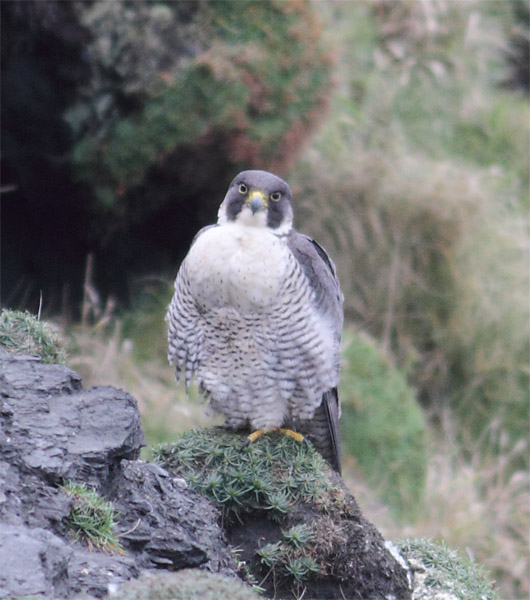
Sunday 31st March began with an early morning stroll around the cliffs at Boscastle, before being confined to the house for domestic duties. I started with a stroll through the scrub on The Stitches before settling down in a sheltered spot for a bit of sea watching on Willapark. The Stitches were predictably quiet with chaffinch, robin and dunnock being the most numerous species. The cliffs too were extraordinarily quiet with no fulmars or herring gulls settled on their usual nesting places, although the offshore islands were covered with birds. The sea was a bit more lively with fulmar, guillemot, razorbill and shags all present, a flyby male peregrine added to the excitement and a steady trickle of meadow pipits moved west. A sudden flurry of activity by the auks attracted a couple of sandwich terns, who made quick work of catching and swallowing their prey before the herring gulls got to them. As I was leaving I had the feeling I was being watched and suddenly noticed a peregrine sat watching me. It seemed more intrigued than perturbed by my presence, probably because it knew I no chance in getting too it on the unstable cliff face.

Peregrine Falcon - Boscastle

Monday 1st April began as Sunday with an early morning stroll around the cliffs at Boscastle, before packing up and heading home. This morning I did  the route in reverse, looking at the sea first before heading up to the scrub on the stitches. The sea was much as the day before, even with two sandwich terns feeding just offshore, but then a couple of close gannets and an adult kittiwake came into view. Two male peregrines were sat on the cliff face, one was calling constantly, presumably trying to scare off the intruder from its territory. This went on for about 10 minutes before the intruder took to the wing and flew north, watched all the way to the horizon by the other bird. It was nice to see that two fulmars had taken up residence on a suitable nesting site since yesterday morning, just maybe spring is on the way. The Stitches were as quiet as the previous day, with the only new species added being a jay and a couple of fly over linnets.

Northern Fulmars - Boscastle

Sunday, 18 March 2012

Dippers, Chiffchaffs and Blue Tits in a Spring like Valency Valley

This morning had a decidedly spring feel about it as I ventured out for an early morning walk; the sun was slowly rising on a partly clouded sky, there was a crisp spring feel to the air and a Common Chiffchaff was singing from a nearby copse. I had decided to start with a cliff walk, before heading down to Valency Valley in search of Dippers. A brisk northerly wind was blowing, which was being used to its full by the resident Fulmars, as they searched the cliffs for nesting places. Many of the best ledges had already been taken, and paired up birds were settled and delicately preening each other, or uttering their raucous call whilst others passed close by. 

Northern Fulmar

Driven on by the cold wind, I headed down into the village of Boscastle and onto Valency Valley, and some shelter. I saw my first Dipper in the village centre, unfortunately though, it saw me first and flew down stream and out of view. I continued upstream keeping an eye out for any movement, but initially, other than a Robin and a Wren, both pretending to be Dippers, I was out of luck. The valley was starting to show signs of spring, with the first Bluebells, Wood Sorrel, Opposite-leaved Golden-saxifrage and Red Campion in bloom.

Valency River

The river was flowing well, which was making it difficult for me to hear anything else, but one species that was evident was the Common Chiffchaff. Given the number I was hearing in the valley, at least 10, I am assuming these were migrant birds, and not wintering individuals that have started to sing. I continued up the valley, and in the distance noticed the familiar white breast of a Dipper. The bird was on a rock in the location where I found a nest last year, so I quietly sneaked up to a closer view point.

Dipper

As I crept into position the bird saw me and flew downstream, so I found some suitable cover behind a gorse bush and settled down for the wait. My patience paid off, as within 30 minutes a second bird dropped out of the presumed nest site, sat on a rock in front of me, and began to preen. The way this bird was behaving, constantly preening and stretching, I am assuming it was currently incubating eggs...but I didn't check the nest to confirm that.

Dipper

For around 15 minutes this bird sat preening before being joined by the second bird, presumably the male. He kept his distance, whilst the female preened, although at one point the two birds briefly came together, before the male was chased off.

Pair of Dippers

The female then flew to the bank and rummaged along the waters edge for a while, before collecting a small piece of nesting material and heading back to the nest. Both birds were seemingly totally oblivious or unperturbed by my presence, and the male continued to feed along the waters edge, before eventually flying back downstream.

Dipper with Nest Material

Whenever I see Dippers, and other birds with pure white feathers for that matter, I am amazed at how they manage to keep them so clean. Dippers live in a wet and muddy environment and yet they always look so immaculate, they must spend so much time cleaning.

Blue Tit by Nest Hole

I continued on up the valley, crossing the river and heading up to Minster Church, before noticing a split in a tree that looked good for bats. Whilst scanning for droppings, a female Blue Tit flew into the hole carrying nesting material, whilst the male waited outside calling. When I first started bird ringing, all of the Blue Tits in my nest boxes used to fledge around the third week of May, these days however chicks fledge anytime between late April and early June! All down to climate change, and the odd weather we have these days apparently.

Saturday, 26 February 2011

Fulmars, Dippers and Little Owls - February 2011

Things have been a bit hectic of late and subsequently I have not had the chance to write any new posts, but the weather is grim outside this morning, so it seems like an opportune moment to update. Since my last post I have had a weekend in Cornwall, have done two Timed Tetrad Visits (for the BTO Atlas) and after a three week break, got to go ringing at Manor Farm Country Park.

Visits to Cornwall have been a regular thing for me over the last 30 years since my wife's family come from Boscastle. Over the years I have walked the valley's and the cliffs and have seen a few good birds, but this visit was more about just having a break and enjoying the local beer. The weather was not good on the journey down from Hampshire, and thick fog over Bodmin Moor made driving very difficult. But on Saturday morning the sky had cleared, the sun was blazing down and there seemed to be little wind....so ideal time for a walk.


We began our walk with a look out over the cliffs to the west of Boscastle and up Pentagon. On calm days this is a good place to look out for harbour porpoises or dolphins, but today, despite the lack of wind, there was an amazing swell on the sea. The waves were crashing against the base of the cliffs and creating spectacular displays of spray.


Crashing Waves, Boscastle February 2011 ©T. D. Codlin 

Given that it was still early February, I was a little surprised to see so many of the breeding birds back on the cliffs. Guillemots and razorbills were back of their precarious ledges, herring gulls  were bickering over their nesting sites on the vegetated slopes and a single great black-backed gull commandeered top spot, and idly watched the goings on beneath....no doubt keeping a beady eye out for a tasty morsel! But for me, the highlight was to see fulmars back on the cliffs.


Fulmars Settled on Cliffs in Boscastle February 2011 ©T. D. Codlin  

The northern fulmar is a member of the shearwater/albatross family and birds spend the winter on the high seas, scavenging on any scraps that come their way. Like the other members of their family, their distinctive straight wings and habit of flying very low to the water, make them easy to pick out when compared with the lumbering flight of gulls. They breed on cliffs and this is the best time to see them at close quarters as they use the air currents to practice their aerial acrobatics.....

Fulmar, Boscastle ©T. D. Codlin

.......and give wannabe photographers the chance to practice their skills!!

Fulmar, Boscastle ©T. D. Codlin


After a swift pub stop, well maybe not that swift, it was off up the Valency Valley in search of dippers. The valley is a great place to see this species, and personally I have never failed to see them there.

Valency Valley, Boscastle 2011 ©T. D. Codlin


Looking at the above image, it is difficult to imagine that in 2004 this valley was decimated by a flood. The volume of water was such that the valley bottom was totally underwater, trees were ripped up and the vegetation washed away. Further downstream cars were washed into the sea and buildings were knocked down. Afterwards the gently meandering river had been replaced by a large straight scar through the valley bottom. Four years on though, its looking more like before. During the transitional period the dippers have remained in residence, and the  lack of vegetation in places has in fact made them easier to see.


Dipper, Valency Valley February 2011 ©T. D. Codlin


A new embankment formed by the torrent of water during the flood in 2004 has proved to be a very popular nesting site in recent years. This provides the ideal location for watching and photographing this often elusive species.

Dipper, Valency Valley February 2011 ©T. D. Codlin


The above images show the rusty-brown feathers beneath the white bib which are a distinctive feature of the British, Irish and Central European subspecies. In North-west France and Northern Europe these feathers are dark brown.


Dipper, Valency Valley February 2011 ©T. D. Codlin

The above individual spent ages sat on this rock; it was the only place where the sun was penetrating so I guess this bird was making the most of the additional warmth on offer. I was able to get quite close, and loved the way the light fell on the bird and the rock.

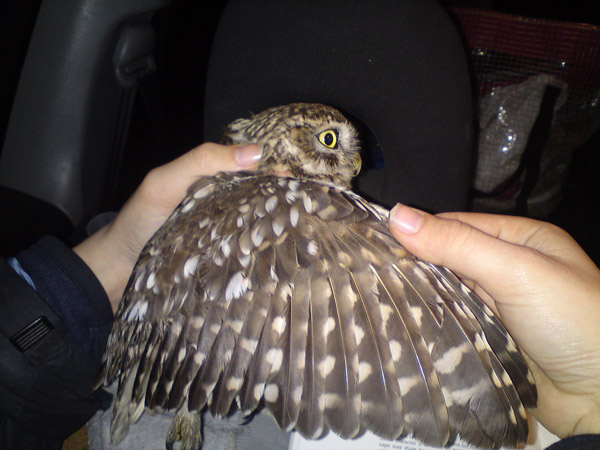
Back in Hampshire for the weekend of 19/20th February, and it was back down to Manor Farm Country Park for some bird ringing. The weekend began with an evening visit to try to catch some owls; there are at least two pairs of little owl on the park, so that species was to be the target. I put the nets up in a gap between two buildings, as I have seen owls flying between these buildings previously, and........

Adult Female Little Owl Manor Farm CP February 2011  ©T. D. Codlin

........within half and hour we had one. I would like to point out that the neatly manicured nails and delicate hands are not mine but Izzy's, who is one of my enthusiastic trainees. This is only the third Little Owl I have caught at this site, the two previous were captured in 2003 and 2006, in the middle of the day.


Adult Female Little Owl Manor Farm CP February 2011  ©I. R. Phillips


Stupidly I left my camera at home, but was saved by Izzy who had luckily brought hers (these are my old gnarled hands!!!). When you look at the size of this bird in relation to my hands you can see what a compact little bird it is.


Adult Female Little Owl Manor Farm CP February 2011  ©I. R. Phillips
The following morning we were back at Manor Farm CP for an early morning ringing session. In all we captured 28 birds, which included a haul of 12 redwing and the usual blue and great tits. Several birds were re-trapped, with the highlight being a long-tailed tit which was originally captured in December 2006 (4 years and 59 days before) and a dunnock which was originally captured in July 2007 (3 years 226 days before).


The session ended with another little corker...a treecreeper. This is another species which I don't catch very often, and this individual was the eighth to be have captured at Manor Farm.


Treecreeper, Manor Farm CP February 2011 ©T. D. Codlin

Related Posts Plugin for WordPress, Blogger...