Showing posts with label Wall Brown. Show all posts

Tuesday, 7 October 2014

Birding in Cornwall - October 2014

This last week I have been on a family break in Cornwall. I was hoping to connect with some good birds whilst down here, and at the very least see some migrants. We were based at St Merryn, on the north coast and within walking distance of Trevose Head and the Stepper Point/Crugmeer area. 

Booby's Bay - Cornwall

The first spot I birded at was Booby's Bay, which is located on the Trevose Head peninsula. There was limited bush cover on the headland itself, but there was plenty around Booby's Bay and the nearby golf course. Birding was tough and there were very few migrants to be found, in fact the most numerous species was Northern Wheatear, with four birds present one evening, otherwise it was just a scattering of Chiffchaffs.

Northern Wheatear's - Booby's Bay
Around 30 Oystercatchers, a Curlew and a Turnstone were feeding regularly on the rocks in the bay and Northern Gannets were present offshore. Whilst scanning over the bay I noticed a dead seal pup being washed in on the rising tide. On closer inspection it appeared to have been in the water for a while as fur had started to lift from its skin, particularly around the head and face. Blood was still present from what appeared to be its umbilical cord, suggesting that it might have been still born. Looking at the head shape it looked like it was a Grey Seal pup.

Dead Seal Pup - Booby's Bay

The Crugmeer/Stepper Point area was my favoured birding area. The meadows were full of Meadow Pipits, Linnets and Skylarks, and there were plenty of Stonechats present. A small wooded valley that leads to Harbour Cove, had lots of potential for migrants and the adjacent cabbage field was popular with Meadow Pipits and Linnets. There was a report of a Lapland Bunting on one day, but I couldn't find it.

Stonechat - Crugmeer/Stepper Point

Despite the lack of birds there was a good variety of butterflies present, Small Copper, Clouded Yellow, Small and Large White, Red Admiral, Speckled Wood, Small Tortoiseshell, Peacock and Painted Lady were recorded regularly, but the most numerous species was Wall Brown, a species which is quite uncommon in Hampshire these days.

Small Copper - Crugmeer/Stepper Point
Wall Brown - Crugmeer/Stepper Point
Wall Brown's - Crugmeer/Stepper Point

On the 2nd October I met up with a mate and spent the day birding the valleys west of Penzance. We visited Porthcurno, Polgigga, Porthgwarra, Nanquidno, Kenidjack, Bottalack Head and Pendeen. There was little to report of note, Chiffs were present at most places, we had a few Goldcrests, a Blackcap, six Jays at Polggiga was apparently notable, but for me the best birds were two Choughs at Kenidjack and a couple of Balearic Shearwaters past Pendeen. A Buff Tip caterpillar provided a bit of a distraction from the birding, and Clouded Yellows were recorded at most places.

Buff Tip Caterpillar - Kenidjack Valley

We ended the day with a visit to Ryan's Field at Hayle where two Little Stints, a Curlew Sandpiper, 100+ Dunlin and two Curlews were present. 

Another good birding area was Park Head, which we visited on the 3rd October. We walked from Porthcothan along the cliff, there were good numbers of Gannets feeding offshore, at least 40 Great Black-backed Gulls and 15 Oystercatchers roosting on one of the offshore islands. On shore there were at least 100 Meadow and 20 Rock Pipits, 50 Linnets, six Stonechats, two Wheaters and a Chiffchaff.

Northern Wheatear - Park Head

On our final day and the way home I decided to make a slight detour and call into Davidstow Airfield. I was hopeful that the overnight rain would have brought in a good yankee wader, but alas that was not to be. At least 20 Pied Wagtails were feeding over the grassland, along with a flock of around 35 Linnets and 15 Meadow Pipits.

Pied Wagtail - Davidstow Airfield

Common Ravens are regular at Davidstow, this time there were just the two, and half a dozen Northern Wheaters were still present.

Northern Wheatear - Davidstow Airfield

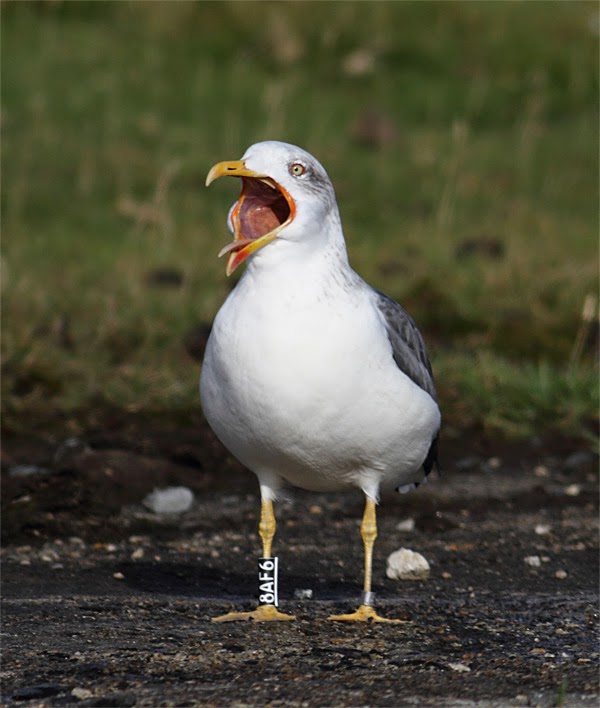
A mixed flock of large gulls was made up of mostly Lesser Black-backed, about 25 and five Herring Gulls. It is often quite easy to get close to the birds roosting on the airfield as it is possible to drive right up to them, as was the case with these birds. Two of the Lesser Black-backs were ringed, one with just a metal ring, that I couldn't read, and the other a black darvic ring, with white numbers and letters on it.

Adult Winter Lesser Black-backed Gull - Davidstow Airfield

The darvic ringed bird was an adult and having carried out a bit of research it appears likely that it is a bird ringed by Paul Veron on the Channel Islands. I will let you know when I find out the details.

Adult Winter Lesser Black-backed Gull - Davidstow Airfield

Saturday, 19 April 2014

Five go birding in Dorset - April 2014

It was a step back in time to the 1980's yesterday (18th April) when I got together with four mates for a trip to Portland for some birding. It had been a long time since I had been birding with them all at the same time, and probably even longer since we had squeezed five birders into the car. Given that it was a long weekend there had been much discussion about which day to go, but the predicted overnight cloud and light north-easterly wind made us go for Friday. Unfortunately the slight low came through early and so there was no overnight cloud, but there was still a brisk north-easterly wind.

Top Fields
We arrived early and started in the top fields. The initial lack of migrants in the first field changed in the second as a mixed flock of northern wheatears, whinchats and common redstarts fed frantically. The wheatears were spread out over the field and moving between the surrounding hedgerows. Their constant flicking between the two made them difficult to count but we estimated around 25.

Male Northern Wheatear

The whinchats and redstarts in contrast were easier to count since there were far fewer present with three and two, respectively. Birds in the bushes were generally proving more tricky to see, except that is willow warblers that were present in good numbers around the field margins. With patience we eventually managed to tease out a few blackcaps and a lesser whitethroat.

Male Northern Wheatear

From the top fields we next headed to the west cliffs. We had picked up a summer plumaged golden plover flying over earlier, this had now settled in a field, but was looking a little nervous due to a couple of inquisitive horses. A couple of common whitethroats were added to the list of migrants and a male peregrine flew over low.

West Cliffs
A steady stream of hirundines were flying along the West Cliffs. Predominantly these were made up of Barn Swallows but a handful of houses martins were also passing through. Guillemots and shags were starting to take up residence on the cliff ledges, with larger numbers sat on the water along with a handful of razorbills. Sea passage was slow; a few gannets and fulmars were lingering off shore and a sandwich tern passed by but that was about all of note.

Hut Fields and Observatory Garden
There was a report of a singing grasshopper warbler around the obs garden so we headed there next. Willow warblers were the most numerous species with the supporting cast being blackcaps and a couple of whitethroats. The grasshopper warbler was skulking in a patch of bramble to the east of the obs. It was occasionally reeling, which I found extremely difficult to hear, thereby highlighting the fact that my hearing has not yet fully recovered.

Culverwell
We next headed over to Culverwell and back up to the Top Fields. We saw a few more blackcaps and willow warblers on the way, and another reeling gropper but that was about all.

Reap Lane/Barleycrates Lane and Avalanche Road Hump
After a visit to the local pie shop for lunch we headed to the Reap Lane - Barleycrates Lane area. There had been a ring ouzel present in the morning, we did not catch up with that but we did add a few more common redstarts, whinchats and a further 24 wheatears to the daily totals.

A poor record shot of a Common Redstart

And another, this one is slightly harder to spot

A male pied flycatcher had been reported at Suckthumb Quarry, so this was our next stop. Willow warblers were again commonplace but initially there was no sign of the pied fly. We worked our way around the edge of the quarry and then into the back end of the small copse at the Avalanche Road hump. As we entered the copse we picked up the pied fly immediately, and what a cracking bird it was. Spring pied flys are not a common sight for any of us and this bird showed well for a few minutes before heading to the tops of the trees and out of sight; unfortunately we didn't find it again.

Male Pied Flycatcher

Throughout the day we recorded 10 species of butterfly, which included the typical early species brimstone, peacock, comma, small white, orange tip, speckled wood and small tortoiseshell. Species that were new for the year for us all were holly blue, wall brown and amazingly a very fresh clouded yellow.

Wall Brown Butterfly

By the end of the day we were content with what we had seen and probably slightly surprised, given the fine weather we had had throughout the day. We left Portland and after a brief stop at Lodmoor RSPB reserve headed home.
Related Posts Plugin for WordPress, Blogger...