Showing posts with label Philadelphia Vireo. Show all posts

Friday, 23 May 2014

Birding on the other side of the pond (Part 4) - Point Pelee - May 2014

It was my final day at Pelee today (22nd May) and so I headed down to the point early again. This time the overnight weather had been fine, with a clear sky and no rain. These are not usually good fall conditions, but the clear sky would at least have meant that birds were moving. I chose to walk down to the point again, rather than catch the bus, and it was evident that there had been some bird movement straight away. Flycathers were numerous with Eastern Wood-pewee, Least, Great-crested and trails (Willow/Alder) all present in good numbers. Warbler numbers appeared good too, as Black-throated Green, American Redstart and Common Yellowthroat were seen.

I arrived at the Tip and immediately picked up a Tennessee Warbler, Chestnut-sided and two Blue-grey Gnatcatchers. It seemed quieter at the Tip but as I worked my way down a Green Heron flew over, and then a birder informed me of a Black-billed Cuckoo just around the corner. I quickly went round to the spot and there it was. I set about trying to get some photos and it soon became apparent that there were two birds not one, both were giving great views.


Black-billed Cuckoo - Pelee

With the sun on the east side of the point I moved out onto the beach, as this was where most of the insects were. The two Black-billed’s had the same idea and sat on the edge of the trees in full sun, an excellent photo opportunity.


Black-billed Cuckoo - Pelee

Bird activity was buzzing with Red-eyed, Warbling and Philadelphia Vireos present, the warbler species included Magnolia, Blackpoll, Wilson’s, Bay-breasted and the ‘icing on the cake’ a Golden-Winged Warbler.


Blackpoll Warbler - Pelee
Philadelphia Vireo - Pelee 
Golden-winged Warbler - Pelee

Back at the Tip bus station I noticed a small bat roosting on a side wall. I am not that familiar with the bats of Ontario, but think this individual was most likely to be an Eastern Pipistrelle Pipistrellus subflavus, but that is just my opinion. This was the second bat I had seen in three days, the other was a large bat probably Big Brown Bat Eptesicus fuscus, at the B&B. This bat was flying around in broad daylight and tried to land in a nearby tree, before flying off.

Probable Eastern Pipistrelle - Pelee

It was time to move on from Pelee so I headed back towards my car, again walking rather than getting the bus. As I approached the main visitors centre I picked up another Black-billed Cuckoo, and then another. It is likely that the second sighting was the same bird, but it did cross my mind that the two birds at the Tip may have started to move north during the day as many birds do.

Thursday, 22 May 2014

Birding on the Other side of the pond (Part 3) - Point Pelee and Hillman Marsh - May 2014

The plan for 21st May was another early start at Point Pelee, unfortunately at dawn and for a good two hours after it poured with rain. Undeterred I headed down to the harbour at Leamington as on previous visits this had been a good place to see Forster’s and American Black Terns. I arrived during a torrential downpour and thunderstorm, but managed to find a shelter to view from. There were very few birds but what was there included six Forster’s Terns, two Bonaparte’s Gulls and a Herring Gull.

With the weather appearing to ease I decided to head down to Pelee so I was in place for when the birds started moving around. On the way I stopped at the mariner just north of the Pelee as this can often be a good spot for Belted Kingfisher, alas in the rain there were none, but a drake Scaup was present. 


Drake Scaup - Note shape of head and size and shape of black on tip of the bill

After entering the park my first stop was the North-west Beach, there are shelters at most of the trails so it is possible to bird undercover, that is if you are a fair weather birder like me. I don’t actually mind getting wet, but it is not a great way to start the day! There was very little moving in fact a single Eastern Kingbird was the only thing of note. A quick look off the beach though produced four American Black Terns.


American Black Tern

American Black Tern

American Black Tern

The Point
It was still raining hard at this point, but with the sky appearing brighter behind the weather I made the decision to head for the point. My timing was perfect as no sooner had I got off the bus, the rain eased. The conditions were calmer than the previous day which made birding a more pleasurable experience, and immediately I was into the warblers. Tennessee was first followed by a Northern Parula, another Wilson’s, Common Yellowthroat and American Redstart

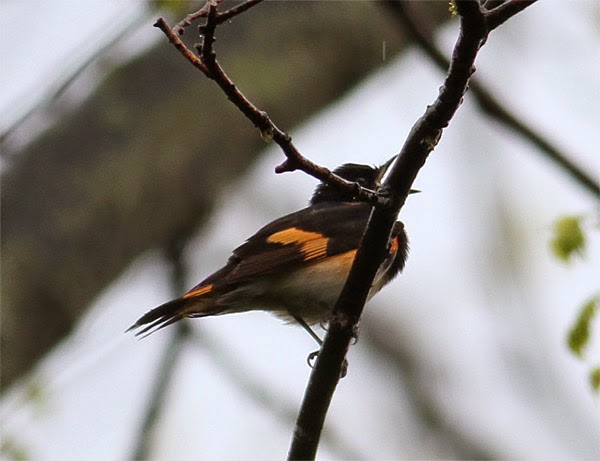
Male American Redstart

Several Black-throated Blues, alas all females, Magnolia, Nashville, Chestnut-sided, Blackburnian and a Black-throated Green. Flycatchers were more abundant with Eastern Wood-Pewee, Least, and a probable Willow seen, plus many more Eastern Kingbirds. Red-eyed, Warbling and my first Philadelphia Vireo of the trip were also seen.


Red-eyed Vireo
Philadelphia Vireo

The weather had now cleared and so I decided to walk the trails back to where my car was at the visitor’s centre. Species wise the mix was much the same as at the tip but I did manage to see Swainson’s Thrush, Blackpoll Warbler and Red-bellied Woodpecker, which were all new for the trip.

DeLaurier Homestead and Trail
With things quietening down at the point I decided to head to Hillman Marsh for some wetland birding, but thought I would make a quick stop at this trail before leaving. The trail passes through patches of scrub, poplar woodland and includes a boardwalk section. A White-throated Sparrow was feeding in the car park as I arrived and on the trail there were more American Redstarts, a pair of Common Yellowthroats, two Tennessee Warblers and a couple of Black and White Warblers.


Black and White Warbler

Black and White Warbler

Despite being one of the least colourful warblers these birds are real characters and one of my favourites. The black and white striping gives them a striking appearance and their habit of running up and down branches and trunks makes them appear more similar to the nuthatches than New World Warblers.

Hillman Marsh
I had visited Hillman Marsh back on the 19th May, my first day in the area. I had arrived at around 3pm and the wetland was full of waders, but most things were very distance since the water levels were too high. The most common species was Black-bellied Plover, Grey in the UK, with the other wader species including Dunlin (100+), Turnstone (15+), Short-billed Dowitcher (5), Semi-palmated Plover (15), Killdeer (1), Least Sandpiper (1, that I could see) and two Stilt Sandpipers. The Stilt Sands were just coming into summer plumage and looked very smart. Several duck species were also present including Northern Shoveler, Mallard, Blue-winged Teal and Gadwall.

Today the waders were even more distant, so combined with the the haze caused by the afternoon sun, viewing was not good. Black-bellied Plovers were again the most numerous but there was also a flock of 159 Hudsonian Whimbrel. Other waders included over 100 Dunlin, five Least Sandpipers, three Turnstone and a Spotted Sandpiper. Around 200 gulls and terns were also present, mostly Ring-billed Gulls, but also Herring and Bonaparte’s, three Caspian Terns and 15 Forster’s Terns. As I headed back to the car I picked up a flock of 30 Cedar Waxwing feeding on some berries from a Viburnum species. 


Cedar Waxwing
Related Posts Plugin for WordPress, Blogger...