Showing posts with label Botley Wood. Show all posts

Saturday, 18 April 2015

The Barley Birds are back again

There is an inevitable re-occurring theme with this blog, other than the obvious general birding and ringing one that is, and that is my fascination with the Common Nightingale. Every April I search traditional territories within my patch and try to establish how many there are. It can be very frustrating at times, as the secretive nature of the species means that I will hear them, but often obtain just fleeting glimpses. Over the years I have learnt the patience is the key, and that is exactly what made this mornings visit to Botley Wood a successful one. 

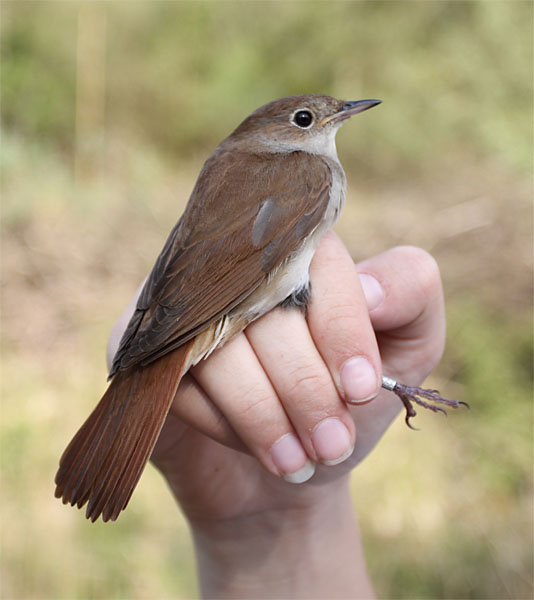
I arrived on site early, just before sunrise, and began my usual circuit. The Ravens were again very obvious, but I am barely even giving them a second glance at the moment. Blackcaps, Chiffchaffs and a few scattered Willow Warblers were still the most notable of the summer migrants, until I walked up the first ride and heard a Nightingale, my first of the year. The bird was fairly close to the path, but was on the opposite side of the vegetation to me so I crept through a small gap and waited. Although they often sit in the open, Nightingales will perch close to a branch and usually behind it if they have seen you, this makes them very difficult to pick out in spite of their loud song. My first male was in full song and very close but initially I couldn't see it. I stood and patiently waited and eventually picked out some movement in a willow tree. The bird flicked left and perched up right in front of me. At this point, the bird was in the open but I was in vegetation and so getting a clear shot was a challenge. I was eventually able to manoeuvre myself so I could get a couple of shots, while the bird continued to sing....just brilliant! This bird was an unringed male, that may be the same bird as last year as I failed to catch the bird on this territory last year.

Male Nightingale
Male Nightingale
Male Nightingale
Male Nightingale

I continued around my usual circuit and could hear two more birds, one was only giving occasional bursts of song, but the other was in full song. I decided to look for that one and was again rewarded with some great views of a singing male, this one also unringed. Whilst watching this bird a second bird was skulking in the dense undergrowth close to me. This bird was not singing but uttering the typical 'wheeling' and 'croaking' calls, so may well be a female.

Male Nightingale

I pressed on with my circuit and picked up the male Lesser Spotted Woodpecker again, Great Spots and Greens were also very vocal, th good weather was clearly encouraging them to call. As I continued it was evident that the Chiffs and Blackcaps were busy nest building. A Chiffchaff was grabbing spiders web, much the the spider's annoyance I should image, although its was better than being eaten.

Chiffchaff nest building

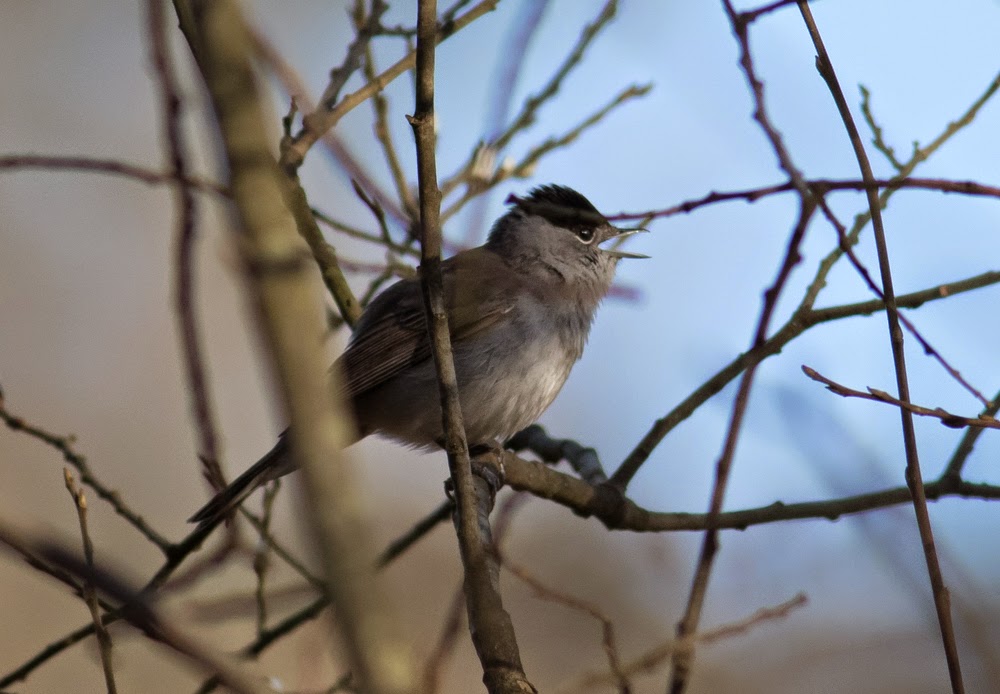
A male Blackcap was singing its scratchy sub-song whilst the female was busy nest building in a small patch of bramble. While I was watching it a second male was paying the female a bit of attention, this went unnoticed by the singing male for a minute or so, but he was quick to see off the intruder once he did.

Male Blackcap

Sunday, 12 April 2015

Botley Wood again and Blashford Lakes

In the hope that the first Nightingale would have arrived back at Botley Wood last night I started the day there with a pre-breakfast stroll. There had been a slight frost overnight but it was quickly thawing as the sun got higher. The Ravens were the most obvious birds when I arrived, one bird was sat on a pylon calling away, whilst the other roamed more widely. A couple of Bullfinch's were calling and Chiffchaff song was everywhere, well at least it appeared to be. 

Chiffchaff - Botley Wood

I took my usual route, taking in all the usual Nightingale territories, but not even a croak was to be heard. Several Blackcaps appeared to be paired up, and there was an abundance of Blackbird and Song Thrush, but yesterdays Willow Warbler appeared to have moved on. I walked all the way through to the Whiteley end and recorded several more Chiffs, Blackcaps and Bullfinch's and a single male Sparrowhawk, but that was about all of note. In spite of the early start there were a few butterflies on the wing, I recorded Brimstone, Green-veined White, Comma and Peacock, the individual below was perched high on a willow taking advantage of the sun.

Peacock Butterfly - Botley Wood

After breakfast I decided to head down to Blashford Lakes. There had been a few Little Gulls around the previous day so I was hoping to catch up with a few of them. I didn't have much time so headed straight for the Tern Hide for a view of Ivy Lake. There were loads of Black-headed Gulls present but I couldn't find any Little Gulls; I bumped into a local birder who had been there all morning and he hadn't seen them today either. There were however a few bits that made the trip worth while, 4 Common Terns were a year tick as were the two Little Ringed Plovers. I don't see LRPs very often so it was good to see them, and one bird was on the foreshore just in front of the hide. 

Little Ringed Plover - Blashford Lakes

The more I watched the close bird it became apparent that something was wrong. Rather than running it appeared to be hoping and was not covering much ground, certainly not in the way that plovers usually do. It would also regularly settle down and rest, which was quite unusual.

Little Ringed Plover - note broken leg

After while the bird turned around and it was then I noticed its right leg. The leg was either broken or deformed and was bent around 180 degrees so it faced backwards. It was also stuck at a right angle so that it didn't touch the ground but just pointed upwards. The bird seemed to be feeding OK and at one point it flew across a creek to the beach opposite the hide, it landed perfectly on its one leg and continued to feed along the edge of the water.

Close up of broken/deformed leg

Over the years I have seen loads of birds with dodgy legs and there was a one legged Redshank the frequented the beach at Hill Head for several years. Hopefully this bird will be able to survive despite its damaged appendage.

Monday, 6 April 2015

Easter Break Birding and Ringing - 3rd - 6th April

Since returning from Norway I have had little time to get out in the field, until that is this weekend. The Easter break meant four days off and the chance to get back out in the field, well at least for a bit of it. The weather was not great on Friday, and as I had a few things to do around the house I didn't venture out. I was hoping to do some ringing with Rob on Sunday morning, and so on Saturday I nipped out to look at a few sites to see what was around. Being Easter Sunday, Manor Farm was likely to be too busy, so I ended up at Botley Wood. It was again a cool and overcast day and there was very little to report on the migrant front, singing Chiffchaffs being about it. There were of course other resident species present, the most obvious being the pair of Ravens, but also several Buzzards, Bullfinch, Green Woodpecker, Stock Dove, and Blackbird. As I was working my way back to the car I heard a Lesser Spotted Woodpecker calling, but was unable to find the bird.

As there was not much happening at Botley Wood, we decided to have a ringing session in my garden. There had been a good mix of species coming into the garden during the week so it seemed like the best option. We opened a net at 7:30 and it was not long before we had a few birds to work on. We had a steady session that resulted in the capture of 22 birds of eight species, Goldfinch (9), Blue Tit (5), Greenfinch (3) and Bullfinch, Dunnock, Goldcrest, Blackbird and Chaffinch.

Female Bullfinch - this bird was a 2cy bird with retained juvenile greater coverts, which are visible in the image above

Adult Male Greenfinch - There is no disputing how stunning male Greenfinch's are, this bird was a retrap that was ringed in my garden 2 years earlier.

The Chaffinch was a 2cy male, it had one retained juvenile greater covert and also retained primary coverts and alula; the central tail feathers were also juvenile. Unfortunately, we were unable to ring the bird since it had growths on its legs, and I therefore just went through the ageing with Rob. The growth of the legs is caused by one of two things, mites of the genus Knemidocoptes or the Fringilla papillomavirus. Details of both can be found on the British Trust for Ornithology website

Growths on leg of male Chaffinch

The weather on Monday morning was glorious, and almost cloudless sky, warm and sunny. There were no plans to ring but I had heard that there had been a bit of a fall along the coast and so nipped down to Lee-on-Solent for a stroll. I did not see many birds, but did pick up my first Wheatear of the year on the beach. I next headed back to Botley Wood to see if any migrants had arrived, but bird wise it was pretty much the same as Saturday. On the invertebrate front things were better though, as I saw four species of butterfly, Brimstone, Peacock, Green-veined White and Comma, Green Tiger-beetle, and several Bee-flies. Several Common Lizards were also basking in the grassland, which were my first reptiles of the year.

A very spring like Botley Wood 

Sunday, 15 June 2014

Quantity and Quality whilst Bird Ringing

I managed two ringing sessions this weekend, the first was yesterday (14th June) afternoon in my garden and the second was this morning at Botley Wood. The sessions were entirely different with one being made up of a large quantity of a Blue and Great Tits whereas the other was made up of predominantly quality birds, such as Whitethroats, Blackcaps and Garden Warblers.

Garden Ringing - 14th June
Over the last couple of weeks I have seen increasing numbers of birds returning to the garden feeders, but I just hadn’t had the time to put a net up. The most numerous species are Blue and Great Tits, and so not everyones cup of tea, but I don’t mind ringing them. If I want to put a net up in the garden to try for other species, then the tits are just a by-product. But its not all bad as it is possible to build up some good longevity data through retrapping the same birds. In fact only this week I heard back from BTO HQ, that a Blue Tit that I had ringed on 31st December 2008 was killed by a neighbours cat on 9th May 2014, 5 years and 129 days since ringing. This is not a record by any means, that stands at 9 years, 9 months and 2 days, but it is a good age for a species that on average survives for just 3 years (according to BTO facts). Interestingly this bird had not been re-trapped since its original ringing date, but was evidently still in the area.

This session was made up of 39 birds of which 18 were Blue Tits and 14 were Great Tits, all of the tits were new birds, and all except one were juveniles. The remainder of the birds were made up of two Dunnocks, two Greenfinch’s and single House Sparrow and Nuthatch. The only re-trap was one of the Dunnocks, which was originally ringed on 28th October 2011. My first juvenile Greenfinch of the year was trapped, and whilst this bird was clearly a juvenile, its tail was broader and not as pointed as other juvenile feathers I have seen in the past.


Juvenile Greenfinch - note streaking on breast
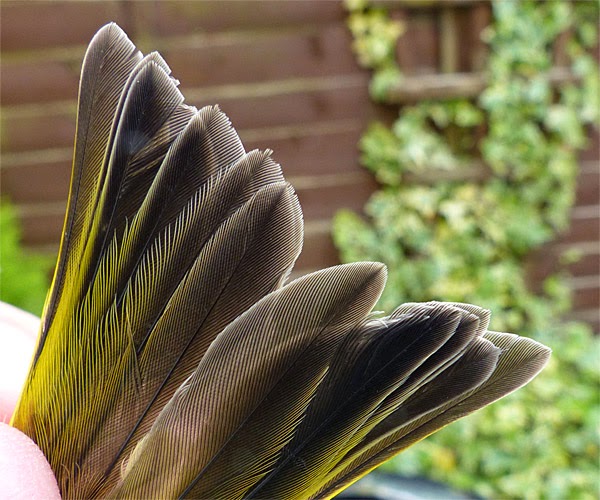
Juvenile Greenfinch Wing - note the brown fringed greater coverts and
pointed primary converts
Juvenile Greenfinch Tail - this tail is broader and not as pointed as many
juvenile greenfinch tails that I have seen. It will obviously wear over time
but it is always worth looking at a combination of features when ageing birds.

Botley Wood Ringing - 15th June
This session required a 5am start which was not idea since I had stayed up late to watch the England vs Italy match. Given the result I wished I hadn’t but we make these mistakes in life, when it comes to watching England playing football I never seem to learn! It was a steady morning that resulted in 30 birds from only four nets. Unlike my garden, only two tits were caught, one blue and one great. The most numerous species was Common Whitethroat, with nine birds ringed, followed by Chiffchaff, with eight birds ringed.


Juvenile Chiffchaff - the plumage is very fresh and fluffy; a yellow gape
is still obvious

Two of the whitethroats were retraps, one from 2nd June 2012 and one from 1st May 2013, four were adults and five were juveniles. This was great training for Chris who was able to compare the differences between adult and juvenile whitethroats in prep for the autumn at Titchfield Haven. 


Adult Whitethroat - note pale iris
Juvenile Whitethroat - note dark iris - when ringing whitethroats in the
autumn always check the eye as the colour of the iris will give you a clear
clue to the birds age

Similarly the Chiffchaff numbers were made up of adults and juveniles, and so it was possible to compare the different ages. The other species ringed were four each of Blackcap and Garden Warbler and three robins. Surprisingly, we did not catch any juvenile Garden Warblers or Blackcaps, I would have certainly expected some to be on the wing: the robins were all juveniles. 

Saturday, 14 June 2014

Orchids, Butterflies and Dragonflies in Botley Wood

My planned early morning ringing session had to be cancelled due to heavy rain on the south coast, which didn’t really seem fair as the rest of Britain seemed to be basking in glorious sun. That said the lie in was very welcome. After the rain had cleared I hung around the house for a while before heading over the Botley Wood for a stroll.

Bee Orchid

Several weeks ago I had seen the leaves of a bee orchid that had flowered two years ago, but last year it was devoured by rabbits. I had been covering parts of the plant up in the hope of hiding it from the little critters, but had forgotten about it since my return from Canada. I was pleased to see that it had escape the attention of the rabbits, since it was now in full bloom. Quite how it had escaped I do not know since it was surrounded by rabbit droppings, and the leaves and one of the flowers had been nibbled. Hopefully it will survive for a few more years yet.

Bee Orchid - Note the leaves and part of the lower
flower have been eaten by rabbits

The verges on either side of the substation road were in full bloom too, and Common Spotted Orchids were abundant in places. I noticed that my net rides will be in need of some trimming, which I will do before erecting the nets next time I go there.

Common Spotted Orchids

Bird wise it was fairly quiet, but that was hardly surprising as it was the middle of a hot sunny day. Several species were singing occasionally, but two species, Wren and Chiffchaff were singing almost continuously. I did hear a burst of Garden Warbler and also occasional Willow Warbler too, but not a sniff of any Common Nightingales. Butterflies and particularly dragonflies on the other hand were very active. During the course of my walk I recorded Large Skipper, Meadow Brown, Red Admiral, Brimstone and my first Marbled White of the year. Brimstone was the commonest species with seven recorded, the majority of which were females.

Brimstone on Marsh Thistle

At Toby’s Pond dragonfly activity was immense. There were at least 20 chasers hunting over the pond, and from what I could make out they were Broad-bodied Chasers and Black-tailed Skimmers. Damselflies were also abundant with Large Red, Blue-tailed and Common Blue the main species present.

Female Black-tailed Skimmer

There are several woodland streams running through the Botley Wood/Whiteley Pastures area and where sunny woodland glades are present so were Beautiful Demoiselles. The males were sparring over the stream and settling back onto a favoured perch, which was a fallen tree of an overhanging leaf. Beautiful Demoiselle is a locally common species that occurs on flowing waters in the south and west of Britain. 

Male Beautiful Demoiselle

They are apparently an indicator of unpolluted waters which is a good sign since I recorded them in three locations in Botley Wood.

Monday, 5 May 2014

Botley Wood Bird Ringing Again - May 2014

I have now found six common nightingale territories in the vicinity of my Botley Wood study area, so I decided that much of the bank holiday weekend would be spent trying to catch some. The weekend started well with a second new bird of the year caught at a previously unused or unknown location. Unlike the first bird of the year, this bird was a bit more tricky to age, at first glance there were no obvious pale tips to the wing feather coverts, thereby suggesting it was an adult. However on closer inspection a pale covert tip was present on the outermost greater covert, so I aged this bird as a 5.

Common Nightingale - the second new bird of the year

Unfortunately, the good start to the weekend did not continue as this was the only nightingale caught, but at least I did get to colour ring this one. Since my last ringing session, there has been a mass arrival of garden warblers, with a least six males on territory. Despite my nets being located in many of their territories only one bird was trapped and ringed.

Garden Warbler - Botley Wood

Typically adult and juvenile garden warblers undergo a complete winter moult and therefore it is not be possible to age them in the spring. Common whitethroats were also much more evident, with at least four territories present. Three birds were trapped during the session, one new bird and two retraps, one that was ringed in May 2013 and one that was ringed in May 2012. 

Adult Male Common Whitethroat

Ageing and sexing common whitethroats in the spring can be problematic for anything other than an adult male. This bird was originally ringed in May 2012 as a male bird, and therefore being two years since ringing, this bird was definitely an adult. The first give away to its age was the colour of the iris. Svensson describes the colour as orange or reddish-brown, which pretty much describes the colour of this individuals eye.

Adult Common Whitethroat 

In a male bird the throat should be white, and the crown, ash-grey, but admixed with brown, and the breast should have a pinkish flush on the breast. This bird was certainly showing a white throat and when the head feathers were raised up they were extensively grey, but this individual lacked the pinkish wash on the breast. The final feature is that the outer tail feather should be pure white, which it was on the outer web but not the inner web. There was no doubt that this bird was a male though, as on release it flew to the nearest bush a sang.

Adult Common Whitethroat Tail

By the end of the session we had ringed 20 birds which included chiffchaffs, robins, long-tailed tits, blue tits, a blackcap and a female bullfinch. After the session I went for a wander and saw that some moorhen chicks had hatched. There were two chicks and despite the best intentions of their parents they appeared not to have learnt the alarm call yet as they swam straight up to me. Unfortunately moorhen chicks have a tarsus that develops slowly and therefore when they are this small it is not possible to ring them.

Moorhen Chick

This time last year I saw both grizzled and dingy skipper, but I only saw dingy this weekend. The one individual that I saw seemed to have a deformed hindwing on one side, but it still seemed to be flying ok.

Dingy Skipper Erynnis tages

After a good start to the year at Botley Wood butterfly numbers seem to have dropped off, as this weekend I only saw four species, brimstone, orange tip, peacock and the skipper, and only singles of each.

Tuesday, 29 April 2014

The First Common Nightingale of the Year - April 2014

I had a spare couple of hours last night (28th April) and so headed down to Botley Wood with Mark Cutts in the hope of catching my first common nightingale of the year. We headed to an area where I had seen an un-ringed male bird that appeared to be already paired, back on the 24th April. A bird was singing as we arrived, but much further back in the vegetation than I had seen it, but given my experiences last year, I presumed it was the same bird. Last year I had ringed a new male at this location and had colour-ringed it, so it was slightly disappointing that it had not returned. We put up a couple of nets, and almost on command the male bird flew back to the main track, where one of our nets was, and began to sing. The bird was very excited and singing in full view before heading down the hedge and straight into our other net.


First year male Common Nightingale - Botley Wood

The bird was un-ringed and therefore was presumably the bird I had seen a few days before. It was first year bird (hatched last year) which was immediately evident due to the pale tips to five old greater coverts, the primary coverts (see below) and the tertials.

Pale tips visible on outer five greater coverts and tips of primary coverts

The BTO have recently changed the ring sizes for some species. Previously adult birds were ringed with an A size and pullus with a B size, now A and B can be used for adult birds. I have often felt that an A ring was a little too small, and this was the case for this bird too so I opted for a B. The only annoying thing was that in my haste to get out I forgot to pack my colour rings, that will have to wait until next time.

This year looks like it might be quite a good one, since I personally have recorded five singing males so far and have heard of two others, so hopefully some got re-traps among them.

Sunday, 13 April 2014

Botley Wood Bird Ringing - April 2014

It was a dawn start this morning with the first proper ringing session of the year at Botley Wood. I say first proper session because we have done some ringing but that only involved a couple nets, that we put up whilst cutting in net rides. Over the last few days there has been a mass arrival of migrants nationally, but this has not been reflected during my visits to Botley Wood, where only a few blackcaps and chiffchaffs have been evident.

We put five nets up in total all along the main access road. This area used to be the best place to catch common nightingales, but as a result of extreme habitat management when the overhead cables were replaced, the last two years have seen none there. There have already been a couple of nightingales reported in the country so I was hopefully optimistic that one would have arrived but not expecting it.


Male Blackcap - One of 12 new birds ringed at Botley Wood

As it turned out my optimism wasn't rewarded and we didn't catch any nightingales, but we did catch good numbers of blackcaps. There were a few blackcaps singing when we arrived so we expected to catch a few, but 12 birds surpassed that expectation by a long way. The twelve birds were made up of seven males and five females, and a mix of adult and first year birds. The first year birds were aged by the presence of retained juvenile greater coverts. Brown in the crown of males, pointed tail feathers and extent of abrasion on wing and tails feathers are also ageing criteria, but I would not use these features in isolation.

The only other migrant species trapped were two chiffchaffs, one male, which was sexed by virtue of a long maximum wing chord (64mm) and the fact that it sang as soon as it was released. The other was probably a female since its maximum wing chord was 55mm.

We also trapped plenty of resident species including wren (2), great tit (3), blue tit (14), a dunnock, coal tit (4), long-tailed tit (2) and a robin. The final total was 41 birds of nine species, which is the best session total we have had at Botley Wood for a few years.


Four new Coal Tits were ringed, two pairs. All of the Coal Tits were age
code five, so hatched last year.

Each Coal Tit was aged by the presence of retained juvenile greater coverts.
These were identified due to a contrast in the colouration of the leading edge of
 the greater coverts. In retained juvenile feathers the leading edge is dull
brown in colour but grey on the adult feathers, as above.

Other species recorded during the ringing session included two ravens, goldcrest, bullfinch, blackbird, goldfinch and a siskin. 

Saturday, 27 April 2013

In Search of the Barley Bird....

After a couple of days wandering around Botley Wood looking for common nightingales, the aim today was to try and catch some. The plan was to start at 6 AM, but after what can only be described as a slightly tardy start by Izzy, we eventually started at 6:45. It had been cold overnight and with the exception of blackcaps, chiffchaffs and willow warblers there was not much in song. 

We started at the first territory, and were soon listening to, and watching a male nightingale singing. That was expected, but the surprise was that this bird appeared to be paired, because a second bird was working its way to and fro along the hedgerow 'wheeting' and 'croaking'. Unfortunately neither bird ventured into the net.

Adult Male Nightingale

Our next stop was the territory where I had managed good views of a singing male last week. This bird was again silent, but we could hear more 'wheeting' and 'croaking', perhaps indicating that this bird was also paired. I knew that this bird was unringed and soon we had captured and ringed it. The bird was an adult male with a wing of 85mm and a weight of 21.8 grams. I have been studying the species since 1998 and as part of the study I colour ring birds so that I can observe individuals in the field. 

Adult Male Nightingale - looking very dapper with his new colour rings

We waited in the hope that we might catch a female but unfortunately we failed. We packed away our nets and headed off in search of the next territory past one of the on-site ponds. Great crested newts breed at this site so we stopped to check for any evidence and soon found loads of leaves folded over in the distinctive newt way. Unfolding, one of the leaves we were able to confirm that inside were the eggs of great crested newt. At this point I should point out that you need to be licenced by Natural England to disturb great crested newts, and both Izzy and I are, and so we were not committing any offences.

We pressed on and went to check out an area of land which is not part of the reserve, but we have permission to enter. As were approached the area we immediately heard a drumming woodpecker, which sounded more prolonged and rapid for great spotted. We hurried to the area and soon found a male lesser spotted woodpecker drumming on a dead tree.

Male Lesser Spotted Woodpecker

This is a very difficult species to see these days, but one that I have seen at Botley Wood before, but only once. This bird was a great performer and gave us some prolonged views before flying off in a northerly direction.


Male Lesser Spotted Woodpecker

We spent a while searching the area looking for suitable nesting trees and a female but unfortunately we had no joy. Nonetheless we were so pleased to have found this bird, in fact I was planning an early start to look for them at Manor Farm Country Park tomorrow...maybe I will have a lie in!

Male Lesser Spotted Woodpecker

Whilst waiting for the bird to return Izzy started looking beneath some wooden cladding on a small shed, and before long she had found some bat droppings and a roosting pipistrelle bat....what a day!

Tuesday, 1 January 2013

Happy New Year and a Barley Bird in France

After a frustrating week without any broadband connection I would like to start this blog by wishing all readers of this blog my best wishes for 2013, and may your year be filled with many wildlife adventures.

I thought I would start this year with news of an interesting recovery of one of the nightingales that I had previously ringed at Botley Wood, Hampshire in April 2011. The bird was originally ringed on 21st April 2011, as a first year, therefore hatched in the summer of 2010. It was fitted with individually identifiable colour rings, but unfortunately it was not these that generated the recovery.

First Year Common Nightingale 21st April 2011

On the 27th June 2012 (433 days after its original ringing date), this bird was found freshly dead in the Vienne region of France 488 kilometres to the south of its original ringing site, having hit glass. This is the first foreign recovery of one of the Botley Wood ringed nightingales which is exciting in itself, but the date of the recovery is something that has got me thinking. 

Common nightingales typically arrive at Botley Wood from mid April and are usually paired up and nesting by mid May. Their chicks tend to hatch around early to mid June and by late June/early July they are fledging the nest. From mid to late July adults undergo a complete moult before migrating around early to mid August. Adult birds show a high degree of site fidelity, and will return to the same territory year after year, so seeing that this bird had been recovered in France in late June got me thinking what it was doing there.

My first thought was that the bird had failed to find a mate in the previous year and had decided to stay in France to breed during the 2012 breeding season. This strikes me as very unusual behaviour, given the level of site fidelity previously exhibited by the species at Botley Wood. Alternatively, it could be that this bird usually breeds in this region of France but had over shot the previous year and ended up at Botley Wood.

My second thought was that the bird had returned to Botley Wood but had not been a successful breeder during 2012 and therefore had began its autumn migration early. There are two reasons why this may have happened; the weather during 2012 was very bad and many species had poor breeding success, given that nightingales are only single brooded in the UK, a failure could instigate an early southward movement. This was certainly experienced with some species during 2012, whereas as other species stayed on their breeding grounds and had very late broods. The second reason may be due to a lack of habitat at the breeding site. During 2012 the National Grid replaced overhead power cables that pass over parts of the site, in doing this they removed all of the scrub where this bird was holding a territory in 2011. Therefore it may have returned and been unable to find a suitable nesting location and/or a mate and moved back south.

My third thought was that the bird had been held up on its northward migration due to bad weather over the Mediterranean in the spring, but a delay of two months from its normal arrival date is probably too much of a delay for this to be the case.

Unfortunately I will never know the answer but it is still a very interesting recovery that will keep me wondering for a while yet.

Saturday, 14 April 2012

The Barley Birds are Back Again!

I spent much of yesterday morning (13th April) walking around Botley Wood in search of the first Common Nightingale of the year without success, only to hear a report of one when I got home in the evening. I had planned to ring there this morning anyway so set off early and was greeted with not one, but three singing males. Enthused by their presence I set my nets in some usual positions, but also in locations where Nightingales were singing, and was rewarded with a retrap male on my first net round. This bird was originally ringed, and colour-ringed, as a first year male on 30th May 2009, therefore it was hatched in the summer of 2008, making it nearly four years old.

Adult male Common Nightingale originally ringed on 30th May 2009
as a first year male


Whilst walking around yesterday I heard the first Willow Warbler of the year, and today I caught one. The number of breeding birds at Botley Wood has crashed in recent years so it was nice to hear that at least one bird was back! Both adult and first year Willow Warblers undergo a complete moult on there wintering grounds and therefore it is not possible to age them in the spring, but given that this bird was singing and had a 68mm wing, it was sexed as a male.

Willow Warbler


Blackcaps have been singing at Botley Wood for a few weeks now, but I have struggled to catch any, today however I did catch a male. 

First Year Male Blackcap

This bird had extremely abraded primary and tail feathers, and still had brown fringed feathers on its forehead, thereby confirming it as a first year male bird.

First Year Male Blackcap

Just as I was packing up two local birders stopped for a chat and reported two more Common Nightingales and a Common Whitethroat further along the track from me. This would take the number of singing male Nightingales to at least five, so there must have been an arrival overnight. I walked along to where they had seen their birds and did hear one, but failed to see or hear the Whitethroat. I did find another Water Shrew under a sheet of aluminium though and a couple of Mandarin Ducks were flying around.

Looks like Spring may have finally arrived at Botley Wood!!!
Related Posts Plugin for WordPress, Blogger...