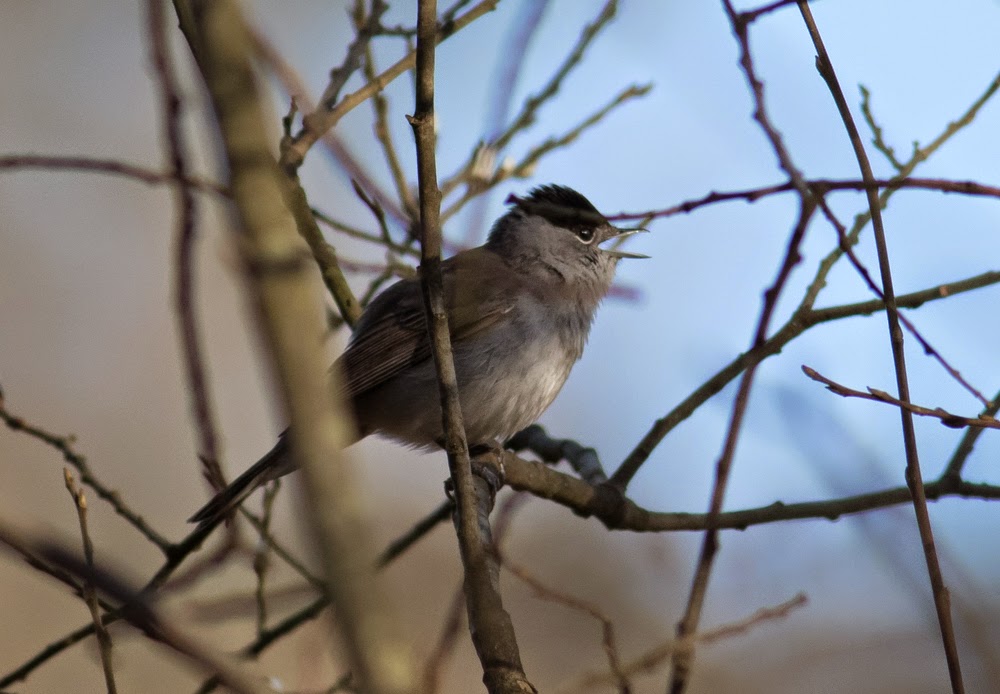
Showing posts with label Blackcap. Show all posts

Thursday, 22 October 2015

Titchfield Haven - Late October update

Typically at this time of the year the frequency of suitable ringing days declines, as does the number of birds that we catch. This year hasn't quote worked like that, in that the weather has been generally set fair, and just as we thought the number of birds was declining, we suddenly have a good day. Since my last post we have ringed on seven occasions with the totals varying from 25 on 16th to 95 on 20th. 

In contrast to earlier in the year, Chiffchaff has become the commonest species, with Blackcap and Goldcrest making up the supporting cast. Blackcap numbers are now well and truly at a record level with 964 birds ringed, Chiffchaff numbers stand at 500. A catch of 27 Goldcrests on 20th October has taken the total to 76 for the year; a very respectable total for us but not unexpected given the numbers recorded on the east coast. 

Female Goldcrest

Again, not unexpectedly two Firecrests have also been trapped, a species that we never get bored with ringing.

Male Firecrest

We have not caught any more Sedge, Willow, Grasshopper or Garden Warblers, but have added the occasional Whitethroat and Reed Warbler. There is always a tinge of excitement when we find a Reed Warbler at this time of year, but as yet they have all been just reeds. A comparison of key species up to 26th October from 2010 - 2014 and up to 22nd October for 2015 is below.


With the key species now tailing off, others have started to increase. We have been regularly catching new Robins and our total now stands at 78, 17 Bearded Tits, 18 Lesser Redpolls, a record for the site, 14 Reed Buntings and seven Song Thrush. Ten Kingfishers is a very good total for the site.

To date the total number of new birds ringed since July stands at 3778 of 37 species.

Tuesday, 15 September 2015

Mid-September Ringing Update

I wasn't intending to do another mid-September update as the weather last weekend didn't look that great and so I thought any ringing was unlikely. However, as it turned out the conditions on Sunday 13th were perfect. It was evident first thing that it was going to be a good day as the nets were 'dripping' with birds on the first round. We were so busy that Barry and I alternated extracting and ringing whilst Maggie patiently scribed. By the end of the session we had ringed 267 new birds and had two controls, one Chiffchaff and one Blackcap and our second Common Redstart of the year, which was a cracking male.

Of course having caught so many birds, it dramatically altered the totals for the year to year comparisons, so I thought I should update the blog to reflect this, and bring it in line with the September 14th date used in previous years. The story with Sedge Warbler is still down, and well down at that, with this years total 40% below our average for the time of year. By contrast, the Reed Warbler is having a fantastic year, and the total is 58% up on the average, and heading towards our highest ever annual total. 

Summary of Key Species Ringing Total up to 14th September

Grasshopper Warbler numbers are still trickling along, but with the total now standing at 118 numbers are over 260% below average. Other species totals below average are Willow Warbler, at 7% down, Garden Warbler at 34% down and Whitethroat at 2% down. 

The winners, as well as Reed Warbler, are Chiffchaff at 38% above average and the real winners Blackcap with a total of 448 birds ringed so far. This total is 116% above the average for the time of year, and if the pattern continues could see Blackcap elevated to the most numerous species ringed this year. In total we have ringed 2472 birds of 29 species, to date.

Saturday, 18 April 2015

The Barley Birds are back again

There is an inevitable re-occurring theme with this blog, other than the obvious general birding and ringing one that is, and that is my fascination with the Common Nightingale. Every April I search traditional territories within my patch and try to establish how many there are. It can be very frustrating at times, as the secretive nature of the species means that I will hear them, but often obtain just fleeting glimpses. Over the years I have learnt the patience is the key, and that is exactly what made this mornings visit to Botley Wood a successful one. 

I arrived on site early, just before sunrise, and began my usual circuit. The Ravens were again very obvious, but I am barely even giving them a second glance at the moment. Blackcaps, Chiffchaffs and a few scattered Willow Warblers were still the most notable of the summer migrants, until I walked up the first ride and heard a Nightingale, my first of the year. The bird was fairly close to the path, but was on the opposite side of the vegetation to me so I crept through a small gap and waited. Although they often sit in the open, Nightingales will perch close to a branch and usually behind it if they have seen you, this makes them very difficult to pick out in spite of their loud song. My first male was in full song and very close but initially I couldn't see it. I stood and patiently waited and eventually picked out some movement in a willow tree. The bird flicked left and perched up right in front of me. At this point, the bird was in the open but I was in vegetation and so getting a clear shot was a challenge. I was eventually able to manoeuvre myself so I could get a couple of shots, while the bird continued to sing....just brilliant! This bird was an unringed male, that may be the same bird as last year as I failed to catch the bird on this territory last year.

Male Nightingale
Male Nightingale
Male Nightingale
Male Nightingale

I continued around my usual circuit and could hear two more birds, one was only giving occasional bursts of song, but the other was in full song. I decided to look for that one and was again rewarded with some great views of a singing male, this one also unringed. Whilst watching this bird a second bird was skulking in the dense undergrowth close to me. This bird was not singing but uttering the typical 'wheeling' and 'croaking' calls, so may well be a female.

Male Nightingale

I pressed on with my circuit and picked up the male Lesser Spotted Woodpecker again, Great Spots and Greens were also very vocal, th good weather was clearly encouraging them to call. As I continued it was evident that the Chiffs and Blackcaps were busy nest building. A Chiffchaff was grabbing spiders web, much the the spider's annoyance I should image, although its was better than being eaten.

Chiffchaff nest building

A male Blackcap was singing its scratchy sub-song whilst the female was busy nest building in a small patch of bramble. While I was watching it a second male was paying the female a bit of attention, this went unnoticed by the singing male for a minute or so, but he was quick to see off the intruder once he did.

Male Blackcap

Wednesday, 15 April 2015

Swanwick Lakes and Manor Farm Country Park

Rob and I had a planned ringing event at the Hampshire & Isle of Wight Wildlife Trust's Swanwick Nature Reserve today (15th April) so we decided to check out the area the night before. We were planning to ring in the north-east meadow and had identified some areas that looked good for a net ride and put up some feeders to attract a few birds in. We cut in three net rides with enough space for four 18 metre nets and left each one open for a while. It was a worthwhile exercise as it turned out because we caught 21 birds, eight each Great and Blue Tits, two Wrens, two Marsh Tits and a Robin.

This morning we arrived on site at 05:45, it had been a clear night and was colder than expected. We hoped that there might be some migrants around, but our first bird was one of the residents, a female Great Spotted Woodpecker. The event went very well and the attendees were able to see Blackcaps, Chiffchaffs, Great Tits and a Goldcrest close up.

Female Blackcap - Swanwick Nature Reserve

After our ringing event had finished Rob headed back with the group to check out the moth trap, whilst I kept an eye on the nets. I continued to catch birds and by the end of the session we had ringed 19 birds, six Great Tits, three Chiffchaffs, two Blackbirds, two Blackcaps and single Great Spotted Woodpecker, Wren, Dunnock, Goldcrest, Marsh Tit and Coal Tit. Over the two sessions we had ringed 40 birds of 12 species so a good quantity and mix or species.

Marsh Tit - Swanwick Nature Reserve
Coal Tit - Swanwick Nature Reserve

Later in the afternoon, I decided to pop down to Manor Farm Country Park for a spot of birding. My intention was to try and find Lesser Spotted Woodpeckers, as I had heard them there recently, but at this time of year there is always the chance of something else. As it turned out I stumbled across a Lesser Spot straight away, and so spent the rest of the time generally birding. Blackcaps and Chiffchaffs were present in good numbers and as I worked my way around the fields I picked up my first Common Whitethroat of the year. I headed into the woods, working my way to were the Lesser Spots bred last year; I did not find them but did find a breeding pair of Marsh Tits hanging around their nest hole.

Marsh Tit - Manor Farm Country Park

After a while I headed to the estuary in the hope of a Whimbrel. It was very busy on the water so the only wader was an Oystercatcher, along with four Little Egrets and a few Black-headed Gulls. I decided to head home and started working my way back to the fields; as I did so a Red Kite drifted overhead, my second patch year tick of the day. I passed the area where the Whitethroat was, it was again in full song but was now only giving brief glimpses. As I approached my car I noticed a chat sat on the barbed wire fence around the overflow car park. I was expecting it to be a Stonechat, which would have been a good bird, but it was in fact an adult male Whinchat, so a truly exceptional bird. It was fairly approachable and perching on prominent places as they do. A cracking bird and my third patch year tick of the afternoon.

Whinchat - Manor Farm Country Park

Back at home, I decided to sit in the garden and go through my pictures. I had only been out there a couple of minutes when I heard the distinctive mewing call of a Mediterranean Gull, and there above the garden were two adults. Although it wasn't a patch year tick it was a nice species to end the day on.

Adult Mediterranean Gull

Tuesday, 18 November 2014

Titchfield Haven - End of Year Summary 2014

After what has been a generally successful season at the Haven, we have hung up our bird bags and migrated to other sites. The season ended with a total of 4651 full grown birds, one pulli, and 259 retraps of 44 species, bringing the grand total to 4911. The undoubted highlights were the Pallas' Grasshopper Warbler, the Cuckoo and the Yellow-browed Warbler. Besides the rarity highlights there were also some record catches for our standard fare, namely Robin, Blackcap and Willow Warbler. Other highlights included the first Woodcock for the site, the Wood Warbler and the Pied Flycatcher. Having now entered all the totals into IPMR there have been some slight amendments to the totals, with Willow Warbler slightly down to 268 and Grasshopper Warbler up to 341.

Table of Ringing Totals for 2014 in the autumn ringing area, the numbers
in red represent highest or equal highest totals for the site.

I have previously posted graphs showing species totals between 1998 and 2014, with trend lines to illustrate how the numbers have increased or declined over that period. For this post I thought I would show how similar species have fared over that same period, so below are comparisons for Whitethroat verses Lesser Whitethroat, Chiffchaff verses Willow Warbler, Blackcap verses Garden Warbler and Reed Warbler verses Sedge Warbler.

Comparison of ringing totals for Whitethroat and Lesser Whitethroat
Comparison of ringing totals for Chiffchaff and Willow Warbler
Comparison of ringing totals for Blackcap and Garden Warbler
Comparison of ringing totals for Reed Warbler and Sedge Warbler

It is interesting to see how the numbers of the different species have varied over the period, and how some species are just that much rarer than others. The most obvious being Common Whitethroat and Lesser Whitethroat and Blackcap and Garden Warbler. It is also interesting to note how the peaks and troughs for each species are mirrored in many cases, with fluctuations in numbers being more pronounced in species with the highest totals.

Our ringing studies will be continuing over the winter, with visits Manor Farm Country Park, Farlington Marshes and Walpole Park all planned, and from there we will see where things take us.

Tuesday, 4 November 2014

Titchfield Haven - End of October Ringing Update

With very few birds ringed at the Haven over the last couple of sessions it is probably time to move on to our winter sites. It is always difficult to close every thing down and move on, but when you catch a measly 10 birds in a session, the enthusiasm does tend to wain. Last Friday was obviously bolstered by the Firecrest and Redwing, but on Saturday there was nothing of note in the ten birds ringed.

Following on from my post of 22nd October, this post provides a further update of the autumns ringing. As expected we did not catch any more Grasshopper, Garden and Willow Warblers, nor did we catch any more Whitethroats; the totals from that post are therefore still correct. Since that last post over 200 more birds were ringed, a total that was well and truly boosted by good numbers of Reed Buntings. We have ringed a total of 4603 new birds of 42 species, with the totals for three species, Willow Warbler, Blackcap and Robin, reaching new highs. 

Ringing Totals for Selected Species from 1998 - 2014

The Sedge Warbler total was looking like that might end up being the highest at one point, but the number of birds tailed off quicker than expected. The total ended on 1225 which was the fifth highest total of all time. The graph below shows some interesting variations in the ringing totals over the last 17 years, but there is a very clear upward trend in the number of birds caught over that period.

Sedge Warbler Ringing Totals from 1998 - 2014 at Titchfield Haven

The Reed Warbler total of 693 was the second highest total ever, and once again there is a clear upward trend in the number of birds caught. The number of birds caught between 1998 and 2014 has not fluctuated as much as with Sedge Warbler, with the exception of 2002 and 2004. The last two years have produced the second and third highest ringing totals.

Ringing Totals for Reed Warbler from 1998 - 2014 at Titchfield Haven

There has been a very strong upward trend in the numbers of Blackcaps ringed at the Haven over the last 17 years, culminating in a record number for 2014. The total of 807 birds was a 14%, or 104 bird increase over the previous best of 703 in 2007. The BTO previously reported that good numbers were being recorded at ringing sites, it will be interesting to see what reasons are given for this.

Ringing Totals for Blackcap from 1998 - 2014 at Titchfield Haven

The Chiffchaff total was again a strong total, with the 611 ringed being the second highest total ever. The numbers of birds ringed over the 17 years have been fairly consistent with a slight peak in 2002, but strong peaks in 2011 and 2014. The upward trend for the Chiffchaff  is probably skewed by the massive 2011, and 2014 totals. There are still a few Chiffs passing through the site, but we have not caught any new birds for a couple of sessions.

Ringing Totals for Chiffchaff from 1998 - 2014 at Titchfield Haven

Other species totals of note are Robin, with a new high of 88, Cetti's Warbler with 61, Goldcrest with 43 and Reed Bunting with 63. Blackbird and Song Thrush numbers are down with only 23 and 8 new birds ringed, respectively.

Friday, 19 September 2014

Titchfield Haven, Mid-September Update

It is now mid-September and what started as a slow season has turned out to be an excellent autumn. As I have mentioned in previous posts, we try to use standard trapping methods at the Haven, this includes using the same number of nets, ringing on only three mornings a week and the same tape lures. This allows us to directly compare our totals year on year. Of course the birds that we catch will not necessarily be from the breeding population in the UK, but are likely to be birds from other parts of Europe, as was illustrated so dramatically illustrated with the Pallas's Grasshopper Warbler a couple of weeks ago.


Looking at the nine key species that we study, it is evident that they have all had good years. The Sedge Warbler total currently stands at 1183, which is already our sixth highest total ever. Reed Warbler's seem to be one of the winners this year, as the total of 642 is already the second highest total ever, and the Willow Warbler total of 267 is the highest ever.

The Grasshopper Warbler total is the fifth highest total ever and Garden Warbler's appear to have had a good year as this total is our second highest ever. It is still early days for Chiffchaff, as this species is a later migrant, but the total to date is the second highest of the last five years. I was only today reading a post on the BTO Bird Ringing Demog Blog about large numbers of Blackcaps being ringed at western and central sites in the UK, and this is definitely the case at the Haven. We have already ringed 537 birds, which is the eighth highest total, but looking at the year to year comparisons, the total this year is already 180 more that at the same point in 2010 when the third highest total ever was recorded. The total for Common Whitethroat is on a par with our highest ever total, which was recorded in 2011 and the Cetti's Warbler is again indicating a strong breeding season.


There were no surprises over the last week, although we did catch our second Sparrowhawk and Green Woodpecker of the year and our first Spotted Flycatcher of the year.

Sunday, 13 July 2014

Some clues to ageing birds - July 2014

Normally by now we would have started ringing at Titchfield Haven, but unfortunately we are running very behind this year. In preparation for a start next week, we did cut in most of the net rides this morning, and hope to finish things off one evening during the week. With no ringing at the Haven my activity has been limited to occasional sessions in the garden and so for this post I thought I would go through some of the ageing features on the species that I have caught.

Over the last 3 or 4 years I have regularly caught Great-spotted Woodpeckers, particularly through June, July and August, when the young have recently fledged. Determining the age of a juvenile Great-spotted Woodpecker is pretty straight forward since they have red crown feathers (see below). Birds cannot be sexed until they have undergone their post-juvenile moult and the red nape patch has developed in males, or not in the case of females.

Juvenile Great-spotted Woodpecker

Juvenile birds undergo a partial post-juvenile moult that includes body, primary, upper wing coverts and tail feathers. Usually most, if not all, of the secondary, tertial and greater coverts and primary coverts are retained. Following completion of the post-juvenile moult it should be possible to see a contrast between retained juvenile feathers and new black adult type feathers. Juvenile birds also show white tips to the primaries, that is until they have undergone their post juvenile moult and replaced their primaries.

Active wing moult of Great-spotted Woodpecker - note the white tips to the outer primaries of the juvenile feathers which will not be present in a juvenile bird.

Blackcaps breed in the scrub behind my garden and so I often catch newly fledged birds when ringing in June and July. Juvenile birds have a dark brown cap, which to the unwary could be confused with the chestnut brown cap of a female bird. They cannot be sexed until they have undergone their post juvenile moult. Juvenile Blackcaps undergo a partial post juvenile moult (which does not include primary, secondary or tail feathers), whereas adults undergo a complete moult post breeding, replacing all their feathers. It may therefore be possible to see a contrast in retained greater coverts in juveniles to aid ageing.

Juvenile Blackcap - showing brown crown, note the deeper brown colour as opposed the the chestnut of a female.

The shape and extent of wear on feathers can be very useful when ageing birds in the autumn, particularly tips of primaries and tail feathers. Juvenile tail feathers are generally pointed and thinner, but also look at the ground colour of the feathers. Juvenile feathers tend to have a brownish wash unlike the greyish tone of adult feathers, although this can be more difficult to determine in female birds.

Blackcap - Juvenile tail; pointed tail feathers are often a good clue to the age of a bird

Blue Tits and Great Tits follow the same moult strategy as many passerine species, with adults undergoing a couple moult of all feathers post breeding where as juveniles undergo a partial moult. This post-juvenile moult does not include any wing or tail feathers and therefore any bird that is replacing it's primaries (as in the image below) must be an adult. In the image below it is possible to see a contrast between the new blue adult primary coverts and the old greenish juvenile ones, thereby making this bird as an age code 5.

Post Breeding Wing Moult in a Blue Tit

The image below illustrates the post-juvenile moult of a Great Tit. Although it cannot be seen in this image, there is no moult in the primaries or secondaries, but there is in the greater coverts. It is possible to see the old juvenile retained greater covert (and all primary coverts), contrasting with the new adult type feather, which is still growing and partially in pin.

Post Juvenile Wing Moult - note contrast between new adult type feather and retained juvenile one.

Another feature that can indicate the age of a bird is a fault bar or growth bar on the tail feathers. Such features are caused by structural differences that have occurred during the development of the feather. If, as in the image below, the pattern forms a band across the tail at the same location on the feather, this indicates that all the feathers have been grown at the same time, as when in the nest. With the exception of the few species that periodically moult their tail feathers, or where an individual has accidentally lost its tail, this can point to the bird being a juvenile. When an adult bird replaces its tail feathers, as with a post breeding moult, the bird would replace its feathers in pairs, and therefore any anomaly would not appear as a band across the tail.


Fault Bar on a Great Tit

It is important to remember when ageing birds to look at a number of features in combination before reaching your conclusion. Even if you have a bird of known age it helps keep you eye in for when you are faced with a difficult individual.

Sunday, 13 April 2014

Botley Wood Bird Ringing - April 2014

It was a dawn start this morning with the first proper ringing session of the year at Botley Wood. I say first proper session because we have done some ringing but that only involved a couple nets, that we put up whilst cutting in net rides. Over the last few days there has been a mass arrival of migrants nationally, but this has not been reflected during my visits to Botley Wood, where only a few blackcaps and chiffchaffs have been evident.

We put five nets up in total all along the main access road. This area used to be the best place to catch common nightingales, but as a result of extreme habitat management when the overhead cables were replaced, the last two years have seen none there. There have already been a couple of nightingales reported in the country so I was hopefully optimistic that one would have arrived but not expecting it.


Male Blackcap - One of 12 new birds ringed at Botley Wood

As it turned out my optimism wasn't rewarded and we didn't catch any nightingales, but we did catch good numbers of blackcaps. There were a few blackcaps singing when we arrived so we expected to catch a few, but 12 birds surpassed that expectation by a long way. The twelve birds were made up of seven males and five females, and a mix of adult and first year birds. The first year birds were aged by the presence of retained juvenile greater coverts. Brown in the crown of males, pointed tail feathers and extent of abrasion on wing and tails feathers are also ageing criteria, but I would not use these features in isolation.

The only other migrant species trapped were two chiffchaffs, one male, which was sexed by virtue of a long maximum wing chord (64mm) and the fact that it sang as soon as it was released. The other was probably a female since its maximum wing chord was 55mm.

We also trapped plenty of resident species including wren (2), great tit (3), blue tit (14), a dunnock, coal tit (4), long-tailed tit (2) and a robin. The final total was 41 birds of nine species, which is the best session total we have had at Botley Wood for a few years.


Four new Coal Tits were ringed, two pairs. All of the Coal Tits were age
code five, so hatched last year.

Each Coal Tit was aged by the presence of retained juvenile greater coverts.
These were identified due to a contrast in the colouration of the leading edge of
 the greater coverts. In retained juvenile feathers the leading edge is dull
brown in colour but grey on the adult feathers, as above.

Other species recorded during the ringing session included two ravens, goldcrest, bullfinch, blackbird, goldfinch and a siskin. 

Saturday, 13 April 2013

Yellow-fronted and Cross-billed Blue Tits - April 2013

It was almost back to normality this week in that I dusted off my ringing kit and was able to have three ringing sessions. For the first I headed back down to Manor Farm Country Park, whereas the two latter sessions were in my back garden. 

Sunday 7th April was the first session and having not got up very early for a while, it was tough extracting myself from the warmth of my bed at 05:15, and when I ventured outside, the heavy frost covering my car didn't help to fill me with enthusiasm. But it wasn't long before I was at Manor Farm the nets were up and and the sun was breaking through.

As with the last session I was going to be assisted by a handful of trainees only and so limited the number of nets I put up to four. The first net round yielded an adult redwing as the highlight, a couple of blue tits and a re-trap blackbird. The next round was slightly better with more blue tits and blackbirds, a few robins, on re-trap from two and a half years ago, and a couple of new house sparrows. The latter is still one of the target birds at this site, since it is where I run my BTO RAS project, alas we did not catch or see a re-trap. It is difficult to understand what is going on at this site, since the sparrow population seems to be declining, yet superficially the site looks the same. Hopefully I will have more time available this year to investigate.

The session was steady with 25 birds captured of 11 species, 16 new and nine re-traps, so a nice mix for the trainees. The highlight for all was a Eurasian treecreeper, not a species I catch many of each year, but always a delight.

The second session was on Monday 8th April, an evening session in the garden after work, oh how I love these light evenings!! Recent windy conditions have made ringing difficult, so I have to take every opportunity that I can. There have still been quite a few siskins in the garden, and this was the main motivation for opening the nets. I did catch one new one, and a new Eurasian goldfinch, but the bulk of the bird caught were blue tits. In fact it was the blue tits that proved to be the most interesting, because one had a yellow forehead and the other had a crossed over bill (hence the title to this blog post).


Yellow-fronted Blue Tit

Sometimes at this time you year birds will have yellow foreheads where they have been feeding either on pollen or the insects that are on it. Typically I have seen this in migrant birds, such as chiffchaffs just after arrival from their wintering grounds. But this blue tit has probably been feeding on willow catkins, since these are the only trees with pollen on in the field behind my house at present. I have seen several blue tits with deformed bills in the past, one of which had a ridiculously long lower mandible, which I have to admit I did trim back for it. The bird below though had a badly deformed and crossed bill, which overlapped in a similar style to a crossbill. The bird was obviously feeding OK though since it was an adult bird, and when on the feeder was happily feeding on sunflower hearts. Hopefully I will catch it again a be able to see how it's doing. This session ended with 13 birds ringed, which was a fair result for one and a quarter hours ringing.


Cross-billed Blue Tit

The third session of the week was today, Saturday 13th April, and another garden session. This session was carried out to the back drop of chiffchaff song and the threat of imminent rain, fortunately the latter held off long enough to allow a couple of hours ringing. The day began with a male blackcap on the peanut feeder, right next to the net, but not going in, but there were enough other birds to keep me occupied. Several siskins were still present in the garden, the most I counted was five, with only one having been already ringed. Blue tits were again the commonest birds, but it was worth opening the net since I also caught two  new goldfinches, two new greenfinches, two new siskins and one re-trap and a female blackcap. 

Female Blackcap (one of two in the garden)

Finally, the spring bird migration seems to have arrived, as yesterday I saw my first swallows and house martins and today caught my first balckcaps. I ended the session having caught 18 birds of six species, but have now caught 39 siskin in the garden since February.

Friday, 23 November 2012

The First Winter Blackcap in the Garden...or is it a Late Migrant?

I spent the day at home today and so had the chance to put a net up in the garden. The usual suspects were present, blue tit, great tit, coal tit and great spotted woodpecker, but also a couple of marsh tits. Marsh tits are regular visitors to my garden in the winter and over the last 12 years I have ringed nine new birds in my garden. I did not have my binoculars handy and therefore could not see whether these birds had been ringed before, but I will keep an eye out. 

A steady trickle of blue tits were passing through the garden, when a juvenile male blackcap turned up in the net. I had glimpsed a male blackcap earlier in the day in another part of the estate and suspect that this is the same bird.

Juvenile Male Blackcap

This bird was in immaculate condition, the wing and tail feathers were very fresh and it was in good condition, having a fat score of 1 and a muscle score of 2.

Juvenile Male Blackcap

My immediate impression was that this bird was a winter visitor that had just arrived, but given that there is still a scattering of migrants present in the UK, such as subalpine warbler in Cornwall, a few dusky warblers and chiffchaffs, it could just be a late summer migrant. The next few months will determine that..

Thursday, 16 August 2012

The Fruits of our Labour - Titchfield Haven Bird Ringing


I have recently been given a list of some recoveries of birds ringed or retrapped at Titchfield Haven over the last year and so thought I would share them so readers could see where some of the birds ringed at The Haven go to or have come from. There are some very interesting recoveries, whereas others are more mundane, but for a bird ringer this information makes very interesting reading. For those who have not seen a recovery sheet before, the first date is the first capture and the second is the retrap, with the distance, direction and time since original capture following on. 

The Eider was an interesting bird, since this bird was found at Titchfield Haven hanging from one of the groynes by a discarded fishing hook and line, that was hooked inside its bill, so it has done well to survive for nearly eight years since it was freed. Other interesting recoveries include the Robin to Germany, a six year old Sedge Warbler and a Chiffchaff returning to its breeding site in Derbyshire 2 years running.

Eider
HT09183 5M 22/06/2003 Titchfield Haven National Nature Reserve: 50°49'N 1°15'W (SU5302) (Hampshire) 
A 25/05/2011 Lymington: 50°45'N 1°31'W (SZ3494) (Hampshire)   20km WSW 7 yrs 337days
Robin
X675840 3 08/10/2010 Titchfield Haven National Nature Reserve: 50°49'N 1°15'W (SU5302) (Hampshire) 
X 15/10/2011 Wittmund, Burhafe: 53°36'N 7°42'E (Weser-Ems exept islands (Auric), Germany, 683km ENE 1yr 7 days
Cetti's Warbler
L537341 3J 03/07/2011 Farlington Marshes: 50°50'N 1°2'W (SU6804) (Portsmouth) 
R 25/09/2011 Titchfield Haven National Nature Reserve: 50°49'N 1°15'W (SU5302) (Hampshire) 15km W 84 days
Grasshopper
Warbler
Y096313 3J 24/07/2011 Wheldrake Ings Nature Reserve, Wheldrake: 53°53'N 0°56'W (SE7043) (York) 
R 14/08/2011 Titchfield Haven National Nature Reserve: 50°49'N 1°15'W (SU5302) (Hampshire) 341km S 21 days
Sedge Warbler
6281395 4 15/08/2009 Massereau, Frossay: 47°14'N 1°55'W (Loire-Atlantique) , France
FRP R 21/07/2011 Titchfield Haven National Nature Reserve: 50°49'N 1°15'W (SU5302) (Hampshire) 401km N 1yr 340 days
FRP R 26/07/2011 Titchfield Haven National Nature Reserve: 50°49'N 1°15'W (SU5302) (Hampshire) 401km N 1 yr 345 days
L017801 3 12/08/2010 Icklesham: 50°54'N 0°40'E (TQ8815) (East Sussex) 
R 05/08/2011 Titchfield Haven National Nature Reserve: 50°49'N 1°15'W (SU5302) (Hampshire) 135km W 358 days
L071735 3 01/08/2010 Sandwich Bay: 51°16'N 1°23'E (TR3658) (Kent) 
R 02/08/2011 Titchfield Haven National Nature Reserve: 50°49'N 1°15'W (SU5302) (Hampshire) 191km WSW 1yr 1 day
L430872 3J 04/07/2011 Stanford Reservoir: 52°25'N 1°7'W (SP6080) (Northamptonshire) 
R 14/07/2011 Titchfield Haven National Nature Reserve: 50°49'N 1°15'W (SU5302) (Hampshire) 178km S 10 days   
L589416 3 19/07/2011 Titchfield Haven National Nature Reserve: 50°49'N 1°15'W (SU5302) (Hampshire) 
R 23/07/2011 Tour aux Moutons, Donges: 47°19'N 2°4'W (Loire-Atlantique) , France, 393km S 4 days
L589447 3 23/07/2011 Titchfield Haven National Nature Reserve: 50°49'N 1°15'W (SU5302) (Hampshire) 
R 06/08/2011 Mars-Ouest, Saint-Philbert-de-Grand-Lieu: 47°2'N 1°38'W (Loire-Atlantique) , France, 421km S 14 days
L589966 4 30/07/2011 Titchfield Haven National Nature Reserve: 50°49'N 1°15'W (SU5302) (Hampshire) 
R 08/08/2011 Mars-Ouest, Saint-Philbert-de-Grand-Lieu: 47°2'N 1°38'W (Loire-Atlantique) , France, 421km S 9 days
L590741 4 06/08/2011 Titchfield Haven National Nature Reserve: 50°49'N 1°15'W (SU5302) (Hampshire) 
R 16/08/2011 Massereau, Frossay: 47°14'N 1°55'W (Loire-Atlantique) , France, 401km S 10 days
L924912 3 27/08/2011 Chew Valley Lake, Avon: 51°19'N 2°38'W (ST5658) (Bath and N. E. Somerset) 
R 28/08/2011 Titchfield Haven National Nature Reserve: 50°49'N 1°15'W (SU5302) (Hampshire), 111km ESE 1 day
R100389 3 29/07/2010 Shannon Airport Lagoon: 52°41'N 8°56'W (IR3760) (Clare) , Eire
R 30/07/2011 Titchfield Haven National Nature Reserve: 50°49'N 1°15'W (SU5302) (Hampshire), 568km ESE 1 yr 1 day   
T053813 3J 06/08/2005 Rye Meads, Hoddesdon: 51°46'N 0°0'W (TL3810) (Hertfordshire) 
R 06/08/2011 Titchfield Haven National Nature Reserve: 50°49'N 1°15'W (SU5302) (Hampshire) 137 SW 6 Yrs 0 days  
T617567 3 26/07/2008 Titchfield Haven National Nature Reserve: 50°49'N 1°15'W (SU5302) (Hampshire) 
R 22/07/2011 Icklesham: 50°54'N 0°40'E (TQ8815) (East Sussex)   135km E 2 yrs 361days
T620833 3 29/08/2009 Titchfield Haven National Nature Reserve: 50°49'N 1°15'W (SU5302) (Hampshire) 
R 24/04/2011 Upton Warren, nr Droitwich: 52°18'N 2°6'W (SO9367) (Worcestershire)   175km NNW 1 yr 238 days
V681529 3 24/07/2010 Titchfield Haven National Nature Reserve: 50°49'N 1°15'W (SU5302) (Hampshire) 
R 05/05/2011 Weybourne: 52°56'N 1°8'E (TG1143) (Norfolk)   286km NE 285 days
X355155 3 03/08/2011 Hams Hall, Whitacre Heath: 52°31'N 1°41'W (SP2192) (Warwickshire) 
R 09/09/2011 Titchfield Haven National Nature Reserve: 50°49'N 1°15'W (SU5302) (Hampshire), 191km S 37 days  
X674644 3 28/08/2010 Titchfield Haven National Nature Reserve: 50°49'N 1°15'W (SU5302) (Hampshire) 
R 26/07/2011 Icklesham: 50°54'N 0°40'E (TQ8815) (East Sussex)   135km E 332 days
Y001908 3 31/07/2011 Icklesham: 50°54'N 0°40'E (TQ8815) (East Sussex) 
R 05/08/2011 Titchfield Haven National Nature Reserve: 50°49'N 1°15'W (SU5302) (Hampshire), 135km W 5 days   
Y112418 3J 14/07/2011 Betley Mere, Betley: 53°1'N 2°23'W (SJ7447) (Staffordshire) 
R 02/08/2011 Titchfield Haven National Nature Reserve: 50°49'N 1°15'W (SU5302) (Hampshire), 256km SSE 19 days
Y118110 4M 03/07/2011 The Wilderness, nr Kintbury: 51°24'N 1°26'W (SU4067) (West Berkshire) 
R 26/07/2011 Titchfield Haven National Nature Reserve: 50°49'N 1°15'W (SU5302) (Hampshire), 66km S 23 days
Y223027 3 13/07/2011 Belvide, nr Brewood, Staffordshire: 52°41'N 2°12'W (SJ8610) (Staffordshire) 
R 14/08/2011 Titchfield Haven National Nature Reserve: 50°49'N 1°15'W (SU5302) (Hampshire), 217km SSE 32 days
Y295227 3 12/08/2011 Walberswick: 52°18'N 1°38'E (TM4873) (Suffolk) 
R 20/08/2011 Titchfield Haven National Nature Reserve: 50°49'N 1°15'W (SU5302) (Hampshire), 258km SW 8 days
Y308458 3 27/09/2011 Farlington Marshes: 50°50'N 1°2'W (SU6804) (Portsmouth) 
R 01/10/2011 Titchfield Haven National Nature Reserve: 50°49'N 1°15'W (SU5302) (Hampshire), 15km W 4 days   
Y314344 3 27/08/2011 Titchfield Haven National Nature Reserve: 50°49'N 1°15'W (SU5302) (Hampshire) 
R 30/08/2011 Icklesham: 50°54'N 0°40'E (TQ8815) (East Sussex)   135km E 3 days
Y332351 3 01/09/2011 Leighton Moss: 54°10'N 2°48'W (SD4875) (Lancashire) 
R 16/09/2011 Titchfield Haven National Nature Reserve: 50°49'N 1°15'W (SU5302) (Hampshire), 387km SSE 15 days   
Reed
Warbler
L589258 3 26/07/2011 Titchfield Haven National Nature Reserve: 50°49'N 1°15'W (SU5302) (Hampshire) 
R 10/08/2011 Noyant,Soulaire-et-Bourg: 47°11'N 0°51'W (Maine-et-Loire) , France, 405km S 15 days
L701486 3J 02/08/2011 Trimley Marshes, near Felixstowe: 51°58'N 1°16'E (TM2435) (Suffolk) 
R 01/09/2011 Titchfield Haven National Nature Reserve: 50°49'N 1°15'W (SU5302) (Hampshire), 216km SW 30 days   
P431338 3 15/09/2008 Titchfield Haven National Nature Reserve: 50°49'N 1°15'W (SU5302) (Hampshire) 
R 17/08/2011 Icklesham: 50°54'N 0°40'E (TQ8815) (East Sussex)   135km E 2 yrs 336days
T618971 3 26/07/2009 Titchfield Haven National Nature Reserve: 50°49'N 1°15'W (SU5302) (Hampshire) 
R 27/05/2011 Longham Lakes: 50°46'N 1°55'W (SZ0697) (Dorset)   47km W 1 yr 305days
X565346 1 10/06/2009 nr Laleham Abbey, Laleham: 51°24'N 0°29'W (TQ0568) (Surrey) 
R 06/08/2011 Titchfield Haven National Nature Reserve: 50°49'N 1°15'W (SU5302) (Hampshire), 84km SW 2 yrs 57 days   
X674405 3 29/08/2010 Titchfield Haven National Nature Reserve: 50°49'N 1°15'W (SU5302) (Hampshire) 
R 28/07/2011 Rutland Water: 52°39'N 0°43'W (SK8707) (Rutland)   207km N 333 days
X799268 4 17/06/2010 nr Red Row, East Chevington: 55°16'N 1°35'W (NZ2698) (Northumberland) 
R 19/08/2011 Titchfield Haven National Nature Reserve: 50°49'N 1°15'W (SU5302) (Hampshire), 495km S 1 yr 63 days
Y243060 3 30/07/2011 Queen Mary Reservoir: 51°25'N 0°29'W (TQ0670) (Surrey) 
R 02/08/2011 Titchfield Haven National Nature Reserve: 50°49'N 1°15'W (SU5302) (Hampshire), 85km SW 3 days   
Blackcap
V681646 3M 28/08/2010 Titchfield Haven National Nature Reserve: 50°49'N 1°15'W (SU5302) (Hampshire) 
R 17/04/2011 Great Meadow Pond, Windsor: 51°25'N 0°37'W (SU9670) (Windsor and Maidenhead) 80km NE 232 days   
X361632 3J 09/07/2011 Squires Down, Stalbridge: 50°58'N 2°22'W (ST7418) (Dorset) 
R 03/09/2011 Titchfield Haven National Nature Reserve: 50°49'N 1°15'W (SU5302) (Hampshire), 80km ESE 56 days   
X675989 3F 12/10/2010 Titchfield Haven National Nature Reserve: 50°49'N 1°15'W (SU5302) (Hampshire) 
R 18/08/2011 Wheldrake Ings Nature Reserve, Wheldrake: 53°53'N 0°56'W (SE7043) (York), 341km N 310 days   
Y314936 3M 01/09/2011 Titchfield Haven National Nature Reserve: 50°49'N 1°15'W (SU5302) (Hampshire) 
R 10/09/2011 Cauldwell Hall Farm, Hollesley: 52°3'N 1°27'E (TM3745) (Suffolk)   232km NE 9 days
R 18/09/2011 Cauldwell Hall Farm, Hollesley: 52°3'N 1°27'E (TM3745) (Suffolk)   232km NE 17 days

Chiffchaff
CHP490 4 14/08/2009 Meols, Wirral: 53°24'N 3°9'W (SJ2490) (Merseyside) 
R 29/09/2011 Titchfield Haven National Nature Reserve: 50°49'N 1°15'W (SU5302) (Hampshire), 315km SSE 2 yrs 46 days   
CVE400 3 03/10/2009 Titchfield Haven National Nature Reserve: 50°49'N 1°15'W (SU5302) (Hampshire) 
R 20/06/2010 Williamthorpe, nr Holmewood: 53°11'N 1°22'W (SK4265) (Derbyshire)   263km N 260 days
R 12/08/2011 Williamthorpe, nr Holmewood: 53°11'N 1°22'W (SK4265) (Derbyshire)   263km N 1 yr 313 days
DLD142 3J 08/07/2011 Thornton, York: 53°54'N 0°52'W (SE7446) (East Riding of Yorkshire) 
R 24/09/2011 Titchfield Haven National Nature Reserve: 50°49'N 1°15'W (SU5302) (Hampshire), 344km S 78 days   
EDX209 3 24/09/2011 Titchfield Haven National Nature Reserve: 50°49'N 1°15'W (SU5302) (Hampshire) 
R 13/10/2011 Villefranque: 43°27'N 1°28'W (Pyrenees-Atlantiques) , France, 819km S 19 days
EDX291 3 29/09/2011 Titchfield Haven National Nature Reserve: 50°49'N 1°15'W (SU5302) (Hampshire) 
R 01/10/2011 Icklesham: 50°54'N 0°40'E (TQ8815) (East Sussex)   135km E 2 days
A - Alive and probably healthy fate unknown, R - Caught and released by ringer, X - Dead


Related Posts Plugin for WordPress, Blogger...