Sunday, 18 January 2015

January Ringing

The last week has been a busy one work wise but I have still managed to fit in a few ringing sessions. I have carried on from where last year finished with my quest for crests and have also had a couple of sessions at the Hampshire and Isle of Wight Wildlife Trust's Swanwick Lakes nature reserve and in the grounds of the head office at Curdridge. 

My quest for crests took me back to Gosport and the Wildgrounds. On the last visit I had seen at least three Firecrests, but only managed to catch one, so it was an obvious site to retry. Chris and I put three nets up and almost immediately caught a new Firecrest, we also saw a ringed bird, which was probably the bird we ringed last time, and subsequent to catching the first bird saw another un-ringed one.

Firecrest - The Wildgrounds, Gosport

Three new Goldcrests were also ringed at the Wildgrounds, two males and a female, so it was a successful visit to start the week.

Female Goldcrest - Wildgrounds, Gosport

Rob has been keeping an eye on the feeders at Swanwick Nature Reserve, and so we nipped over during the week to have a look. As it was a lunchtime visit we didn't have too much time but quickly put up a net to see what we would catch. I say that but there were never going to be any surprises given the number of Blue and Great Tits present. The lunchtime visit produced 15 birds, mainly Blue and Great Tits as suspected but also a Dunnock. The best thing about the session was the capture of a Blue Tit that had been ringed back in May as a nestling.

The next session was another lunchtime session in the grounds of the Hampshire and Isle of Wight Wildlife Trust's Beechcroft office. It was a quiet session with only four birds ringed, a Great Tit, two Nuthatches and a Firecrest, this one was a retrap from December.

Nuthatch - Curdridge

We were fortunate to catch one male and one female Nuthatch which provided the ideal opportunity to compare the plumage differences (see the image below).

Nuthatches - Female left, Male right

The final session of the week was a Saturday morning visit back to Swanwick Nature Reserve. The feeders were heaving, which was not surprising given the cold overnight temperature. I would not normally do bird feeders due to the large numbers of Blue and Great Tits that are usually caught, but such sessions are great for trainees, and as Rob and Megan wanted to ring it seemed like a good thing to do.

It was a busy session that resulted in the capture of 65 birds, most of which were Blue and Great Tits as suspected. There were a few other bits to make the session more interesting, three new Nuthatches, three Robins and a Coal Tit. 

Coal Tit - Swanwick Lakes

So not a bad week, 88 birds ringed including two Firecrests, four Nuthatches, a Coal Tit and a Blue Tit that was ringed last summer as a nestling.

Sunday, 11 January 2015

Greater Yellowlegs, Titchfield Haven, Hampshire

This morning I set off early to meet Chris at Gosport Wildgrounds to try and catch more crests. Things were going quite well, in that we had caught one new Firecrest and three Goldcrests, when news broke of a possible Greater Yellowlegs, that had been found by Dan Houghton on the flood north of the Haven. We were on the verge of finishing up anyway, so decided the nip along to have a look. The bird was initially located on an area of standing water known as the Posbrook Flood, which is located along the canal path rather than in the Haven itself. There are three main areas of water, the Posbrook Flood is the southernmost flood, the northernmost flood is known as the Bridge Street Flood, I don't think the middle area has a name.

When I arrived the bird was tucked into a grass tussock, behind a couple of Pintail and a Black-tailed Godwit on the far side of the flood. It was spending most of its time asleep, and mostly out of view and as such the ID had not been confirmed. After about 15 minutes, it began moving around and began showing features that suggested that the bird was indeed a Greater Yellowlegs, and the second record for Hampshire. We were all being very cautious with calling the bird as a Greater given its extreme rarity and likely confusion with Lesser Yellowlegs, especially given that Lesser Yellowlegs have become such a regular feature of late with birds wintering in Hampshire last winter and this winter in Sussex and Cornwall.

The bird was gradually becoming more active and after a while it started to call. The call was, what I can only describe as being very reminiscent of Greenshank, a three syllable call, which is described in the Collins Bird Guide as peu-peu-pew, which in my view was pretty accurate. After a while the bird flew north up the valley and began feeding with Black-tailed Godwits and Lapwing. It was now possible to compare the size of this bird with the other species directly, and the long, slightly up-turned bill became very apparent.

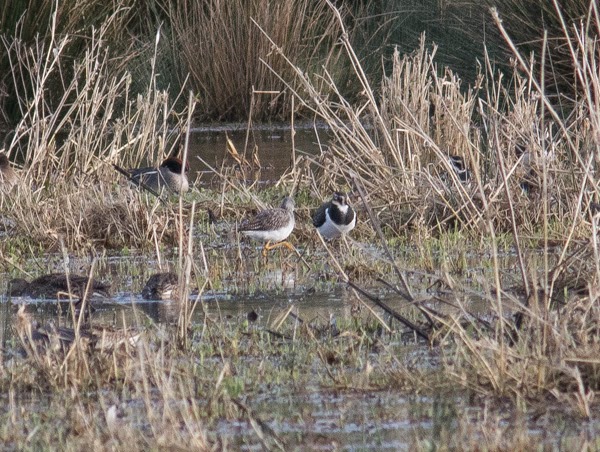
Unfortunately the bird was pretty distant most of the time, it was giving great scope views, but it was not really possible to get any decent photos, but I did manage a few record shots. The series of shots below were taken when it was feeding on the Bridge Street Flood and hopefully give a good indication of the bird's size when compared with the other nearby species, Lapwing, Teal and Black-tailed Godwit. The final photo also shows the long, slightly upturned bill as opposed to the shot needle-tipped bill of a Lesser Yellowlegs.


Great Yellowlegs with Lapwing
Greater Yellowlegs with Lapwing
Greater Yellowlegs - with Black-tailed Godwits
Greater Yellowlegs with Black-tailed Godwit - note the long upturned bill

Massive congratulations to Dan for finding this bird and for getting the news out so quickly, a very well deserved find.

Monday, 5 January 2015

The First Ringing Session of the New Year

It was very much a weekend of two halves last weekend, on Saturday the weather was wet and windy, whereas as Sunday was mainly overcast and dry without a breath of wind. I had anticipated that Sunday would be good and arranged to meet Rob and Chris at Manor Farm Country Park. The Little Owls were very vocal when we arrived, and continued to call up to mid morning. I estimated at least three were present based on the calls, one individual was roosting in a small copse near one of our nets, but unfortunately we did not catch it, but it gave great views.

It was a steady session with 38 birds of 14 species caught, although 12 of the birds were retraps. The most numerous species were House Sparrow and Blue Tit with eight birds of each species trapped. Of the House Sparrows six were retraps, one of which was approaching five years since its original capture date, the others were all from within the last year. 


Redwing - Manor Farm Country Park. This bird is actually from last year, when the light was better

As is usual this time of year I had expected to catch loads of Redwings, but there were very few around, we did however manage to catch one. A female Bullfinch was a nice surprise and a species that we have not caught at Manor Farm for a few months. The Bullfinch was a first year female that was aged due to the presence of two retained greater coverts. The other species caught included four Great Tits, five Blackbirds, three Wrens, and single Wood Pigeon, Magpie, Robin and Song Thrush. The Song Thrush was also a first year bird and had six retained juvenile greater coverts.


Song Thrush - Manor Farm Country Park
Song Thrush - Close up of greater coverts showing retained outer coverts
visible due to large thorns and chestnut colouration. The break between adult
feathers and retained juvenile feathers is indicated by red arrow

We did also continue my recent quest for crests, catching four Goldcrests, one of which was a retrap from a couple of months ago. Other bird species seen during the session included Fieldfare (5), Greenfinch (20+), Green Woodpecker (1), Linnet (5), Little Egret (1), Common Gull (7), Goldfinch (5) and Moorhen (3).

Friday, 2 January 2015

Happy New Year and the start of a new year list

So here we are again, at the start of another New Year, and the beginning of my fifth year of writing this blog. I hope that you all had a good year and enjoyable New Year celebrations and also enjoyed my ramblings over the last year. January 1st 2015 started for me with a lie-in followed by a lazy day in front of the telly watching football, and therefore my birding amounted to only those species seen in the back garden. 

On January 2nd I teamed up with Simon Colenutt, for a spot of birding in the South-east of Hampshire. We planned our route based on birds that had been reported recently and set off pre-dawn.

Eyeworth Pond
Our first stop was Eyeworth Pond, near Fritham where we would be guaranteed to see Mandarin Duck. It was dark when we arrived but it was still possible to see several Mandarins present, along with Mallards and Moorhen. There were 22 Mandarins present and despite the poor light I decided to take a few photos. It is now a couple of months since I received my new Canon 7D MK2 and I have to admit that I get more amazed by it every time I use it. The series of pictures below were taken in near darkness, with an ISO rating of 12,800; the noise was then removed in Adobe Lightroom, given the conditions I don't think these are that bad.

Pair of Mandarin Ducks
Mandarin Ducks
Mandarin Ducks
Mandarin Ducks

Whilst at Fritham we picked up most of the woodland species also, with the most notable being Marsh Tit, a species that is increasingly more difficult to catch up with these days.

Milkham Bottom, New Forest
A Great Grey Shrike has been wintering around Milkham Inclosure/Bottom so this was our next stop. We spent a couple of hours birding the area and did catch up with some good birds, which included Dartford Warbler, Goshawk, Crossbill, Raven and Stonechat, but the shrike unfortunately eluded us.

Blashford and Kingfisher Lakes
Blashford Lakes was our next stop, where we hoped to pick up most of the duck species, including the long staying Long-tailed Duck, Great White Egret along with other specialities such as Goosander, Black-necked Grebe and Egyptian Goose. Unfortunately  we did not connect with the Great White Egret but saw the rest, as well as most of the duck species and a wintering Chiffchaff.

Blurry record shot of the very distant Long-tailed Duck

There has been a Ferruginous Duck at Kingfisher Lake for a while now, but unfortunately viewing is very difficult and therefore it is difficult to see unless it sits right out in the middle. We stopped there for a while but did not see the duck, however we did see an adult Yellow-legged Gull and also a Firecrest.

Pennington Marsh
Our next stop was Pennington Marsh. We first stopped at the flood just off Lower Pennington Lane before walking a circuit to the seawall and back down the main track. The flood was heaving with Wigeon, Teal, Black-tailed Godwits, Dunlin, Redshank, Brent Goose, Golden Plover and Lapwing present. The highlight though were the three Ruff that were present.

On the intertidal we added a few more species including Oystercatcher, Grey Plover, Turnstone, Ringed Plover, Bar-tailed Godwit and Mediterranean Gull. On the sea there several Red-breasted Mergansers, two Eider and four Slavonian Grebes.

Denny Wood
Our final stop was in the hope of catching up with Hawfinch and Lesser Redpoll but we failed miserably. We did however add Stock Dove and Sparrowhawk.

By the end of the day we had recorded 94 species, so not a bad start to the year but still leaving plenty of species to see this winter.
Related Posts Plugin for WordPress, Blogger...