Sunday, 31 May 2015

Birding in black and white at Titchfield Haven

Over the course of the weekend I have made a couple of visits to the Haven, for no other reason than to enjoy the present spectacle of breeding gulls and waders. There is also the long-staying Greater Yellowlegs which is always worth a look if its showing, but I don't tend to seek it out if its not. As well as the breeding birds there are always plenty of other species on hand and this weekend there were Dunlin, Black-tailed Godwit, Oystercatcher, Redshank and a couple of marauding Lesser Black-backed Gulls. Single Curlew Sandpiper and Little Stint have also been seen this week and over the weekend, but I didn't manage to catch up with either.

Whilst walking around it was evident that the majority of the birds I was watching were mainly black and white, well at least it appeared like that, so I thought I would theme this post on them. My first species is Pied Avocet. This year is providing to be a good one for Avocets, with at least 14 nests on the south scrape. This species has to be a favourite of many a birder; they are elegant and very distinctive with their black and white markings. The upturned bill is perhaps the most distinctive feature, perfectly designed for sweeping from left to right as they feed. They are often feeding just in front of the hides giving excellent views and the first chicks of they year on the south scrape were a welcome sight, let's hope the evade the Lesser Black-backs.

Pied Avocet - There are at least 14 pairs on the scrape this year and truly black and white bird
Another Pied Avocet

The Black-headed Gull colony at the Haven is doing very well, I haven't bothered to count them but there are loads. Within the colony there are a couple of pairs of Mediterranean Gulls and it is this species that is my next black and white species. The hood on a Med gull is jet black and contrasts with the white neck and underparts, there is of course the light grey back/mantle, but I won't dwell on that. The image below clearly shows the brown hood of the Black-headed Gull in comparison with the black hood of the Med, somebody clearly got it wrong when they named Black-headed Gull.

Adult Mediterranean Gulls (one sitting on the nest behind the other). Its jet black hood contrasts with the white neck and underparts as opposed to the Black-headed Gulls with their brown hoods - who on earth came up with Black-headed for this species

A Northern Lapwing was feeding, whilst protecting its two chicks just in front of the hide on the north scrape. Another distinctive species with its dark olive green back but black bib, crown and face mask, so this is my next black and white species. Its crest is also black and curls up in the opposite direction to the Avocet and is longer on the male. 

Lapwing - ok not really black and white, but more dark olive green and white, but it does have black on it!

My next species was Greater Yellowlegs, not a black and white species at all really, more grey and white, but has showed so well this weekend that I just had to include some images. Now that it has come into some plumage there are some black centres to some of the feathers on the back, so I think I can just about get away with including it. The bird seems to have got into a bit of a pattern now, when the river is high it moves up to the Posbrook flood, but as more mud becomes exposed on the river it moves back down. Occasionally it visits the scrapes but those visits are more sporadic.

Greater Yellowlegs - Definitely not black and white, more grey and white, but is its summer plumage it does have black centres to feathers on the mantle
Greater Yellowlegs

As I left the reserve and headed back to my car I noticed the almost resident Black Swan in the harbour. An all black bird, except that is for the red bill, but when sat next to a Mute Swan there was a very black and white scene. There were two Black Swans when I was at the Haven the other day, I don't think anyone has any idea where they have come from but they are an interesting addition to the harbours avifauna.

Two Swans, one Black and one White (Black Swan and Mute Swan)

Saturday, 30 May 2015

Red-necked Phalarope and Black-winged Stilt - Sidlesham Ferry Pool

This morning I made a brief excursion out of Hampshire for a spot of birding in West Sussex. Yesterday it was reported that a Black-winged Stilt was present on the Ferry Pool at Sidlesham; this morning it was still there and had been joined by a Red-necked Phalarope. Red-necked Phalarope is not a species I see that frequently and certainly not in summer plumage so given that it was only a 25 minute drive away I decided to go. 

When I arrived the bird was feeding in middle of the pool about 50 metres away, and was typically spinning and twisting as it delicately picked tasty morsels off the surface. It was occasionally chased by Black-headed Gulls that seemed intent on bullying it, but it always returned back to its favoured spot to feed. Looking at the plumage I am inclined to think that it was a male, the bird was generally quite dull and and the colouration less intense than on a female. The patterning was also more diffuse and not as neatly defined as I would have expected for a female.

I have seen Red-necked Phalaropes on the Ferry Pool before but not since the 1980's and when I got back home I checked to see just what the status was. According to the Birds of Sussex, which was published in 2014, there have been about 85 recorded with the majority in August and September. Between 1962 and 2011 only four have been recorded in May and four in June, five of those have been between the last week of May and the first week of June, as with this bird.

Red-necked Phalarope - Sidlesham Ferry Pool, West Sussex

I was so intent on watching the phalarope that I almost forgot about the Black-winged Stilt. It was not as obliging as the phalarope and spent all of its time at the back of the pool feeding amongst the Black-tailed Godwits and Pied Avocets. This species bred and the RSPB's Medmerry reserve last year and so is a bit devalued now, but still a nice bird to see in the UK. This individual appeared to be a 2cy bird as its legs were dull pink, its back was also dull and blackish rather than jet black of an adult. The top of the head, back of the neck and nape were also smudged brownish. Up until 2011 there were 25 records but some of those are considered to involve the same individuals. As I mentioned earlier the species bred in the county in 2014, and it is of course entirely possible that this bird was one of last years juveniles.


Black-winged Stilt and two Black-tailed Godwits - Sidlesham Ferry Pool, West Sussex

Monday, 25 May 2015

Moth Trap no longer mothballed

This weekend I have pretty much been tied to the house, except that is for a brief excursion to Manor Farm Country Park to check some nest boxes, oh and a trip to Old Winchester Hill for a walk, so it seemed like an appropriate time to get my moth trap out of storage. The trip to Manor Farm was a success in that four of my six boxes were occupied, one with a pair of Barn Owls, two with breeding Kestrels and one with breeding Stock Doves. The chicks of the Barn Owls and Kestrels were too small to ring, and the Stock Doves were on eggs, so I will have to go back for another visit.

I haven't run my moth trap in the garden since last October and keep meaning to put it out but just haven't felt that inspired to do so. Rob had put the trap out at work on Thursday evening and I had taken a quick look at his haul on Friday morning, which was enough to tempt me to give it a go. The weather conditions looked good on Saturday evening so I checked everything was working a put it out. I use a Robinson designed trap with a 150w mercury vapour lamp, and usually leave the trap on overnight, much to the disgust of the resident Hedgehogs, although they soon get used to it.

It proved to be a worthwhile exercise as my first haul of the year included 80 moths of 26 species, several caddisflies and Ichneumon wasps and a few Cockchafers, or May bugs. Ten years ago I would catch large numbers of Cockchafers, but in recent years the numbers have dropped off, four were in the trap this time. The adult beetle will live for about a month, but the complete life-cycle from egg to adult lasts three-four years.

Cockchafer

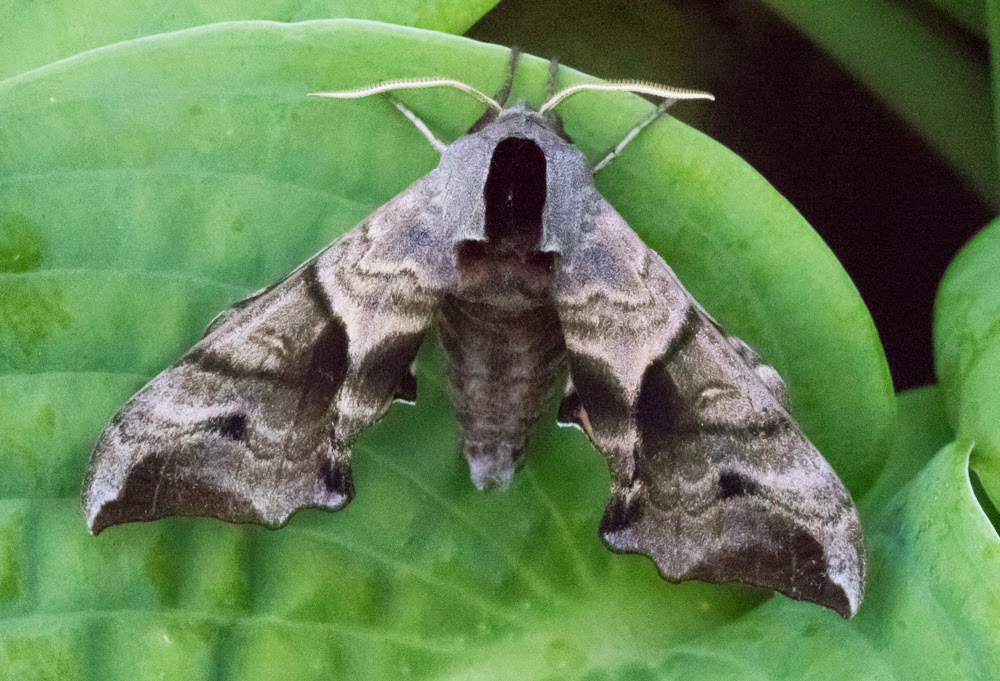
There was nothing really noteworthy in the trap but a good variety which included Spectacle, Poplar and Eyed Hawkmoth, White Ermine, Flame Shoulder, White-pointBrimstone Moth, Heart and Dart, Shuttle-shaped Dart, Pale Tussock, Small Square-spot, Small Waved Umber, Common Marbled Carpet, Vine's Rustic, Flame Carpet, Treble Lines, Small Phoenix, Eyed Hawkmoth, Hebrew Character, Rustic Shoulder-knot, Oak Hook-tip and Green Carpet.

Pale Tussock
Small Waved Umber
Flame Shoulder
Rustic Shoulder-knot
White Ermine
Eyed Hawkmoth

Today (25th May) I spent much of the day in the garden, there were a couple of highlights; a Red Kite that drifted north at 11:50 and a Hobby that flew west at 13:45. I also caught up with my first Orthoptera of the year, an adult Slender Groundhopper and a 1st instar nymph Dark Bush-cricket

Sunday, 17 May 2015

Aerial Combats

This morning I visited Manor Farm Museum to check on the House Sparrows, and get some colour-ring combinations as part of my BTO RAS project. I had intended to get up early and set a couple of nets, but an alarm clock malfunction, meant that I arrived later than hoped and therefore did not have the time to open nets before the farm museum opened. It was still a worthwhile visit, as I managed to get 11 different colour-ring combinations, and counted at least 20 breeding pairs.

Un-ringed male House Sparrow
Colour-ringed male House Sparrow

After the farm I stopped off in the woods and checked on a few next boxes. There are only seven boxes and within those there were three broods of Great Tit and one Blue Tit. My next stop was Botley Wood; I was hoping to catch up on a few butterfly species and also any new migrants for the patch. 

The Common Buzzards were very active and one bird had a finely barred tail and therefore I presume it to be a 2nd CY bird. It was showing evidence of primary moult and as I understand it, spring moult is typical of a 2nd CY bird.

Common Buzzard

The warm and slightly breezy conditions were good for raptors, and as other species appeared the local buzzards engaged them in aerial combat. Two Hobby's were the first to drift over Botley Wood; they appeared not to be hunting but the buzzards were keeping a close eye on them.

Common Buzzard (top) and Hobby
Hobby

A Eurasian Sparrowhawk also put in a brief appearance and this was immediately shadowed by a buzzard. With this level of activity I presume the buzzards are nesting nearby and are keen to keep an eye on any potential predators.

Common Buzzard (top) and Sparrowhawk

A surprise species for the day was a Turtle Dove; once a regular breeder at Botley Wood, I have not recorded this species for at least two years.
Related Posts Plugin for WordPress, Blogger...