Friday, 8 August 2014

Back on the Patch - August 2014

I had a couple of hours spare this morning and so headed down to Curbridge for a spot of patch birding. As I got out of the car and headed down the track towards the river I noticed an odd shaped raptor with pale underparts circling, and a second raptor beneath it. I quickly got my bins onto the top bird and to my surprise it was a Honey Buzzard, which was being seen off by a Common Buzzard. I had the wrong lens on my camera, plus the bird was back lit and distant, but I managed to get a record shot. The distinctive pigeon shaped head and bulging secondaries are evident in this photo, and the large gap between the outermost bar and the next suggest that this bird was a male.

Honey Buzzard

I continued on down to the river, checking the meadow for grasshoppers and crickets on the way. Meadow, Field and Common Green grasshoppers were abundant and nearer the river Short-winged Conehead nymphs were present. The tide was just dropping so gulls and waders were starting to appear. At first there were just a couple of Herring Gulls, and around 20 Black-headed Gulls, but as the water levels dropped a Lesser Black-backed and several Mediterranean Gulls dropped in. The Meds were of mixed ages, juveniles, 2nd summer and adult, all of them were in moult to some degree and some were now almost in their winter plumage. 

Black-headed and Mediterranean Gulls plus Little Egret and Canada Geese 

The Black-heads too were moulting and the last remnants of their brown (I know odd name but there you go!) summer hoods was just about visible. The best place to stand and watch the gulls is usually at the northern end of the estuary, by the sewage works; as the tide drops they gather their to bath. Unfortunately there were a few kayakers on the river today so the birds were finding it difficult to settle.

Black-headed Gull moulting out of its summer plumage

There were three Little Egrets feeding along the waters edge, and a young Shelduck flew past and headed upstream. Three Curlew suddenly appeared, presumably from the roost down stream as did a single Greenshank. I have been seeing two Greenshank on the estuary for a while now so I guess the other one will be around somewhere.

Common Greenshank and Black-headed Gull

I picked up a Kingfisher sat on a fallen tree. I had been hearing them call but had struggled to pick one up, from the sounds of it there were two birds present but I couldn't find the other. A flock of 70 Starlings was quite notable and potentially evidence of a good breeding season, and Nuthatch, Treecreeper, Blue and Great Tits were all present in the woods.

Common Kingfisher - Curbridge

The numbers and diversity of butterflies was quite poor with Peacock, Small White, Meadow Brown and Gatekeeper the only species recorded. Just as I was about to leave a Banded Demoiselle flew past, which was an interesting record for the site.

Thursday, 7 August 2014

Farlington Marshes - 7th August 2014

The tides weren't ideal but we decided to start this autumns wader ringing sessions anyway. The priority species, as last year, was Common Sandpiper. Any individuals captured were to be colour-ringed in the hope of learning a bit more about their migration patterns, and how they use the marsh. We arrived on site at around 18:30 and went out to set the nets straight away; we intended to put up five nets and on the scrape only. 

Once the nets were set it was a waiting game, so we took advantage and did a bit of birding. It was a bit of a breezy evening but there were plenty of Barn Swallows and Common Swifts around to keep us occupied. The swallows were feeding over the meadows and gathering around the reed bed in readiness for roosting.
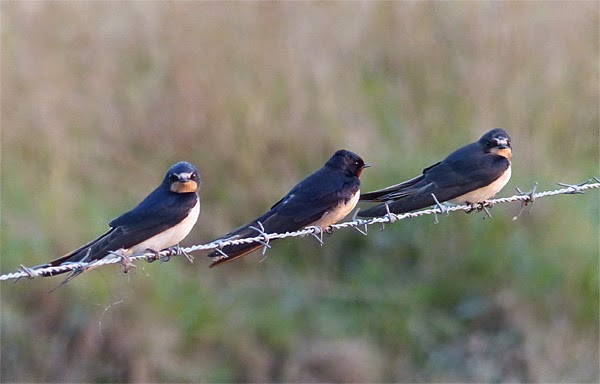
Barn Swallows gathering in readiness to roost

Bearded Tits were very evident in the reed bed, constantly pinging as the flew back a forth across the reed bed. The stream was the best place for waders, with about 25 Black-tailed Godwits, 15 Northern Lapwing, five Common Sandpipers and a couple of Common Redshank and Common Teal.

Black-tailed Godwits, Common Teal and Mute Swans on the Stream

As the sun set over Portsmouth Harbour the wind began to drop and the tide neared its peak. The five Common Sandpipers on the stream began to call and circled around before heading out into the mid-marsh.

Sunset over Portsmouth Harbour

Our first net round produced two birds, and Dunlin and a Common Sandpiper, both of them juveniles. As I mentioned earlier the Common Sandpiper was a target species for us and was fitted with a combination of colour rings that would allow for the bird to be individually identified in the field.

Common Sandpiper with colour rings

This juvenile bird was aged due to the generally brown but extensively buff tips and dark subterminal bands to the upper parts, and the coverts, were brown and with very heavy dark brown and bright rufous-brown barring.

Juvenile plumage of Common Sandpiper showing extensive barring.

Our second and final round produced four birds, three Dunlin and a Common Redshank, all the birds were once again juveniles. This time last year we were commenting on how we were only catching adult birds, so it was a refreshing change to be catching juveniles.

Dunlin 

The chestnut fringes on the wing and body feathers age this bird as a juvenile. Some juvenile feathers will be retained through to the next summer so birds should still be able to be aged up to that point.

Juvenile Dunlin showing buff fringing to feathers

The upperparts and coverts of the Redshank were extensively fringed buff and warm brown, thereby ageing it as a juvenile. The bill was a dull reddish colour, darkening towards the tip again a juvenile feature.

Juvenile Common Redshank with obvious buff tips to plumage

Monday, 4 August 2014

The Latest Bird ringing update from Titchfield Haven - August 2014

We have been a little slow to get going with bird ringing at the Haven this autumn. This has been partly due to some of us taking a summer break, and also due to Barry being busy radio-tracking Eurasian Woodcocks. The season is now underway and to date we have run eight sessions, six in July and two this weekend. Early indications are that it has been a good breeding season for some species, the Sedge Warbler total currently stands at 326, whereas the Reed Warbler total is only 198. Grasshopper Warbler numbers have started slowly with only 75 ringed to date, but 95 Willow Warblers in eight sessions is indicative of a good breeding season.

Juvenile Willow Warbler Phylloscopus trochilus

The majority of the Willow Warblers we have caught have been juveniles, including the bird below with slightly aberrant plumage. An adult bird was trapped during the last week of July, this bird was in primary moult and so will not be going very far until it has finished that.


Juvenile Willow Warbler with aberrant plumage (B S Duffin)

Cetti's Warblers and Chiffchaffs breed in good numbers at the Haven and to date we have trapped 22 and 29 respectively. Common Whitethroat numbers are trickling along with just 14 so far, but then we would expect the peak numbers to be ringed in September.

Juvenile Common Whitethroat 

The first Garden Warblers of the year were ringed on 31st July, and the total to date is just eight birds, and the Blackcap total stands at just nine.

Juvenile Garden Warbler

We have to open our nets pre-dawn in the hope of catching good numbers of Grasshopper Warblers and regularly catch bats as a result. I have plenty of experience extracting bats and so am usually the nominated person to get them out. This latest individual was a juvenile pipistrelle bat and it was badly tangled, but after being liberated it rested on me for a while before flying off.

Pipistrelle bat Pipistrellus species

Tuesday, 29 July 2014

Noar Hill, Revisited - July 2014

Around this time last year I visited the Hampshire and Isle of Wight Wildlife Trusts Noar Hill Nature Reserve in order to carry out a grasshopper survey. The visit was a success as we recorded the local Rufous Grasshopper, along with a variety of other species. The Trust is looking to set up a standardised monitoring programme for the species, so when I was asked to assist I jumped at the chance. We visited the site on 22nd July with the main purpose to survey for grasshoppers, and test the survey methodology that had been designed, but whilst I was there I took the opportunity to catch up with a few other species. 

As I have covered grasshoppers before I didn't take any photos, but during the survey we recorded Rufous, Common Green, Field, Stripe-winged and Meadow Grasshopper and Speckled, Dark and Roesel's Bush Crickets. Noar Hill is well know for its orchids too and there was plenty of evidence of them, but the only species in flower was the Pyramidal Orchid

Pyramidal Orchid Anacamptis pyramidalis

As would be expected at this time of year, butterflies were everywhere and making use of the abundance of nectar available. Meadow Brown, Ringlet, Gatekeeper and Red Admiral were the most numerous, the latter species making the most of the flowering Hemp Agrimony.

Red Admiral Vanessa atalanta

Silver-washed Fritillary and Marbled White seemed to be just hanging on, with some very tatty individuals present, whereas the Brimstone's and Green-veined White's were immaculate and clearly evidence of a recent emergence.

Brimstone Gonepteryx rhamni
Green-veined White Pieris napi

We also recorded Large and Small Skippers, but the only species of Blue recorded was Common Blue. This time last year their had been an abundance of Chalkhill Blues at the site, but we may have been a bit early this year.

Small Skipper Thymelicus sylvestris infected with the red mite Trombidium breei

Whilst photographing a Small Skipper and Common Blue I noticed that they were infected with a small red mite. I did a bit of research and it appears that this mite is Trombidium breei, which usually attaches itself to the legs or thorax of its host. Apparently there are no detectable negative impacts on the host butterfly, and the mites transfer from host to host via flower heads. For more information on butterfly parasites check out the following link enemies of butterflies.

Common Blue infected with Trombidium breei
Female Common Blue

Another species recorded was the Small Heath, but only in small numbers. In total we recorded 13 species of butterfly during our visit.

Small Heath Coenonympha pamphilus

Despite the orchids not being in flower there were plenty of other plant species on show, including bellflower, yellow-wort, Greater Knapweed and Harebell.

Greater Knapweed Centaurea scabiosa
Harebell Campanula rotundifolia

The Small Scabious flowers were proving very popular with the Six-spot Burnet moths, which were the most numerous moth species we recorded.

Six-spotted Burnet Zygaena filipendulae stephensi on Small Scabious
Related Posts Plugin for WordPress, Blogger...